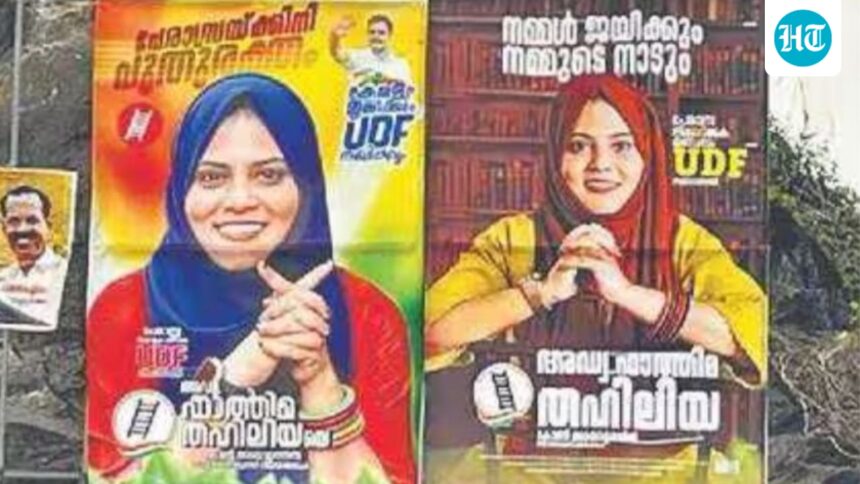
The narrow winding road from Narakud to Kesariyur was lined with a sea of flags. The red flag of the Communist Party of India (Maoist), the green flag of the Indian Union Muslim League (IUML), and the hand-stamped tricolor of the Congress Party were signals of the political preferences of this rural region of northern Kerala, where agricultural prosperity had long given way to wealth coming from remittances in the Gulf.

There was a small memorial standing guard in the memory of the Hindu and Muslim actors in the Kesariyur bomb conspiracy case. This is where local socialists, led by KP Menon (later MP), planned to bomb the railways after launching the Quit India movement in 1942. It is here that Fatima Tahlia seeks a place in history.
Read also | The spirited election campaign in Kerala, Assam and Puducherry comes to an end ahead of the April 9 polls
In a party synonymous with male politicians, Tahlia is an exception. A 34-year-old lawyer from Kozhikode, she is one of two candidates for the IUML, the Congress’ most valuable ally within the United Democratic Front (UDF). Her candidacy has changed the nature of the contest in Perambra, a popular constituency near Kozhikode surrounded by the Western Ghats to the east and the Korappuzha estuary to the west, which has voted for Left Democratic Front candidates in all elections since 1980.
Her entry threatens to upset the re-election of LDF organizer and former CPI(M) minister TP Ramakrishnan (although TP won by a margin of over 22,000 votes in 2021). Whatever the outcome, her nomination is a sign of the massive changes underway in Muslim politics in Malabar. It bodes well for the overall health of politics in Kerala, where political parties are adamant about sending women to the state Assembly and Parliament; In fact, only 7.86% of MLAs in Kerala are women.
Read also | From the margins to the muscle, the BJP’s efforts have intensified in Kerala
On the night this reporter visited Perambra, Tahlia was holding a roadshow that attracted people of all ages, religions and genders. This diminutive law graduate – fluent in English and Malayalam and boasting a string of achievements – spoke to a receptive audience about the merits of voting for the United Democratic Front.
In leftist strongholds, men looked away, but women welcomed her enthusiastically. Everywhere she got off the campaign vehicle, women flocked to her to take selfies. “Very good feelings,” she told this reporter. “Her entry excited the youth,” said Akbar Shah, a polytechnic student.
Muslims constitute 26.56% of Kerala’s population (2011 census) and have influence in 57 seats in North Kerala districts such as Kasargod, Kannur, Kozhikode, Malappuram and Palakkad. The IUML, or the League as it is popularly known, has remained the preferred platform of the community and the rock on which the UDF has stood for decades. In the past, the Communist Party of Iran (Maoist) had popular leaders such as EK Impichibava and Baluli Mohammad Kutty, and the Congress party had the support of “nationalist” Muslims. These groups have disappeared recently, despite the rise of young leaders within Congress and the Chinese Communist Party.
Importantly, the association had first fielded a woman candidate in 2021, and has now nominated two women, including Jayanti Rajan, a Hindu Dalit, from the unreserved Kuthuparamba seat. Rajan, an ASI national assistant secretary active since 2010, hopes to follow in the footsteps of UC Raman, a Dalit Hindu who has represented ASI three times in the assembly. Both Rajan and Tahlia have previously represented the association in local bodies.
“Given the social base of the League, this transformation is revolutionary,” says N. P. Chikotty, author of the Muslim League in Kerala History. Shikoti recalls that the president of the association, Mr. Sadiq Ali Shihab Thangal, stated that larger societal concerns were more important than community issues. MH Elias, a professor at Mahatma Gandhi University, points out that the association’s priorities have shifted over the past decade towards social welfare policies, addressing poverty, health, and the needs of expatriates in the Gulf.
This adaptability explains how the League was able to survive political isolation after the Emergency and the challenges posed by extremist groups after the demolition of the Babri Mosque in 1992. Although the Pankhad Thangal family remains the guiding force, the leadership has shifted to democracy to reflect a diverse caste base. “The mature stance of the LLD leadership towards the provocative statements made by the LLD is the result of deep reflection on the prevailing anti-Muslim sentiment,” says Cicuti. As a result, the association attracted many non-Muslim politicians and even temple music practitioner Najjaralat Hari Govindan.
In this election, community support for the United Democratic Front may be crucial. While the League is contesting only 27 seats, it is providing foot soldiers for the United Democratic Front in north Kerala. Conversely, the absence of the League in the southern regions is detrimental to the United Democratic Front because the Congress stands alone, and unfamiliarity with the League often exacerbates Islamophobia.
The transformation of the association reflects changes in society. Shelogas, a sociology professor at Farooq College, points out that there is a new class of young political women empowered thanks to remittances and modern education. She points out that they do not compromise on Islamic values, but are firm in their effectiveness. Shilogas sees Tahlia as a representative of this Muslim woman of Generation Z. The League has embraced this shift. After a disciplinary measure in 2021 against leaders of Haritha, the student wing of the League, including Tahlia, for opposing sexism, the party rescinded the measure and appointed them to leadership positions.
This cultural renaissance is also evident in cinema, academia and the arts. Films like Halal Love Story and Feminichi Fatima suggest a society in transition. Shilojas sees new Malayalam cinema as a space of dissent where young creatives build a world outside male-dominated religious conservatism.
This is a world the Left seems unwilling to engage with, perhaps for fear of losing core Hindu voters to the BJP. It is also an inward-looking society, sympathetic to the Palestinian cause and concerned about the Israeli-American-Iranian conflict. To portray this as extreme misinterprets a society under siege and denies the liberal impulses guiding its response to Indian democracy. “Maybe the left has lost the trust of society,” Shilogas says. This has political consequences.