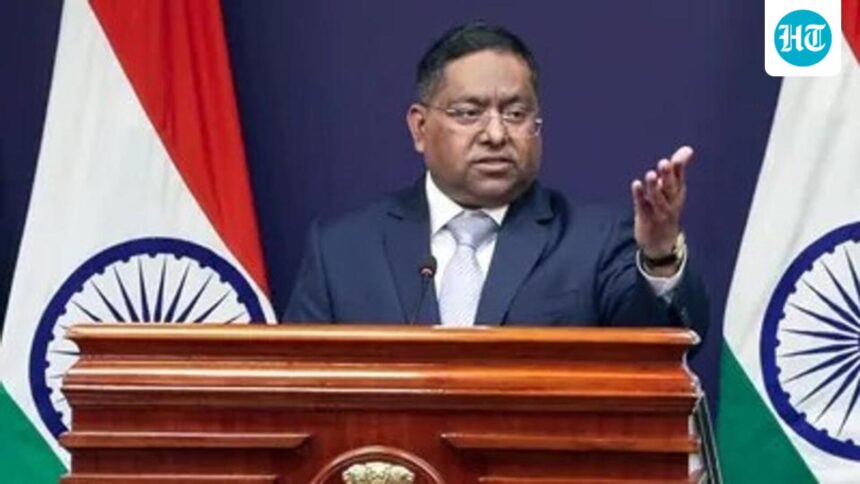
India on Wednesday welcomed a two-week ceasefire between Iran and the United States and called for unhindered global trade movement through the Strait of Hormuz, while expressing hope that developments in West Asia would encourage peace efforts in Ukraine.

Iran and the United States announced the ceasefire, brokered by Pakistan with support from China, early on Wednesday, after 40 days of air strikes and attacks on energy and other infrastructure that raised fears of a broader war sweeping West Asia. The conflict, which began with Israeli and US military strikes on Iran on February 28, has disrupted shipping through the Strait of Hormuz, which is used to transport 50% of India’s oil imports.
“We welcome the ceasefire reached and hope it will lead to lasting peace in West Asia. As we have consistently advocated earlier, de-escalation, dialogue and diplomacy are essential to bring an early end to the ongoing conflict,” Foreign Ministry spokesman Randhir Jaiswal said at a press conference.
“India has always been pro-peace. We welcome all steps leading to peace and stability. We hope that this development in West Asia will also encourage peace efforts in Ukraine,” he said.
Jaiswal noted that the conflict has caused “enormous suffering to people and disrupted global energy supply and trade networks,” and India expects unhindered freedom of navigation and global trade to flow through the Strait of Hormuz.
Energy supplies through the Strait of Hormuz have been affected by the virtual closure of the vital waterway by Iran’s Islamic Revolutionary Guard Corps, raising concerns about possible oil and gas shortages in the country. Since the beginning of the conflict, only eight Indian-flagged LPG tankers have transited the strait, and Iran has been allowing ships to pass on a case-by-case basis.
Jaiswal said the Indian side remains in touch with Iran and other stakeholders to ensure unhindered transit of Indian-flagged cargo through the strait, though there are no discussions with Tehran on paying fees to use the waterway. “This is an evolving situation [and we are] He said: “We are in contact with partners and stakeholders to serve our interests.”
Donald Trump said in a social media post that there will be a “two-sided ceasefire” as he decided to stop using “destructive force” against Iran for two weeks after talks with Pakistani Prime Minister Shehbaz Sharif and Army Chief Field Marshal Asim Munir. He added that this would be subject to Iran’s approval of the “full, immediate and safe opening” of the Strait of Hormuz.
He also claimed that the United States has “met and exceeded all military objectives” and is “a long way away” from reaching a final long-term peace agreement with Iran, as almost all “previous points of contention” between the two sides have been agreed upon.
Iranian Foreign Minister Sayyed Abbas Araqchi issued a statement from the Supreme National Security Council in which he thanked Pakistani leaders Sharif and Munir for their “efforts to end the war” and said that the Iranian Armed Forces would halt their defensive operations if “attacks against Iran stop.” This is due to the United States’ request for negotiations based on the US 15-point proposal, and Trump’s acceptance of Tehran’s 10-point proposal.
Trump said Iran’s 10-point proposal was a “practical basis for negotiation” and that a two-week truce would allow “the final touches to be put to the agreement.”
But the Indian side is cautiously monitoring Pakistan’s efforts to mediate between Iran and the United States, especially in light of its significant interests in West Asia, the main source of oil and gas and home to ten million Indians. The mediation also helped strengthen US-Pakistan relations at a time when New Delhi is engaged in rebuilding relations with Washington after a period of unprecedented tension over Trump’s trade policies and tariffs.
Jaiswal also said at the press conference that ensuring the safety, security and well-being of the large Indian community in West Asia remains the “top priority”, and Indian missions are facilitating visas and transit through neighboring countries due to airspace restrictions in Israel, Iran, Iraq, Kuwait and Bahrain.
The Indian Embassy in Tehran issued a new warning on Wednesday urging Indian citizens to “quickly exit Iran” in coordination with the mission and use the routes suggested by the Indian authorities. Indians are leaving Iran via Armenia and Azerbaijan due to the closure of Iranian airspace.
“We have learned that we have about 7,500 Indian nationals still residing in Iran,” Jaiswal said. As of Tuesday, a total of 1,864 Indians, including 935 students and 472 fishermen, have exited Iran via Armenia and Azerbaijan.