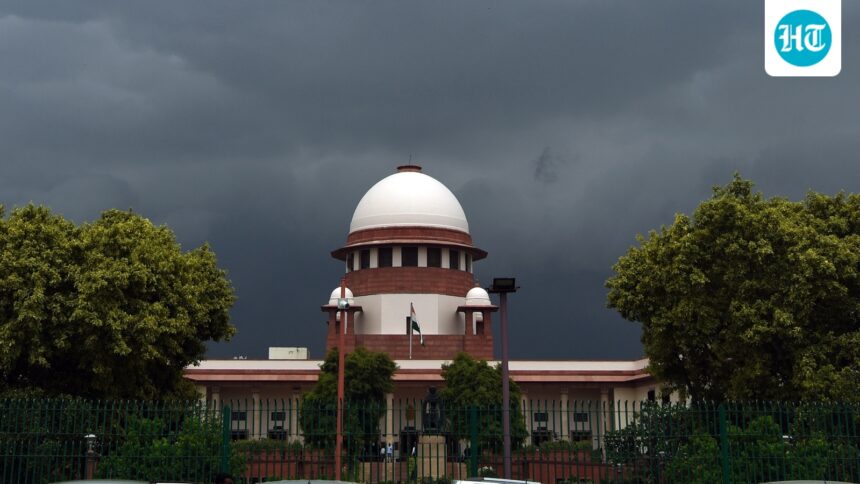
The Supreme Court on Friday issued a harsh ruling on dowry-related harassment while hearing a case linked to the death of a woman in Chhattisgarh who died by hanging within three years of her marriage. The court refused to intervene in the case, and made sharp observations about the treatment that brides and their families often face in their marital homes.

A bench of Justice B V Nagaratna and Justice Ujjal Bhuiyan questioned the repeated financial pressure allegedly exerted on the woman’s family and stressed that such behavior cannot be normalized.
Read also | The Supreme Committee upholds the arbitration decision, and criticizes the Parliamentary Party’s Road Development Authority for its “unfortunate” behavior.
“Why do boys marry girls and then insult them and their families? Leave a message that they cannot continue to insult the bride and her family,” Justice Nagaratna was quoted as saying by the Bar & Bench website.
Court questions harassment over dowry demands
The case relates to an incident that occurred in 2010 in which a woman died by hanging in her matrimonial home in Chhattisgarh. According to the prosecution, the husband and his family allegedly subjected her to constant harassment over her demands for dowry, including money and a car, according to a report by Bar & Bench.
Read also | ‘Extremely painful’: SC asks Center to ensure no repeat of 2024 and 2026 NEET leaks
Both the trial court and the Chhattisgarh High Court held that the woman’s death occurred under unnatural circumstances within seven years of marriage, attracting the legal presumption of death due to dowry. Evidence presented to the courts pointed to repeated demands for money and cruelty “shortly before” her death.
Medical evidence confirmed death by hanging, but the courts found that the alleged harassment and financial coercion proved a direct link between the cruelty and the woman’s death.
Supreme Court denies relief to son-in-law
Several members of the husband’s family have been convicted under Sections 304B, 306 and 498A of the Indian Penal Code. The appeal was filed in the High Court by the younger brother of the deceased woman, who sought relief from his conviction under Section 498A which deals with cruelty and harassment.
Read also | SC allows Vinesh Phogat to join Asian Games trials, exempts from HC order
The petitioner’s lawyer said that the crime was not directed against his client. But the court remained unconvinced.
“You should be happy that it is only 498A and only three years,” Justice Nagaratna said.
The judge highlighted the pattern of financial pressure in such cases, and said: “The attempt is to put pressure on the bride and her family.”
Referring to the allegations made in this case, Justice Nagarathna also observed, “What exactly did the boy’s family say? You are beggars; you cannot pay. The girl’s family was pleading to save their daughter and they were called beggars.”
When the lawyer tried to respond, the judge interrupted him, saying: “You should have kept quiet. The bride’s father said they could bid.” $60 thousand and you call them beggars?
The petitioner’s counsel also raised the issue of delay in filing the FIR, but the court did not accept the argument.
Justice Bhuyan also expressed concern about the social acceptability of such behaviour, saying: “These are educated people.”
Ultimately, the Supreme Court rejected the appeal and upheld the lower courts’ findings.