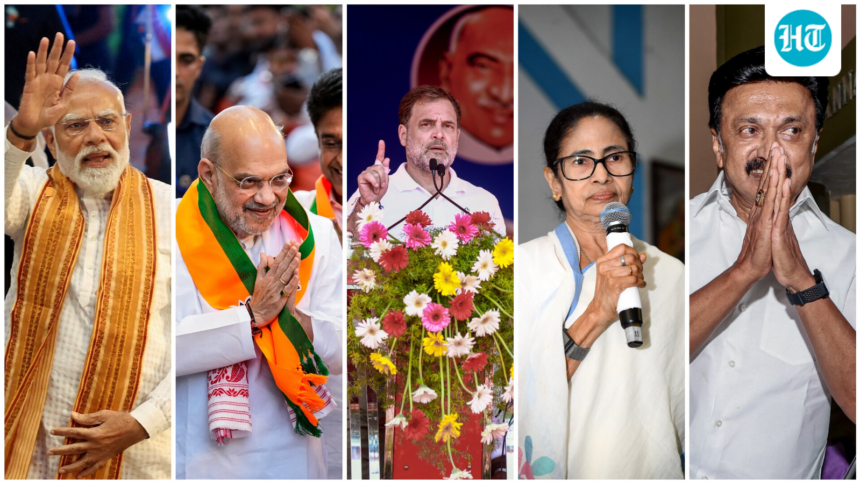
Last month’s National Assembly elections and the results on Monday, May 4, reshaped India’s regional politics as we know it. While the saffron tide took hold in West Bengal with the BJP achieving a historic landslide victory, Tamil Nadu put its power behind first-time actor-turned-politician Vijay, and the Congress-led United Democratic Front managed to upset the Pinarayi Vijayan-led Left Democratic Front in Kerala. The elections saw two senior ministers, all opposition and regional leaders, lose not only their states but also their places in the respective assemblies, with Assam’s Himanta Sarma being the exception. Rangasamy from Puducherry, and Pinarayi Vijayan from Kerala.

Here’s what the historic May 4 ruling means for key leaders-
Prime Minister Modi
If there is one trace in Prime Minister Narendra Modi’s enviable set of political achievements, it is the BJP’s repeated failure to penetrate the ideologically and electorally pivotal citadel of West Bengal. Even as the countdown to elections began this spring, the state’s unity appeared in disarray, with Chief Minister Mamata Banerjee appearing to have the upper hand. His personal investment in the campaign – more than 20 rallies, roadshow after roadshow in both Siliguri and the Trinamool Congress stronghold of Kolkata, and on-camera moments like eating jalmuri in Jhargram – has paid huge dividends.
Track live updates of election results here
Any doubts about the longevity of his political brand after the BJP’s somewhat underwhelming performance in the 2024 polls should now go to the dustbin; First Mumbai, then Patna, and now Kolkata indicated that 2024 was likely just a blip. The BJP has underperformed in every major state where assembly elections have been held since then. Under Modi, the BJP has retooled its electoral machinery after its modest performance, showing that it can conduct coalition politics in the complex state of Bihar, and win alone in the equally complex but more volatile Bengal. Monday’s victories (the BJP also won in Assam, and the NDA in Puducherry) have confirmed that running a coalition government will not weaken his unique style of governance. This makes him the first Prime Minister to win West Bengal since Jawaharlal Nehru. He cements his position as the country’s tallest political leader and the one who has taken on every tall regional and Congress leader in the country – and won.
Read also: Governance anger and Muslim division behind the downfall of Mamata Banerjee and the Trinamool in Bengal
Not only did he broaden his party’s caste scope – pushing it beyond its original comfort zone from the upper castes to the Dalits and backward classes – but he also succeeded in growing the party at the regional level. The BJP has not only had its first chief minister in Bihar, but now in West Bengal as well, something that would have been unthinkable before Modi built an enduring national image unconstrained by regional or gender concerns.
The party now has more legislators across the country than ever before, a testament to its dominant position. The victory in India’s third-largest state in terms of political weight means that the National Democratic Alliance is now prepared to retain a two-thirds majority in the Rajya Sabha.
The historic victory in Bengal means Modi has fulfilled his promise to sail up the Ganges from Patna and occupy a country that has long been hostile to the political right. He is now sailing on the same river to Uttar Pradesh, where elections will be held next spring.
Amit Shah
On New Year’s Eve, as waves of people in Kolkata flooded Park Street, Amit Shah was holding a quiet meeting in a hotel in Salt Lake City. Senior BJP functionaries and Suvendu Adhikari were present. But his black opponent, former state unit chief Dilip Ghosh – a man who not only rebelled against the party but also met Chief Minister Mamata Banerjee – was also invited. Taking the reins of the 2026 campaign, Shah hastened to rearrange the unity of a state torn apart by factions. He felt that anti-incumbency was boiling over and spent a month in Kolkata micro-managing the campaign. Having learned from the mistakes of 2021, he did not accept turncoats, promoted local workers into candidates, ran a quieter campaign that focused on everyday corruption, and contrasted TMC’s rule with his own vision of Sonar Bangla (Golden Bengal). For each key demographic, Shah held a different lure – for rural women, the promise of doubling unemployment benefits; For the rural man, the promise of jobs and an end to migration; For the urban middle class, the promise of restoring Bengali pride and driving out the so-called Bengalis. She has disputed the TMC’s accusations that she is alien to Bengal’s culture, language and food. It has sapped the TMC’s greatest strength – its dense grassroots network of workers who control polling stations and electoral districts – with 300,000 paramilitary forces. This especially helped in South Bengal where the BJP did not have a committed cadre. The extensive, lengthy special review added a sectarian charge to the election – allowing the BJP to keep the issue of illegal immigrants at the heart of the campaign, even if the exclusions did not appear to affect the outcome. All this has built up the BJP’s biggest milestone since it won Uttar Pradesh in 2017. Shah must be smiling.
Rahul Gandhi
For a man who suffers electoral setbacks so often, Rahul Gandhi must be a relatively comfortable man. The Congress has achieved its most decisive victory in Kerala in a generation. The party now has four solo prime ministers – three of them in south India. Moreover, the losses suffered by MK Stalin and Mamata Banerjee may give the Congress more space within the India bloc.
However, alarm bells are ringing. After ruling Assam, the Congress has now lost the state three times. In Tamil Nadu, one of its oldest allies, the DMK, was defeated by an upstart who captured the imagination of young people. The party’s tally has shrunk, and any consolation association with Vijay – if any – will not help expand its base. In Bengal, the Congress Party may derive some encouragement from opening its account in the Assembly, but its importance is limited.
Gandhi, the Congress leader, had a mixed day. But Gandhi, the Leader of the Opposition in the Lok Sabha, was having a terrible day. The opposition lost in the first round of elections where it was expected to achieve good results. The India bloc will be cornered in Rajya Sabha. A loss in Tamil Nadu would deprive Gandhi of the subject of his talk on federalism and diversity. After all, the BJP today rules a more linguistically and regionally diverse region than the Congress.
Mamata Banerjee
Mamata Banerjee is no stranger to setbacks. In August 1990, the then Youth Congress leader received two slaps on the head during a protest against the then Left Front regime. The following year, she was attacked by members of the ruling party again. Then in 2001, she was so certain of her victory that she raised the famous “V” sign. The seven-term MP, former Union Minister and three-time Prime Minister is as tough a fight as they come. However, Banerjee faces the toughest test of her career.
The formidable coalition she had built with social welfare and her personal charisma had disintegrated. Muslims were divided at a time when great discontent had arisen Demographic ambitions and concerns have united Hindu voters behind the Bharatiya Janata Party.
Even the hinterland – long a prisoner of the softball of welfare and the hard ball of the TMC muscleman – has drifted away. Banerjee can claim that these elections were not fair. SIR disenfranchised 2.71 million. The European Commission sent 2,500 companies of paramilitary personnel. Some of her candidates have been raided by federal agencies, as has her political consulting firm. She still received 41% of the votes. But it will also have to acknowledge that anti-incumbency has been the main theme of this election. The loss diminished its national standing. India’s most successful regional politician, 71, is back on the streets. Can you return to the corridors of power? Time is not on her side.
MK Stalin
Of the many dynasties that have risen to power, MK Stalin’s rise is among the longest. The son of DMK patriarch M Karunanidhi became secretary of the party’s youth wing in 1982, a legislator in 1989, mayor of Chennai in 1996, and a minister in 2006. It was only in 2021 that he finally became chief minister.
In hindsight, Stalin may regret promoting Udhayanidhi as minister in 2022 and deputy prime minister in 2024. The appointment of his actor son, 48, as his successor so quickly entrenched resentment against the KDP, sapped its case for being an ideology-driven party, and emboldened critics. The KDP’s weakness against incumbents – it had never successfully defended a government in nearly fifty years – and entrenched corruption among lower-level leaders magnified its generational problem, especially when faced with the more charismatic Vijay.
Having been among the most vocal advocates of federalism, Stalin would now find his national voice muffled. The KDP’s position within the India bloc, as well as Tamil Nadu’s place in the larger plan of the national opposition, will be eroded. A Vijay victory would mean greater realignments within the Dravidian duopoly. The DMK’s generational shift may also fail.
Himanta Biswa Sarma
If there was a cautionary tale about the dangers of dynastic politics, it would have to be Himanta Biswa Sarma. A former aide to Congress CM Tarun Gogoi, Sarma left the Congress in 2014 after he felt that his political mentor was pushing his son Gaurav Gogoi to succeed him. Since then, Mama – as he is affectionately called – has succeeded in turning Assam into a northeastern bastion for the BJP. However, 2026 was far from stable. The Congress party has performed surprisingly well in the 2024 general elections. This was the first election that Sarma faced as the public face of the party in the state. Facing difficult elections, Sarma succeeded in achieving great results. His administrative record, welfare efforts, and anti-immigrant policies helped bring the NDA to a century. In every district, the BJP was ahead of the opposition, and Gogoi’s loss to Jorhat must come as a personal satisfaction. Sarma is now among the longest serving BJP chief ministers with a rapidly growing national profile. Whether he leaves Guwahati for the next period of his political career will be watched with keen interest.