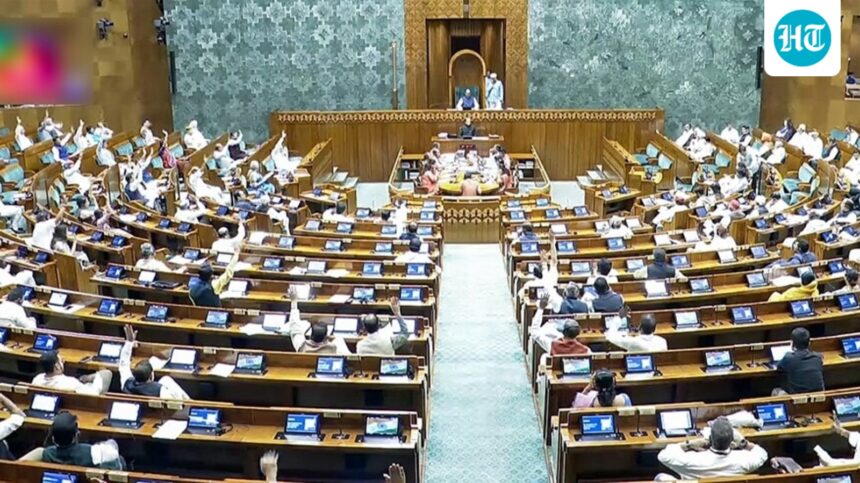
The government is set to begin the process of redrawing constituencies and increasing Lok Sabha seats to 850 from the current 543 in a bid to ensure one-third reservation for women in Parliament and population growth over the decades.

The Center will form a new delimitation committee to implement this process, which is likely to conclude before the next general elections in 2029. The last such process was conducted in 2002, however, only the boundaries were changed while keeping the total number of seats constant.
On Wednesday, the government unveiled three draft laws, including the Constitution Amendment Bill and the Delimitation Bill, through which the process of cutting new seats and redefining the boundaries of existing seats will be implemented. The demarcation process will depend on the 2011 census, as the census, which is scheduled to begin this week, will take another year to complete.
The three draft laws are scheduled to be presented to Parliament in the expanded budget session that will be held from April 16 to 18.
What is demarcation and why is it necessary?
Delimitation is a routine practice and is carried out every few decades by carving out new seats and defining their boundaries to ensure that states get their proper representation as their populations grow. The last exercise if it is the fifth exercise.
The first delimitation was carried out in 1952, based on the 1951 census which allocated 494 Lok Sabha seats. Similar exercises were conducted in 1963 and 1973. During the 1973 exercise, based on 1971 census data, the number of seats was fixed at 543, while the population of the country was 54.8 crore.
In the last revision in 2002, while the seats remained unchanged, their boundaries were only redefined as previously mentioned.
Based on the latest official census data from 2011, the population has doubled since 1971, requiring redistribution among states.
While some constituencies, in both North and South India, have 2-3 million voters, others like Lakshadweep, Daman and Diu or Ladakh have 47,972, 102,260 and 159,949 voters respectively.
What does the Lok Sabha look like after delimitation?
According to the government’s proposal, reviewed by Hizb ut-Tahrir, the number of Lok Sabha seats will be increased from 543 to 850, with the bulk going to the North. While 815 of these seats will be allocated to states, another 35 seats will be allocated to union territories.
The demarcation will also bring into effect one-third reservation for women in Parliament, a long-awaited plan approved in 2023. Under the new framework, reserved seats for women will be allocated on a rotating basis.
The biggest point of contention over this practice is the north-south divide, with northern India with high population growth benefiting from more proportional seats, while southern India – a large contributor to GDP (about 30-31%) – gets lower proportional seats due to lower population growth. The Southern States have repeatedly indicated that mere population alone should not be the criterion for such revisions or additions.
Looking at the government’s proposal, the biggest winners are Uttar Pradesh (UP), Bihar, Rajasthan, Madhya Pradesh (MP) and Maharashtra. On the other hand, the laggards are Tamil Nadu, Kerala, Andhra Pradesh (+ Telangana), Odisha and West Bengal.
While UP will see Lok Sabha seats rise from 80 to 140, Bihar seats will rise from 40 to 73, Rajasthan from 25 to 48, and MP seats from 29 to 51.
Interestingly, all the big winners are currently ruled by the BJP-led NDA.
Tamil Nadu’s seats will increase from 39 to 51, while Kerala’s from 20 to 23, Andhra and Telangana’s from 42 to 59, while Odisha’s from 21 to 29, and West Bengal’s from 42 to 64. Except for Odisha and Andhra, all the backward seats are ruled by the opposition.
NDA sources told news agency PTI that the final number of seats will be determined by the demarcation committee and that the draft law does not specify a specific number of seats. The sources added that the figure of 850 represents only the upper limit of the total Lok Sabha seats.
What Open said and fears of fraud
The opposition and leaders of the southern states were the first to express concerns about these exercises, describing them as a “conspiracy” and an attempt that would “change the political map.”
Prime Minister Narendra Modi, in a public message to women, asserted that Indian democracy will become stronger and more vibrant if elections to the Lok Sabha and various assemblies are held in 2029 with the women’s quota fully implemented. Parties like Shiv Sena, BSP, AIADMK and others have supported the bills.
However, the opposition called for a “hybrid model” and criticized the government for punishing states with successful population control measures.
This is what opposition leaders said:
MK Stalin: Tamil Nadu Chief Minister M K Stalin alleged that the Center was trying to punish southern states that implemented population control initiatives. He further said that the Center plans to “enact its conspiracy law in this regard”. He also warned in a video message of widespread unrest and “full force protests” if anything is done to harm the state or if the political power of the northern states is disproportionately increased in demarcating borders. Stalin also called an emergency meeting of DMK MPs on Wednesday to discuss the impact of the exercise.
Revanth Reddy: The Telangana CM has issued a formal appeal to Prime Minister Narendra Modi and the chief ministers of southern states to reject pure population expansion of Lok Sabha seats. In an open letter, Reddy warned that a “proportional” increase to 850 seats would penalize states for successful population control. He proposed a “hybrid model” that rewards economic contribution and development performance.
Congress: Party general secretary Jairam Ramesh described the intent behind the bill as “mischievous” and said that the Constitution (131st Amendment) Bill was “very ill-timed”. “When the intent behind the bill is mischievous, and its content is deceptive, the extent of damage to parliamentary democracy is enormous. Under the guise of bringing up women’s reservations, the BJP is looking to demolish the flawed, unconstitutional and anti-federal delimitation process,” Ramesh said. Meanwhile, Congress is also expected to hold a key meeting to formulate a joint strategy before the special parliament convenes this week.
Left parties: Left leaders also raised strong concerns and warned of the potential impact on India’s federal structure and political balance. “The bills being brought in the name of implementing women’s reservation amount to a death warrant for federal India,” John Prithas, Rajya Sabha leader of the Communist Party of India (Marxist), said in a post on X.
Shiv Sena (UBT): Shiv Sena (UBT) MP Sanjay Raut raised strong objections to the proposed exercise and said it could change the political map of the country. He also warned of possible unrest between the southern states. “Our party’s position is that under the guise of women’s reservation, they are trying to change the political map of the country. But in this process, the map of the country will change. The way the southern states have pointed to the central government, I am afraid that under this pretext, a Manipur-like situation may arise in the southern states,” he told ANI.
Concerns about border manipulation: Political activist Yogendra Yadav cited concerns about manipulation in demarcation and said the move was “primarily aimed at facilitating early demarcation and expanding the size of Lok Sabha to 815”.