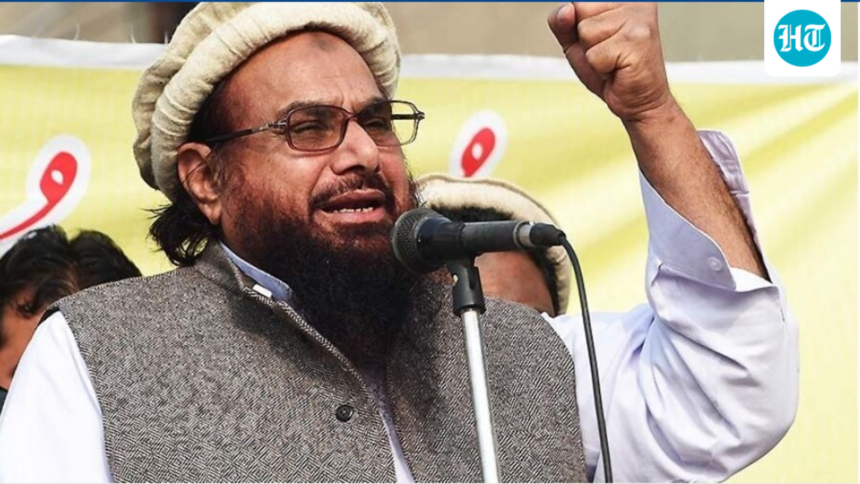
The special NIA court in Jammu has issued an open-dated non-bailable warrant (NBW) against Lashkar-e-Toiba founder and designated terrorist Hafiz Muhammad Saeed, holding that his arrest and custodial interrogation are necessary for a “fair, complete and effective investigation” into the April 22, 2025 Pahalgam terror attack.
The court passed the order on the basis of an application filed by the National Investigation Agency (NIA), which sought it as Saeed was named as accused No. 8 in the supplementary chargesheet in the case.
The court noted that Saeed’s arrest and interrogation during his detention were necessary to ensure a fair and effective investigation. It directed that a non-bailable warrant be issued and forwarded to the Deputy Inspector General (DIG), NIA, Jammu, for implementation in accordance with law.
According to the NIA, Saeed, a resident of Sargodha in Pakistan’s Punjab province, is a designated terrorist under the Unlawful Activities (Prevention) Act, 1967, and the founder of the banned outfit Lashkar-e-Taiba.
The agency told the court that he is operating from Pakistan and is deliberately evading arrest, making the issuance of an open non-bailable warrant necessary to facilitate further legal action and investigation.
The case relates to the terrorist attack that took place on April 22, 2025 in Baisaran Marg near Pahalgam in Jammu and Kashmir, in which 26 civilians, including tourists, were killed. The NIA claimed that the attack was orchestrated by members of the banned Lashkar-e-Taiba based in Pakistan, and named Saeed in the larger conspiracy behind the attack.
Full Speech: Prime Minister Modi Pahalgam’s terrorist attack message to the Indonesian Parliament | India| buck| Sindoor
What does memo mean?
The NIA plans to use the non-bailable arrest warrant to obtain a declaration that Saeed is a declared guilty party, a key procedural step before starting a trial in absentia under the Bharatiya Nagarik Suraksha Sanhita (BNSS), HT reported.
People familiar with the matter told HT that the arrest warrant will be sent to Pakistan through official channels with a request to repatriate Saeed.
Since Pakistan is unlikely to extradite him, the agency expects to proceed under Section 356 of the National Security Act, which introduced provisions for investigation, trial and sentencing of a declared offender in absentia.
After filing the supplementary charge sheet naming Saeed as the main conspirator in the terror attack, the NIA approached the Jammu Special Court seeking a memorandum to initiate further proceedings and facilitate the ongoing investigation.
Although Saeed has been named in several Indian cases and is declared a terrorist by the United Nations, he has never faced trial in an Indian court because he has never appeared before any court. Provisions for trial in absentia were introduced under the BNSS Act to enable proceedings against fugitives who remained outside the purview of Indian law.
(With inputs from Neeraj Chauhan)