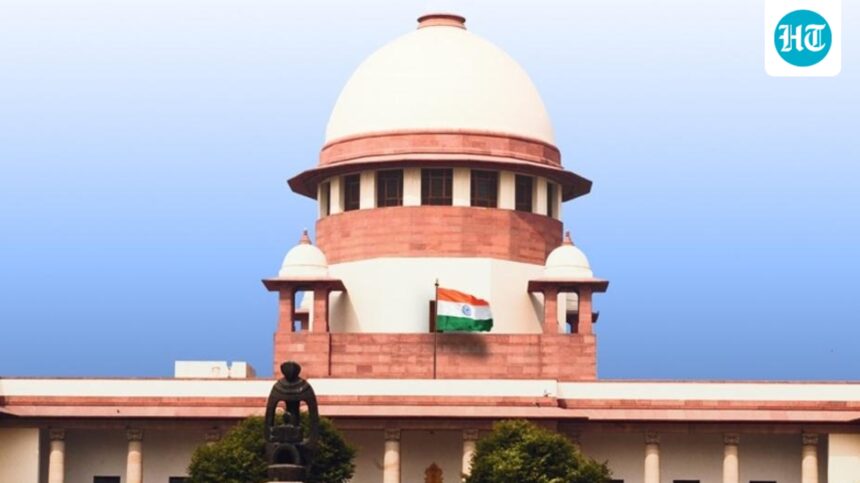
The integrity of democracy depends as much on the inclusion of eligible voters as on the exclusion of those who are not legally entitled to vote, the Supreme Court said on Wednesday, as it emphasized the constitutional importance of the right to vote while upholding the Electoral Commission’s Special Intensive Review (SIR) of electoral rolls.

In an important clarification on the nature of the right to vote in the Indian constitutional framework, a bench headed by Chief Justice of India Surya Kant noted that although the right to vote is a “valuable constitutional right” and fundamental to democratic governance, it is not absolute and can be subject to reasonable regulatory conditions aimed at maintaining the purity and accuracy of electoral rolls.
“The integrity of the franchise depends as much on the inclusion of eligible voters as on the exclusion of those who are not entitled to it,” the 124-page ruling said while dismissing the appeals to the SIR initiated by the ECI under Section 324 of the Constitution and Section 21(3) of the Representation of the People Act, 1950.
The “foundational importance” of electoral lists
The court said that maintaining accurate and credible electoral rolls is of “fundamental importance” to the democratic process because representative governance depends on the validity and integrity of the electoral rolls.
She said: “The integrity of the elections is closely linked to the validity of the electoral list, and any systematic distortion in it strikes the roots of representative rule.”
The right to vote is constitutional
The ruling is important for its detailed constitutional formulation of the right to vote, especially against the backdrop of the evolving judicial debate over whether voting rights are purely legal or enjoy constitutional protection.
Referring to the Constitution Bench decision in the CAA case under Section 6A filed last year, the court reiterated that the right to vote under Article 326 is no longer viewed as a mere statutory right but has acquired the status of a constitutional right through judicial interpretation.
Citing extensively the Constitution Bench judgment of Justice Kant, the court noted that the issue was “finally settled” in the judgment in Rajbala v. State of Haryana (2015), where the Supreme Court held that the right to vote under Article 326 is a constitutional right subject to the limitations prescribed by law.
“It can therefore be observed that with the help of judicial construction in the context of the nature of the right to vote, it has been upgraded from a mere statutory right to a constitutional right,” the ruling noted.
Verification and guarantees
At the same time, the Commission explained that the constitutional guarantee of universal adult suffrage under Articles 325 and 326 necessarily considers mechanisms for verification, identification and periodic review of electoral lists.
According to the Court, procedural requirements such as proof of identity, verification of regular residency, and confirmation of eligibility cannot by themselves be treated as unconstitutional burdens on voting rights. “Such conditions are integral to preserving this right, as they ensure that the electoral roll remains limited to those who are legally entitled to be included on the list,” the ruling said.
The court rejected the petitioners’ argument that the SIR system disproportionately burdened voters by forcing them to repeatedly prove citizenship or eligibility even though they were already registered on the electoral rolls.
The court held that requiring voters to submit one of several prescribed documents, along with multiple opportunities to correct omissions and challenge exceptions, did not amount to a disproportionate restriction on voting rights. “It must therefore be recognized that a measure aimed at improving and correcting the electoral register, even if it involves certain compliance requirements on the part of voters, does not in fact violate the right to vote,” the court added.
There is no case of mass disenfranchisement
The ruling repeatedly stressed that the relevant constitutional test is not whether some difficulty or exclusion may arise during implementation, but whether the general framework includes adequate safeguards against arbitrary deprivation of rights. The court cited safeguards such as notice before disqualification, opportunities to respond, appellate remedies, and judicial review, holding that the framework reflects “a measured approach in which the right to vote is regulated, but not abrogated.”
The Court also rejected claims of mass disenfranchisement arising from the SIR, holding that the post-exercise data before it did not reveal “widespread or systematic” exceptions to demonstrate constitutional incompetence in the design of the process. “Individual exclusions may arise, but they can be addressed within the framework of claims, objections and appeals,” the court said.
The Court ultimately concluded that the SIR regime met the constitutional test of proportionality because the measures adopted by the EEC bore a rational connection with the aim of ensuring the accuracy of electoral rolls, were not manifestly excessive, and were accompanied by sufficient procedural safeguards to prevent arbitrary exclusion.