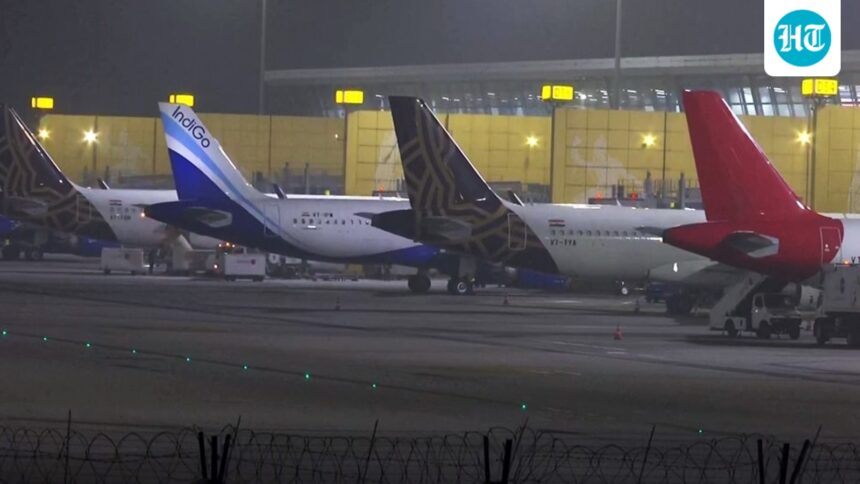
The Airports Authority of India (AAI) on Tuesday denied reports claiming that it had requested details of fuel stocks from airports as a precautionary measure amid a possible closure of the Strait of Hormuz.

The escalating conflict between Iran and the United States has raised concerns about oil trade, with Tehran claiming to have already closed the strait, but it is not clear whether this is a complete closure. Follow live updates about the US-Iran war
AAI issues a statement and denies media reports
The Airports Authority of India has denied media reports that it has sought details of aviation turbine fuel stocks at international airports in view of the conflict in the Middle East.
“AAI categorically denies these reports. The authority states that it has not formally or informally requested any airport operator to provide details regarding fuel stocks or estimated fuel requirements. Reports indicating such communications are false and factually incorrect,” AAI said in a statement.
He added: “It was also emphasized that AAI operates strictly within its mandate. AAI is the airport operator and navigation services provider. It does not exercise oversight over fuel stocks. AAI remains committed to the safe, secure and efficient management of the airport infrastructure.”
Strait of Hormuz
The Strait of Hormuz is the most important oil corridor in the world, as it is located between Iran and Oman, and connects the Persian Gulf to the Gulf of Oman and the Arabian Sea.
The strait is only 33 kilometers wide at its narrowest point, and the shipping lane is three kilometers wide in both directions.
About a fifth of the world’s total oil consumption passes through the Strait of Hormuz, with the member states of the Organization of the Petroleum Exporting Countries (OPEC) – Saudi Arabia, Iran, the United Arab Emirates, Kuwait and Iraq – exporting the majority of their crude oil through the strait, especially to Asia.
Meanwhile, India gets about 55% of its crude oil imports from the Middle East, equivalent to about 2.7 million barrels per day.
Track flight cancellations and live updates for the Iran War
India’s buffer stock is much weaker than China’s, which is said to hold up to six months of crude oil.
While the center said that the total storage capacity may be sufficient for about 74 days, HT reported earlier, citing refining sources, that actual stocks may cover only 20 to 25 days under the current circumstances. This makes India particularly vulnerable if shipments through the Strait of Hormuz are significantly curtailed.
The Strait of Hormuz has historically been a focal point during conflicts. During the Iran-Iraq War (1980-1988), both sides sought to disturb the other’s exports in what was known as the “Tanker War.”
Read also | The Strait of Hormuz is “closed”: what is it and how does it affect global trade and oil prices?
In 2012, Iran threatened to close the Strait in response to US and European sanctions. Then again, in May 2019, four ships, including two Saudi oil tankers, were attacked off the coast of the UAE, outside the Strait of Hormuz, prompting Iran to repeat its threat.
Global oil prices are rising
Oil prices rose on Tuesday as tensions in the Middle East continued to rise. Global benchmark Brent crude rose to $80 a barrel, after rising 7 percent on Monday, Bloomberg reported.
Meanwhile, WTI was trading at $73.
The $82 to $85 area is seen as the upper bound over the next two days as Iran targets energy and shipping infrastructure, said Robert Rennie, head of commodities research at Westpac Banking Corp.
cancellation of journeys
Several westbound international flights were delayed from Delhi’s Indira Gandhi International Airport on Tuesday amid rising tensions and airspace closures.
Delhi Airport has issued an advisory asking passengers to check the latest flight status with their airlines before heading to the airport.
So far, 36 departures and 44 arrivals have been canceled at IGI Airport.
In Bengaluru, 44 flights were canceled due to airspace restrictions, and at least 10 international flights were canceled at Kolkata airport.