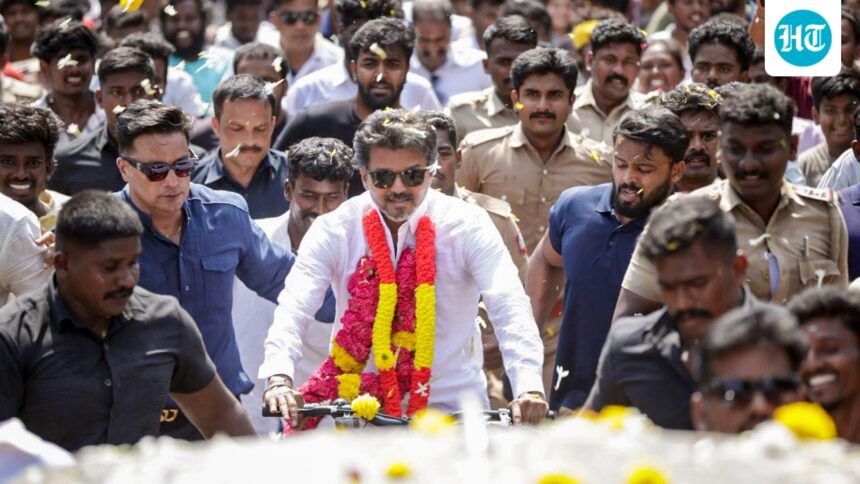
Actor-turned-politician TVK’s stunning election debut, headed by Vijay, is the front-runner to form the government in Tamil Nadu, has put the spotlight on political ‘start-ups’, very few of which have turned into instant ‘unicorns’.

The Tamilaga Vettri Kazhagam (TVK) has followed the footsteps of parties like Aam Aadmi Party (AAP), Asom Gana Parishad (AGP) and Telugu Desam Party (TDP) in moving to form the government after its first round of elections.
While the AAP formed the government with the support of the Congress after its first elections in 2013, the AGP formed the government in 1985 soon after it was formed with the support of successful independent candidates belonging to the Assam Movement.
Read also | Who will win in Karur, the constituency that witnessed a storm after the stampede at Vijay’s rally last year?
The LDP had swept the 1983 Andhra Pradesh state assembly elections with a large majority, winning 201 seats, a year after its formation.
However, many political startups did not turn into unicorns, while some took time, and others failed to make a mark.
Just last year, Jan Suraj bit the dust. There were also other parties that created a strong buzz but failed to succeed in campaigning like actor-turned-politician Kamal Haasan’s Makkal Needhi Maiam Party, which got a blank result in the 2021 Tamil Nadu Assembly elections.
From the beginning, TVK created a huge buzz and with several political ‘start-ups’ formed by film stars having performed well in the past in the South, there were high expectations from it in the Tamil Nadu Assembly polls.
Read also | Prashant Kishor’s old predictions about Vijay resurface as TVK rises in Tamil Nadu: ‘Save the video, play it after the results’
TVK took everyone by surprise, causing a major political earthquake in Tamil Nadu by defeating both the DMK and AIADMK, the two major players in the state for decades.
According to the Election Commission website, TVK was leading in 107 seats, DMK in 58 seats and AIADMK in 51 seats. The majority mark in the Tamil Nadu Assembly polls is 118.
There are many small ’emerging’ parties in Bihar like the Plurality Party headed by Pushpam Priya Chaudhary. Then there are small parties with limited ambitions that continue to remain in pockets, such as Jitan Ram Manjhi’s Hindustani Awam Morcha (secular) and Upendra Kushwaha’s Rashtriya Lok Morcha.
In Uttar Pradesh, there are parties like Nishad Party, Peace Party, Apna Dal (Sonelal), and Suheldev Bharatiya Samaj Party (SBSP).
Read also | Will Vijay’s TVK join hands with DMK or AIADMK to form the government in Tamil Nadu? What we know
In India, parties continue to form and then disappear after poor performances in election campaigns, causing hardly any buzz. But this cannot be said about Prashant Kishor’s Jan Suraj, as he has created more than just a stir, with many predicting that he may emerge as the next Aam Aadmi Party in the Bihar polls.
However, the media euphoria surrounding it proved to be a mirage, as the party was decimated in the elections and failed to open its account in any of the 238 seats it contested.
If one looks at the political landscape of the country, there are six national parties – Bharatiya Janata Party, Congress, Bahujan Samaj Party (BSP), Communist Party of India (Marxist) (CPM), National People’s Party (NPP), and AAP.
While the Congress party arose from the freedom movement, the BJP arose from the ideology and gained from the Ram Janmabhoomi movement.
The Communist Party of India (Maoist) was built around ideology, the National Progressive Party was formed by a well-known politician who broke away from his parent party, the BSP was built around a social group and the AAP emerged from the India Against Corruption Movement.
Very few “political startups” have done well. The AAP came into existence in 2012 and the regional Telugu Desam Party (TDP) in 1982. However, the TDP gained the popularity of film star NT Rama Rao.
Parties that have emerged as regional forces, such as the Trinamool Congress in West Bengal, the Biju Janata Dal in Odisha and the AIMIM in Telangana, have made gains because of a well-known political figure who broke away from the parent party (Mamata Banerjee) or because of dynastic goodwill (Naveen Patnaik and Asaduddin Owaisi). Although AIMIM was formed very early, it gained popularity under Owaisi.
Other parties like the Lok Janshakti Party (Ram Vilas), Nationalist Congress Party (SP), and Shiv Sena (UBT) are also examples that fall into either category – separatist factions or dynastic goodwill.
Viduthalai Chiruthaigal Katchi (VCK) was built around a movement to protect Dalits and had limited success in Tamil Nadu.
But TVK’s debut in the poll may instill confidence in those who are considering the idea of launching a political startup. After all, it was TVK’s political debut and may have inspired many for a “remake”.