As March draws to a close, the days of Bengaluru summer are approaching. Bright yellow copper pod flowers also replace the pale pink clusters Pink taboo On the horizon, it’s fitting that we celebrate two important days in March – March 3, World Wildlife Day, and March 21, World Forest Day.

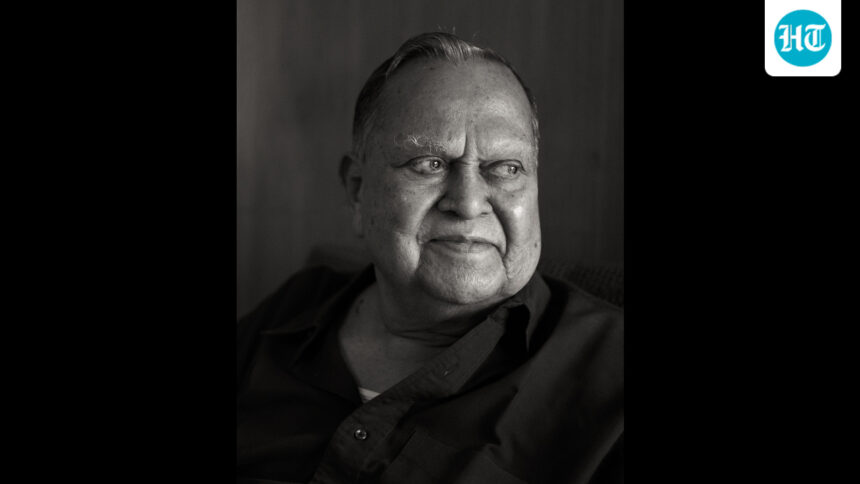
It is also a perfect opportunity to remember an extraordinary person who conquered both of these interests – Seethuram Gopalrao (SG) Nijenhal, the award-winning wildlife photographer, conservationist, and forest officer, who not only spent his life roaming the forests of Karnataka but was also responsible for spearheading a massive tree plantation drive in the 1980s that brought in green – pink and yellow! – Back to every concrete-choked neighborhood in Bengaluru.
SG Neginhal (1929-2021) grew up in Belgaum and Dharwad, which was then part of the Bombay Presidency. His father, Gopalrao, a forest officer under the British, was trained at the Rangers College, Dehradun (established 1878), one of the oldest forest schools in the world and the precursor to the Imperial Forest Research Institute (FRI). Gopalrao passed on his love for forests to his young son, who followed his father to the Bombay State Forest Department when he was 22 years old.
After the States Reorganization Act of 1956 redrawn state boundaries, Nijenhal was sent to Karnataka, where he worked as a ranger in the Dandeli forest, focusing only on trees. In 1965, fascinated by famous ornithologist Salim Ali’s best-selling 1941 book, Book of Indian birdsIt brought his attention to wildlife. A piece he then wrote – Dandeli Bird Sanctuary – For the legendary Birdwatchers’ Newsletter It came to the attention of YML Sharma, the forest officer who developed Bannerghatta National Park. Sharma sent Nijenhal to Dehradun for training in wildlife management, and when he returned in 1972 as a new Indian Forest Service officer, he sent him to Mysore, taking charge of BR Hills, Bandipur, Nagarhole and Ranganathittu.
1972 was also a watershed year for Indian wildlife management – the Wildlife (Protection) Act was passed, which banned all forms of hunting in Indian forests. In order to create awareness about the alarming decline in its numbers, the tiger has replaced the Asiatic lion as India’s national animal. The following year, Prime Minister Indira Gandhi launched Project Tiger, which required countries to establish and manage exclusive tiger reserves. Of the nine trial reserves, one was to be in southern India. It was Nijenhal who, through his pioneering administrative plan for Bandipur, resisted fierce competition from Mudumalai and Wayanad to bring him home.
In 1977, Nijenhal was appointed curator of the Mysore Zoo, but seeing animals in captivity disturbed him so much that he returned to the forests. In 1981, he was brought to Bengaluru for the first time, by the then Chief Minister of Karnataka, R Gundu Rao, and was tasked with quickly bringing back trees to the city that was rapidly losing its green cover. Realizing that previous tree-planting campaigns had failed because of the height of the saplings—two feet, meaning they were within reach of grazing livestock—Nigenhall planted saplings that were at least six feet high, surrounding each with a protective fence of his own design, including four posts and chicken netting, which was much cheaper and more effective than the previous concrete barrel.
Between 1982 and 1987, when he retired as Deputy Conservator of Forests, SG Neginhal personally led the planting of at least 15,000 trees in the city.
Judiciously mixing exotic and local species – amalta, gulmohar, champaka, badminton, jacaranda and, yes, Tabuya – Involving residents in deciding which trees they wanted for their street, the Forest Man returned the park to the city.
(Rupa Pai is a writer who has had a long-lasting love affair with her hometown of Bengaluru)