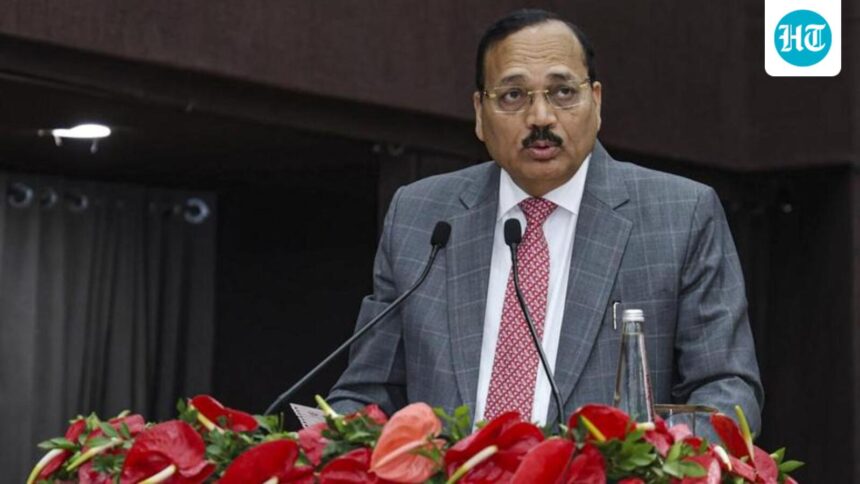
The Supreme Court on Friday witnessed a rare personal moment from Chief Justice of India Surya Kant, who narrated how a senior apex court judge once persuaded him to join the judicial service early in his career, telling him instead that “the Bar is waiting for you.”

The tale unfolded during the hearing of a petition filed by advocate Prerna Gupta, Advocate of Record (AoR) in the Supreme Court, who sought re-evaluation of a paper in the Delhi Judicial Services Examination, alleging alteration of marks.
The bench, led by an IJC that also included Justice Joymalia Bagchi, seemed reluctant to accept the petition, observing that reassessment can usually only be allowed when the governing rules expressly provide for it.
When the bench learned that Gupta was already a responsible officer practicing in the Supreme Court, the judicial magistrate asked her: “So, why do you want to become a judicial officer?”
The petitioner responded that she intended to sit for the Senior Judicial Services Examination in the future but had not yet reached the minimum age of 35 years.
Read also: CJI Surya Kant recalls his literary upbringing and love for the Hindi language
At this point, Judge Kant advised her to attempt the Senior Judicial Services exam at a later date, before moving on to deeply personal memories of his early years at the Bar.
“Apply for higher judicial services next time. But let me share something with you, why you shouldn’t press this,” the ICJ commented.
Judge Kant recalled that when he was in his final year of law school, students were allowed to sit for judicial service examinations even before graduation. However, around that period, recruitment procedures underwent a major change following a Supreme Court ruling, under which High Court judges were required to act as subject matter experts during interviews, and their opinions became binding on the Public Service Commission.
By then, the future CJI had already started practicing before the Punjab and Haryana High Court.
“The chief justice who was nominated for the interview panel already knew me because I had argued two matters before him,” Justice Kant said.
He pointed out that one of these matters was a marital dispute, in which the judge allowed his appeal and overturned the divorce judgment on the grounds of schizophrenia.
Justice Kant narrated that the same judge had also seen the list of candidates who had appeared for the Judicial Services interview and learned that the young lawyer had applied.
“One day, he called me into his room and asked me: Do you want to become a judicial officer?” I said yes. He immediately said, ‘Get out of the room,'” the CJI recalls.
He said the remark left him devastated.
Judge Kant told the courtroom: “I walked out shaking. All my dreams were shattered. I thought I was going to become a judicial employee, and he ignored me like that.”
But the story took an unexpected turn the next day.
“The next day, (the Supreme Court judge) called me back into his chambers. He said, ‘If you want to be, you are welcome. But my advice is, don’t become a judicial employee. The Bar Association is waiting for you,” the CJI narrated.
Judge Kant paused briefly and emphasized: “Those were the exact words he said – ‘The union is waiting for you.’” He said the interaction changed the course of his career.
He said: “I left the room and decided not to go for the interview. I did not inform my parents because I knew they would be upset. After two or three months, I lied to some people here and there and refused to go.”
Turning towards the petitioner, the country’s premier judge and 53rd Chief Justice of India asked with a smile: “Now tell me, was my decision wrong or right?”
While the courtroom was smiling, the ICC gently advised the petitioner not to insist on the current petition and instead try to examine the higher judicial services in the future.
He told her: “So don’t insist on this petition, next year I will appear for the Higher Judicial Services Examination and all the best to you.”
Justice Kant commenced his legal practice at the Hisar District Court in 1984 before moving to Chandigarh, where he established a thriving practice before the Punjab and Haryana High Court, specializing in constitutional, service and civil law.
In July 2000, at the age of 38, he was appointed Solicitor General of Haryana, becoming the youngest person to hold the highest legal office in the state. He was appointed as Senior Advocate the following year and was elevated to the post of Judge of the Punjab and Haryana High Court in January 2004.
In October 2018, he was appointed Chief Justice of the Himachal Pradesh High Court before being elevated to the Supreme Court in May 2019. In November last year, he took over as CJI.