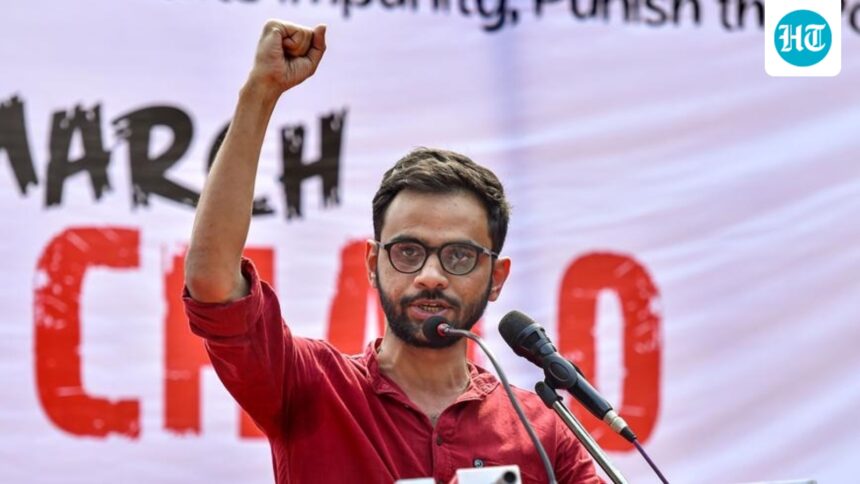
A member of Khalid’s legal team said the Supreme Court’s crucial observation on denying bail to Jawaharlal Nehru University researcher and Delhi riots accused Omar Khalid could increase his chances of challenging the decision against him by filing a curative petition.

Khalid and his co-accused Sharjeel Imam were denied bail on January 5 by a two-judge bench of Supreme Court Justices Aravind Kumar and N V Angaria. Khaled later favored the review petition, which suffered the same fate as it was rejected by judges sitting in conference rooms (rather than in open court) on April 16.
Read also | The Supreme Court criticizes its January ruling denying bail to Omar Khalid and Sharjeel Imam
The last remaining legal solution for Khaled to challenge the ruling issued against him is to file a curative petition. Such petitions are heard by a larger bench comprising the judges who decided the case along with the three highest-ranking judges of the Supreme Court (including the Chief Justice of India).
The scope of filing a curative petition is very limited – it is only granted if a litigant can prove that he or she did not receive a fair trial, that there was bias in the ruling, or that the court’s procedures were abused in a way that caused a grave injustice. Such petitions are decided in chambers unless the judges decide to include the matter in open court.
Khaled has not yet submitted a treatment petition. Imam has not yet filed a review application against the January 5 ruling. However, Khaled’s legal team believes that the current ruling gives a glimmer of hope for both to appeal. “We are studying the ruling and will decide the future course of action. Interpretation of the law in the context of constitutional freedoms is one of the reasons that must be taken while submitting the treatment application,” the aforementioned lawyer said.
Read also | Omar Khalid case shows that denial of bail cannot be a punishment, says former CJI Chandrachud
“We have serious reservations on various aspects of the judgment in the Gulfisha Fatima case, including depriving the appellants of the right to seek bail for a period of one year,” said the ruling delivered by a bench of bench BV Nagrathna and Ujjal Bhuyan on Monday.
The court raised doubts about the way this ruling interpreted a 2021 ruling by the Supreme Court in the Najib case (2021) decided by a three-judge panel that denounced pretrial detention.