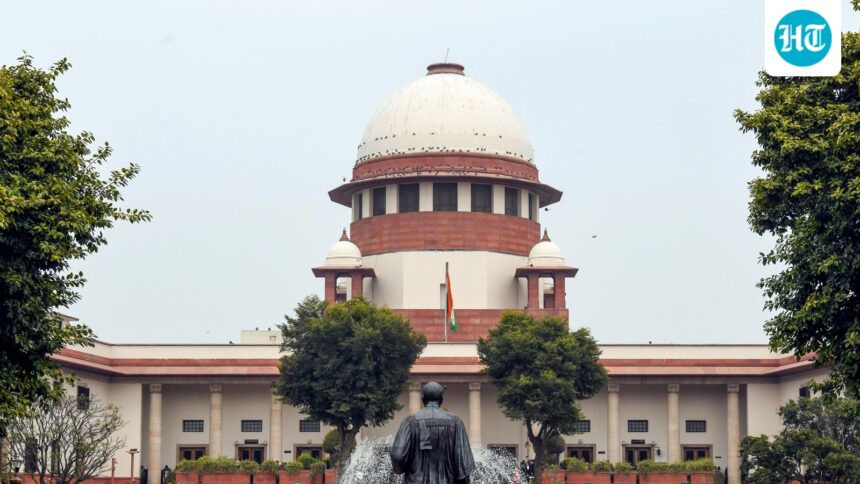
The Supreme Court on Thursday warned that excluding people from temples on the basis of caste, creed or denominational identity could have a detrimental impact on Hinduism itself, stating that the constitutional endeavor should be “to unite and not create further divisions” within the community.

“Leaving aside the Sabarimala controversy… everyone should have access to every temple and every temple. But if you say it is a practice… that only my section should attend my temple and no one else, it is not in the interest of Hinduism,” the nine-judge bench led by Chief Justice of India Surya Kant observed, adding that such an approach would ultimately lead to “further division of society”. The bench also includes Justices B V Nagarathna, M M Sundresh, Ahsanuddin Amanullah, Arvind Kumar, A G Masih, R Mahadevan, Prasanna P Varali and Joymalia Bagchi.
These observations came on the third day of the hearing in the Sabarimala reference, where the court considered the interplay between communal rights under Article 26 and the state’s power to enact social reform laws under Article 25(2)(b), particularly in the context of temple entry.
While appearing before the Nair Service Association, senior advocate CS Vaidyanathan argued that the landmark judgment in Sri Venkataramana Devaru v. State of Mysore (1958), which upheld the application of temple entry laws to denominational temples, had been wrongly taken. He stressed that Article 26 (b), which guarantees religious communities the right to manage their own affairs, operates independently and cannot be curtailed by the laws stipulated under Article 25 (2) (b).
However, the commission expressed reservations about such a broad reading of sectarian independence. She pointed out that Article 26 itself is subject to public order, morals and health, and cannot be interpreted in a way that allows exclusionary practices that undermine social cohesion.
At one stage, the court noted that even in the Devaro case, which concerned a temple claimed by the Godda Saraswat Brahmin community, the Supreme Court had upheld the validity of the Madras Temple Entrance Licensing Act, which allowed entry to all sections of Hindus, thus prioritizing social reform over communal exclusivity.
“What you are arguing is in direct contradiction to Article 25(2)(b),” the CJI said, pointing out that the constitutional scheme envisages balance and not hierarchy between the two arbiters.
A key element of the court’s reasoning was rooted in the lived reality of Hindu religious practices, which it said did not conform to strict sectarian boundaries. The bench noted that religious people routinely visit shrines and temples across denominational lines, undermining the premise that access can be strictly limited to a particular group.
“People go here and there… and followers of Sampradaya do not restrict themselves to one institution,” the court observed, questioning the utility of strict sectarian barriers in a religion characterized by internal pluralism.
For her part, Justice Nagaratna emphasized that any interpretation that allows entire sections of places of worship to be excluded could promote division rather than cohesion. “We have to unite… we don’t have to divide more,” she added.
In another important exchange, the court highlighted the potential contradiction in arguments seeking judicial deference in matters relating to religious castes and temple entry while endorsing intervention in practices such as triple talaq as social reform measures – Vaidinathan said.
“There is an inherent contradiction in your submissions. You cannot take a stand here and say that triple talaq is acceptable because it is also a part of religion. You may not subscribe to the way it is done and how someone misuses it or interprets it, (but) that does not give the court the right to interfere. Both sets of cases relate to questions of faith, practice and constitutional rights,” Justice Amanullah stressed.
The hearing also reconsidered the scope of judicial review, with the court reaffirming its position taken on Wednesday that religious freedoms are not absolute and remain subject to constitutional restrictions. The bench then hit back against the Centre’s argument on judicial restraint, stressing that courts cannot be “entirely stripped” of their jurisdiction in cases involving clear constitutional violations.
On Thursday, this topic was expanded to include the issue of access to places of worship, with the court noting that an overly expansive interpretation of sectarian rights could risk fragmenting religious communities and undermining the broader constitutional goal of social unity.
The proceedings also saw a brief discussion on the scope of communal rights outside temples, including in the context of educational institutions, although the bench appeared unwilling to expand the reference to such issues at this stage.
The nine-judge panel was tasked with answering seven fundamental questions arising from the 2019 reference, including the contours of basic religious practices, the balance between individual rights and sectarian autonomy, and the limits of judicial review in religious matters.