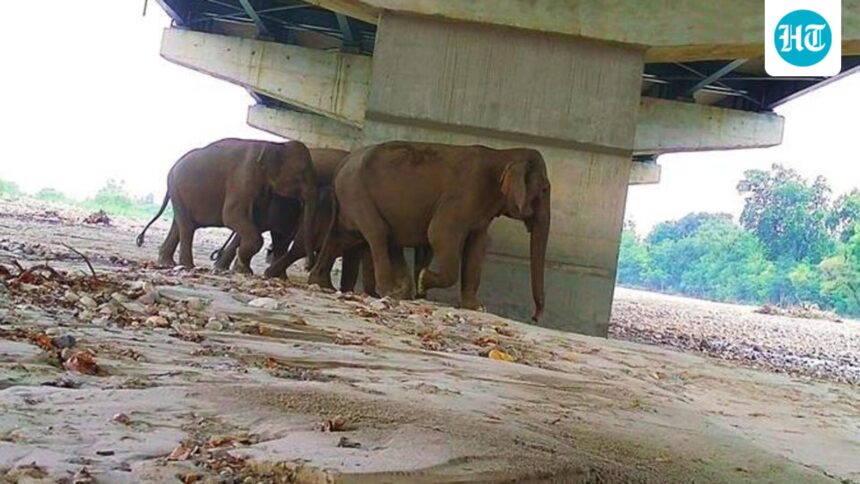
The tunnels built along the Delhi-Dehradun Expressway are being widely used by wild animals as intended, according to a study commissioned by the National Highways Authority of India (NHAI).

The study, conducted by the Dehradun-based Wildlife Institute of India, is based on field monitoring conducted between May 16 and June 24, 2025, along the Ganeshpur-Dehradun stretch.
The results, published by the NHAI on Friday, come ahead of the inauguration of the Delhi-Dehradun Expressway by Prime Minister Narendra Modi on April 14.
The 210-km-long corridor, which is expected to reduce travel time between Delhi and Dehradun from more than six hours to about 2.5 hours, includes India’s longest wildlife corridor and dedicated wildlife crossings along the forests.
This stretch is located within the Shivalik Elephant Corridor and along the edge of the Rajaji Tiger Reserve, part of the Terai Arch Natural Area, a major biodiversity area. As part of the project, a network of tunnels and elevated sections were designed along the alignment, including an 11-kilometre stretch, to allow animals to move beneath the road.
A total of 40,444 wildlife were detected from more than 111,000 images taken using 150 camera traps over a 40-day period.
Nilgai, elephants, jackals, hare, sambar and spotted deer were among the early users, while species such as leopards and rusty-spotted cats appeared later in the sampling period, suggesting a difference in behavioral adaptation.
The study used the relative abundance index (RAI), calculated as the number of independent captures per camera trap day, to estimate how often a species uses crossings. Ungulates and medium-sized mammals dominated use. Nilgai (RAI 16.76), sambar (15.07), and spotted deer (7.72) were among the most frequent users, along with golden jackal (21.05), which recorded the highest relative abundance among wild species. Elephants were also detected, but at lower frequencies (RAI 1.04), suggesting that large mammals also used these structures.
The human presence remained significant through the tunnels, with people, livestock and vehicles, often exceeding wildlife discoveries, the report said.
Spatial patterns were variable. Heat map analysis showed that some sections, especially towards Ganespur, recorded higher activity of species such as leopards and Indian hares, while other stretches saw lower usage. For elephants, the crossings were clustered at specific points, indicating preferred routes rather than uniform movement across the alignment, the study said.
However, temporal analysis showed that many species modified activity patterns to avoid disturbance. Panthers and many ungulates were largely nocturnal, while human and vehicular movement peaked during the day.
The study also incorporated acoustic monitoring using AudioMoth devices to assess the impact of traffic noise. She noted that vehicle noise can affect animals’ behavior and habitat use, sometimes creating a “phantom road” effect even outside of a physical highway.