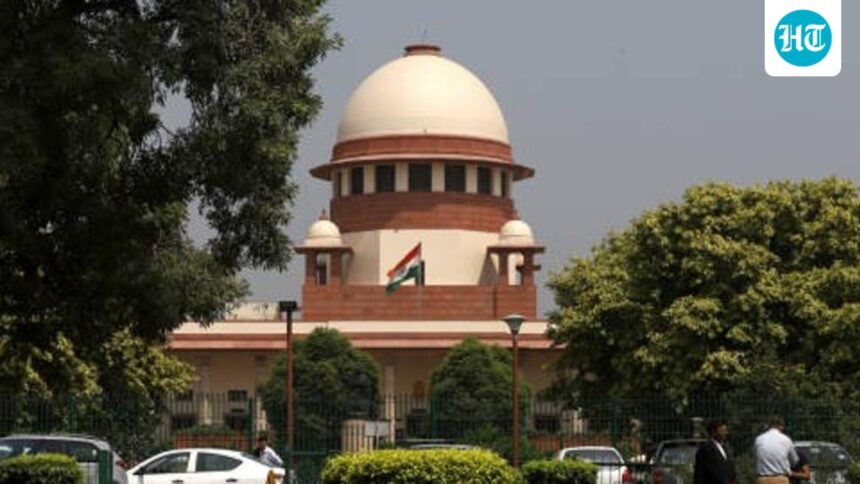
Less than a week after a litigant appeared in person at a Supreme Courtroom brawl by throwing papers, using offensive language and disrupting judicial proceedings, the Supreme Court has decided that parties in person will normally be encouraged to appear virtually, while those who insist on a physical appearance will have to forego live streaming and video recording of the proceedings.
The decision was made at a full court meeting of all Supreme Court justices on Wednesday and was announced through an official statement on Thursday, in what appears to be the first institutional response by the court to the disruption that occurred on July 10, which led to the arrest of two law students after one of them assaulted security personnel while escorting them out of the courtroom.
The Full Court decided that while interacting with the Registrar under the Supreme Court Rules 2013, parties appearing in person will be given the option to argue their cases through virtual mode. However, when a litigant insists on being physically present, “live streaming is not permitted and video recording of the proceedings is also not permitted,” the statement said.
The move aims to maintain courtroom decorum while ensuring litigants’ continued access to court. It also seeks to prevent disruptive incidents from being amplified through publicly available live broadcasts.
This decision comes in the wake of the unprecedented incident that took place last week in Court No. 13, where petitioner Prabal Pratap personally referred to the judges as “judicial officers”, hurled abuses, threw papers inside the courtroom and resisted security personnel before being removed.
The bench, led by Justice K.V. Viswanathan, not to initiate contempt proceedings, stating that she refrained from taking action in view of the petitioner’s condition. Delhi Police subsequently arrested Pratap and another law student, Chander Bhan, on charges including assaulting a public servant and obstructing judicial proceedings.
The latest action also comes months after another courtroom security scare in which a 71-year-old lawyer tried to throw a shoe at then chief justice Bhushan R Gavai. This incident occurred in October 2025. Despite its refusal to initiate contempt proceedings in that case, a bench headed by Justice Surya Kant stressed at the time that the court’s focus should be on putting in place preventive mechanisms rather than punitive measures to ensure that such incidents do not reoccur.
SC condenses an outstanding drive
In another important decision aimed at reducing judicial arrears, the Full Court decided to identify and list about 100 sets of matters ready for final hearing, the disposal of which is expected to lead to the closure of approximately 9,177 pending cases. These matters will be brought before the appropriate benches for hearings outside session hours.
This initiative complements CJI Surya Kant’s recent overhaul of the Supreme Court bench under which four benches have been constituted to exclusively hear the oldest civil and criminal matters on Tuesdays, Wednesdays and Thursdays.
The Full Court also decided that once these identified pooled matters were disposed of, the oldest pending matters would, after issuance of notice, be considered by the Court for hearing on the same three business days of each week.
Read also: ‘Everyone does naare-baazi’: Supreme Court asks to revive protest case against Bhagwant Mann
Earlier this week, the Chief Justice unveiled the special list as part of the first systematic case management exercise in the Supreme Court to institutionalize disposal of old lawsuits. About 800 of the oldest civil and criminal cases have already been scheduled for focused hearings before the four special courts.
The Full Court also decided to simplify the daily list of causes and bring greater uniformity to the sequential list of cases. A committee of judges will be formed to study these issues and make recommendations.
Confirming another recent administrative reform, the justices decided that lawyers who will appear at final hearings will continue to submit advance schedules for filing their oral submissions, a measure intended to facilitate better case management and more efficient use of court time.
Separately, the Full Court decided that all judges of the Supreme Court will participate in the ongoing Samdan Samaru case, culminating in a special Lok Adalat to be held on August 21, 22 and 23, 2026, as part of the Court’s broader efforts to promote consensual dispute resolution alongside adjudication of cases.