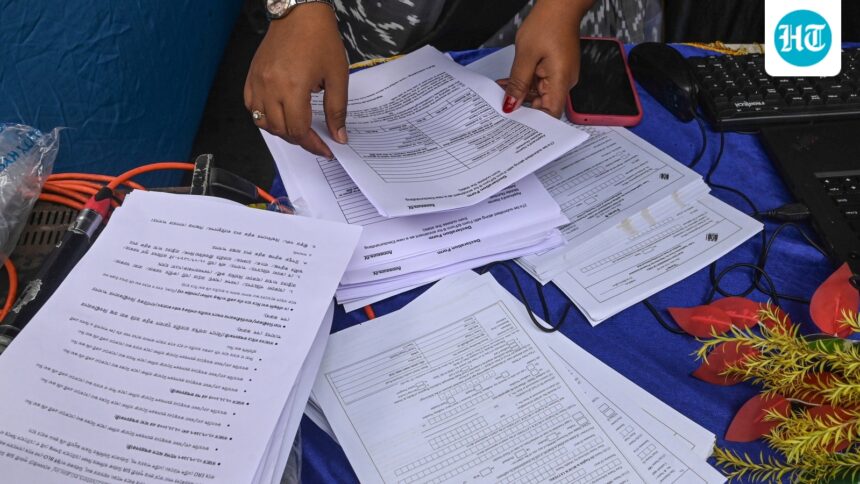
New Delhi: The Election Commission of India (ECI) is scheduled to conduct a Special Intensive Review (SIR) of electoral rolls in the National Capital Territory of Delhi and 21 other states and union territories in April, marking the third phase of the controversial process that has taken the Parliament by storm and reached the Supreme Court.

In a letter on Thursday, the ECI told the chief electoral officers (CEOs) of 22 states and union territories (UTs) that the next phase of the SIR will begin from April 2026, and directed them to complete the preparatory work as soon as possible. “As the SIR is expected to commence in the above-mentioned states/territories from April 2026, you are requested to complete the preparatory work related to the SIR, as soon as possible,” the letter said.
Other than Delhi, the next phase will cover UT in Chandigarh, UT in Dadra and Nagar Haveli, Daman and Diu, UT in Jammu and Kashmir, UT in Ladakh, Andhra Pradesh, Arunachal Pradesh, Haryana, Himachal Pradesh, Jharkhand, Karnataka, Maharashtra, Manipur, Meghalaya, Mizoram, Nagaland, Odisha, Punjab, Sikkim, Tripura, Telangana and Uttarakhand.
This represents a total of approximately 373.9 million voters – approximately 38% of India’s total electorate of 977.97 million in the 2024 general elections.
“The SIR is expected to commence in the selected states and union territories from April 2026. All CEOs are directed to complete the preparatory work at the earliest to ensure that the exercise is conducted smoothly.” An ECI official said.
Read also | SIR verification in Delhi is scheduled to begin in April
Four of these states go to the polls in 2027, including Himachal Pradesh, Manipur, Punjab and Uttarakhand. Three of these states go to the polls in 2028, including Karnataka, Meghalaya and Nagaland.
This represents the fourteenth review of electoral lists since independence, and the last review was conducted between 2002 and 2004. When this review is announced, it will be the third round of review as part of the process that began last summer in Bihar.
The controversial practice was carried out in Bihar beginning June 25, which saw nearly 100,000 officers deployed at booth levels in 38 districts and distributing partially pre-filled forms to voters. In total, the number of names deleted reached 6.9 million, and the number of names added was 2.15 million. The final list of 74.2 million people, which was published on September 30, has become a major issue in the Bihar Lok Sabha elections.
The deletions in Bihar were among the largest single deletions of voters from electoral rolls of any state in recent memory, a move the poll panel defended as necessary in the Supreme Court to preserve the sanctity of elections.
But the opposition described SIR as an attempt to deprive marginalized communities of their rights and the practice turned into a political flashpoint.
Then on October 27, 2025, ECI announced SIR in 12 states and jurisdictions, including Andaman and Nicobar Islands, Lakshadweep, Chhattisgarh, Goa, Gujarat, Kerala, Madhya Pradesh, Puducherry, Rajasthan, Tamil Nadu, Uttar Pradesh and West Bengal.
Separately, a special audit of the lists – where no documents were verified – was carried out in Assam. But the process has been mired in controversy and delays, with repeated petitions in the Supreme Court and multiple extensions now threatening to impact the schedule for the next five state assembly elections.
Of the 12 districts where SIR is being conducted, Gujarat, Assam, Puducherry and Lakshadweep have published their final lists. Gujarat saw its voter list shrink by 7.7 million, Assam by 243,000, Puducherry by 16,619, and Lakshadweep by 48.
In West Bengal, the draft list omitted 5.8 million and another 11.6 million were flagged under the controversial “logical inconsistency”. ECI has conducted 660,000 hearings and the final lists are due to be published on February 28.
In Tamil Nadu, the draft removed 970,000 and another 160,000 were flagged for “logical inconsistency”. The final lists are scheduled to be published on February 28.
In Uttar Pradesh, the draft removed 2.89 million and flagged another 2.22 million for “logical inconsistency”. The final lists are scheduled to be published on February 28.
In Kerala, the draft removed 420,000 and another 880,000 were flagged for “logical inconsistency”. The final lists are scheduled to be published on February 28. In Madhya Pradesh, the draft list removed 1.12 million and flagged another 1.94 million for “logical inconsistency”. The final lists are scheduled to be published on February 28.
In Rajasthan, the draft list removed 1.31 million and flagged another 2.36 million for “logical inconsistency”. The final lists are scheduled to be published on February 28.
The SIR includes door-to-door verification, document screening and systematic removal of duplicate, deceased or converted voters under the Representation of the People Act 1950. Preparatory measures include rationalization of polling stations, modernization of counting blocks and training of booth-level staff before the official start of audit activities in April.