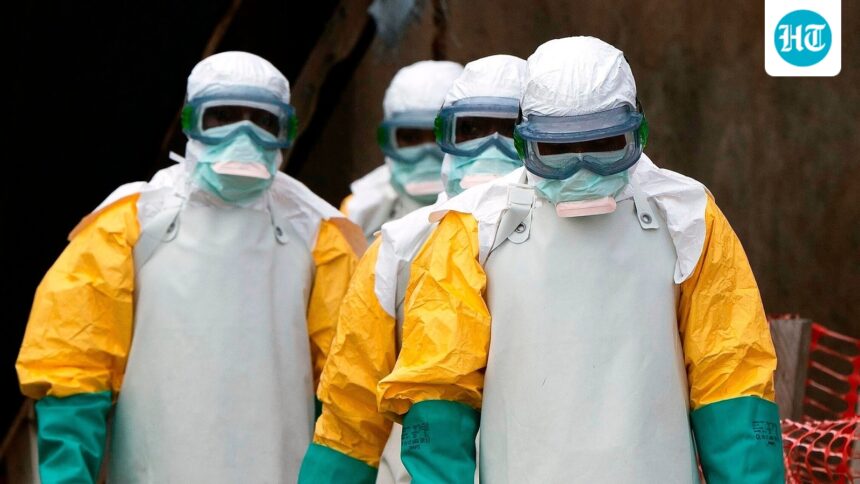
A Sudanese national suffering from fever has been admitted to Gandhi Government Hospital here, bringing the total number of Ebola-related cases to two, officials said on Friday.

They added that the Sudanese citizen, a student in his twenties, was referred to Gandhi Hospital on Thursday evening from a private health facility.
The student’s condition improved and he did not have a fever on Friday morning. He advised his companion to remain in isolation at home.
Read also: India issues new advice amid Ebola scare: ‘Isolate yourself if you travel through the affected country’
Earlier, another 35-year-old Sudanese national, who arrived at Rajiv Gandhi International Airport on Thursday, was transferred to the isolation ward of Gandhi Hospital for further tests after he was found to be suffering from fever during thermal screening at the airport.
The 35-year-old, who came to Hyderabad for a knee surgery, did not have fever as of Friday morning and did not show any symptoms, officials said.
Test reports for both persons are awaited.
Also read: Ebola scare: Surveillance and preparations intensified at Pune airport
The Telangana government has set up a special 10-bed isolation ward at Gandhi Hospital for Ebola cases.
Last month, Hyderabad Airport issued an advisory stating that it was implementing enhanced public health preparedness measures as per the directives of the Directorate General of Civil Aviation (DGCA) and the Ministry of Health and Family Welfare (MoHFW) in connection with the ongoing Ebola virus disease outbreak reported in some countries.
This warning applies to passengers arriving from or transiting through affected areas, including Uganda, the Democratic Republic of the Congo and neighboring high-risk areas. It said passengers arriving from or transiting through these countries may be asked to complete a self-declaration form (SDF) before disembarking the plane.
Read also: Three returnees from African countries affected by Ebola virus have been placed in home isolation in Durg, Chhattisgarh
According to the World Health Organization, Ebola is a serious and often fatal disease that affects humans and other primates.
The virus is transmitted to humans from infected wild animals – such as fruit bats, porcupines, and non-human primates – and then spreads through direct contact with the blood, secretions, organs, or other bodily fluids of infected individuals, as well as through contaminated surfaces and materials such as bedding and clothing.