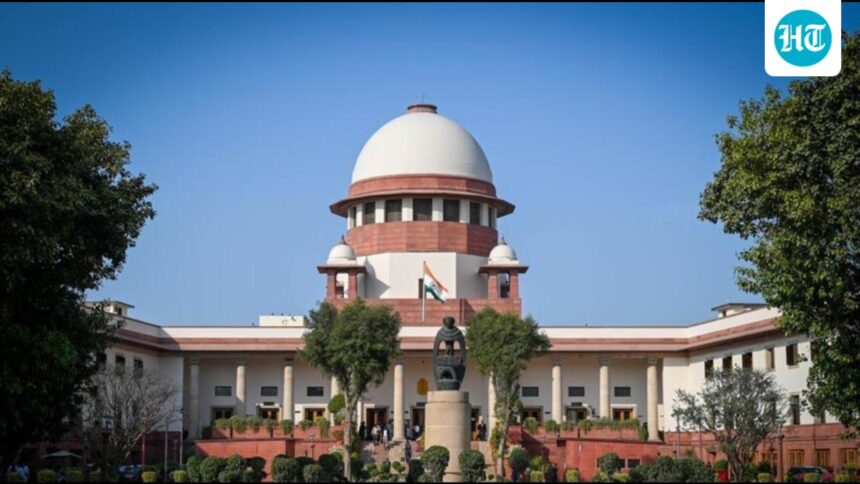
The Supreme Court on Saturday refused to entertain the petition filed by the All India Trinamool Congress (AITC) challenging the Election Commission of India’s directions requiring at least one central government official to be appointed as superintendent of each counting table for the West Bengal Assembly results scheduled for Monday.

A special bench of Justices BS Narasimha and Joymalia Bagchi dismissed the concerns of bias expressed by the AITC and said that during elections, all officers are under the control of the poll panel and the panel cannot be blamed for acting contrary to any regulation in selecting officers from the state or central group.
The April 13 ECI order under appeal states that “at least one among the counting supervisor and counting assistant at each counting table shall be an employee of the central government/central PSU.” The same also requires one official to be at the counting table from the state government, which the commission does not do, noted senior advocate Kapil Sibal, who appeared for the AITC panel along with senior advocate Meenakshi Arora.
The Election Commission of India, represented by senior advocate Dhamma Sisadri Naidu, denied the charge and dismissed the petitioner’s argument as “totally misplaced”. “This is the standard we follow even before they say so,” he said, adding that as part of the “randomisation”, a “counting supervisor” and a “counting assistant” are selected, and care is taken to ensure that if one is from the central government, the other is a state government official. He further clarified that the returning officer, who has “comprehensive” authority over the entire counting process, is necessarily an official from the state government department.
“We are not coming from where you get this proportional representation. All officers discharging their duties are under the control of the IEC. It does not matter whether they are from the central government or the state government. It is open to them to choose from the pool of central or state officials. When that choice is open, we cannot hold that the IEC is acting in contravention of the regulations,” the IEC said.
“I have no problem if they implement this circular. My problem is that the junior observer at each counting table is already an employee of the central government. This circular stipulates that at least one of the counting supervisors must be from the central government or the counting support unit. All we want is for there to be a candidate for the state government. Our instructions are that this will not be implemented,” Sibal said.
“You now want to comply with the circular which you have challenged,” the court asked Sibal.
The court disposed of the petition by recording the Election Commission of India’s assertion, saying: “There is no need for further orders except reiterating the statement of senior advocate Dhamma Sisadri Naidu that the circular issued on April 13 will be implemented in true letter and spirit.”
The AITC approached the Supreme Court after the Calcutta High Court dismissed its petition on April 30. Filing an urgent appeal on Friday, the AITC through advocate Sanchit Garga questioned the timing of the order and the fact that it was not disclosed to them until April 29.
“Why don’t they disclose the circular to us from April 13. We were not informed earlier about this. By their circular, they are assuming that there will be some irregularities in every stall,” Sibal told the court.
The bench replied: “As far as you are concerned, there is no room for consultation with political parties. Your counting agents are there, your election agents are there, and at every table there is a counting supervisor, an assistant counting officer, and a junior observer. We fall into a fallacy when we assume that central government employees will belong to a certain category.”
Sibal then told the court that CCTV footage of the counting process should be preserved. He added, “They destroy it after 45 days. Why can’t it be preserved after this period?”
Naidu informed the court that as a general rule, CCTV recordings are not kept for more than 45 days. He added that if an election petition is filed, it will be preserved.
The Supreme Court, in its April 30 order, had dismissed bias concerns as “impossible to believe” and asked the party to challenge them in an election petition after the results were announced. The petition questioned the decision of the Supreme Court, which it said made an error in refusing to consider the matter. Further, the Supreme Court held that the Election Commission of India has the power to appoint counting officers from the central or state government, which the court cannot question.