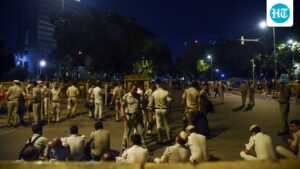
A tough new bill against leakage of exam papers aims to impose tougher penalties, increase the minimum prison sentence and the amount of fines, and promises speedy trials by establishing fast-track courts tasked with concluding trials within three months of the filing of an indictment.
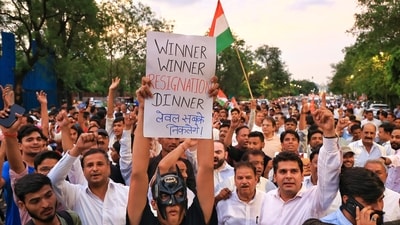
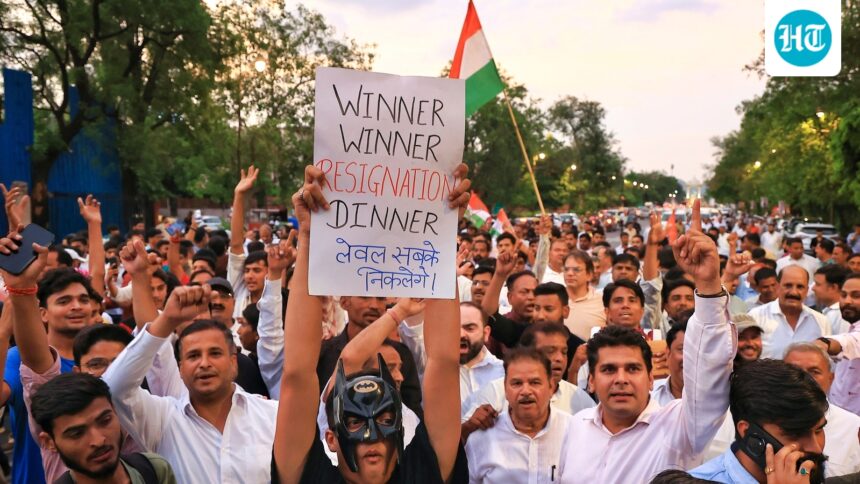
Through the Public Examinations Reform (Prevention of Unfair Means) Act, 2024, the government will on Monday bring forward a series of amendments promised by Prime Minister Narendra Modi in the wake of growing protests by students. The draft law allows for the formation of a special working team, a time-bound investigation, and daily procedures during the trial.
“In recent years, there have been some incidents of leakage of question papers and malpractices in examinations conducted by public examination authorities, which tend to affect the transparency and fairness of the public examination system. Hence, in order to further enhance fairness, enhance the credibility of the public examination system, facilitate speedy prosecution and ensure time-bound investigations into crimes under the said law, the statement of objectives of the said bill, a copy of which has been obtained by HT, said: Consider.”
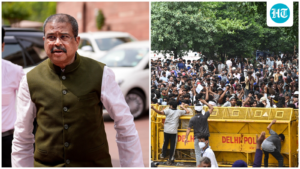
Read also | Fear of losing Generation Z, BJP poll calculations forced Dharmendra Pradhan’s resignation
Under the proposed law, anyone who resorts to “unjust means and crimes” will be punished with imprisonment for a period of not less than “five years, but which may extend to ten years and a fine of up to fifty thousand rupees.” Likewise, the service provider can be punished with a fine $Rs 5 crore and the pro-rata cost of the examination will also be recovered from the service provider, which will be barred from bearing any liability for the public examination for eight years.
In the current draft law, the prison sentence for unfair means and crimes was three to five years $10 thousand fine. Likewise, the fine for service providers was Rs 1 lakh with a ban of four years.
The proposed legislation increased the minimum prison sentence from three years to five years, and the fine to $5 Crores of $2 Crores for any director, senior management or responsible persons of the service providing company who are found guilty during the investigation.
Read also | Pralhad Joshi gets the post of Education Ministry with Dharmendra Pradhan’s resignation accepted
For organized crime resulting in paper leakage, the person or group of persons shall be punished with imprisonment for a period not less than seven years, which may extend to 10 years and a fine of $10 Crores.
Union Minister for Personnel and Training Jitendra Singh, who is also the government’s interlocutor with the student protesters along with Union Health Minister JP Nadda, is scheduled to introduce the bill in Lok Sabha on Monday.
The proposed bill inserts two new sections – 12A and 12B – for rapid investigation and trials. The current bill provides for investigation by federal agencies. The new draft law allows the government to form a special working group for the same purpose. The new sections stipulate that a central investigating agency or special investigation team must complete the investigation “within a period of two months from the date on which it is indicated by the central government.”
Read also | ‘Not a matter of personal prestige’: Dharmendra Pradhan resigns over paper leaks
The Bill makes specific provisions for speedy courts, “For the purposes of providing speedy trial on a day-to-day basis, every State Government and administration of a Union Territory shall, in consultation with the Chief Justice of the High Court concerned, by notification, appoint a Court of Session, to be a Special Speedy Court for the trial of offenses under this Act.”
It also imposes strict trial timelines.
“In every trial for an offense under this Act, the proceedings shall continue on a daily basis, until all witnesses present have been examined, unless the Special Express Court, for reasons to be recorded in writing, finds it necessary to postpone them beyond the next day: Provided that such trial shall be completed within a period of three months from the date of filing of the indictment,” the provisions of the new legislation state.
“An appeal shall be from any judgment, sentence or order, and not an interlocutory order, issued by a special express court, to the Supreme Court,” the bill said.
“Every appeal under subsection (1) shall be heard by a two-judge bench of the High Court and shall, so far as practicable, be decided within a period of three months from the date on which the appeal is accepted,” he added.
“Except as aforesaid, no appeal or review shall be made to any court from any judgment, judgment or order including an interlocutory order of a Special Express Court” and “An appeal shall be made to the High Court against an order of a Special Express Court granting or denying bail.”
The draft law also tightened appeal provisions. “Every appeal under this section shall be entertained within a period of thirty days from the date of the judgment, sentence or order appealed from: Provided that the Supreme Court may entertain the appeal after the expiration of the said period of thirty days if it is satisfied that the appellant has sufficient cause for not preferring the appeal within the period of thirty days: Provided further that no appeal shall be entertained after the expiration of the said period of ninety days.”