The Center’s new draft law against leakage of exam papers, which will be introduced on Monday, aims to tighten penalties, increase minimum prison sentences, higher fines, and speedy trials by establishing fast-track courts that complete the trial within three months of filing an indictment.
Through the Public Examinations Reform (Prevention of Unfair Means) Act, 2024, the government on Monday will introduce a series of amendments in the wake of growing protests in Delhi and across the country by students and the Sarsour Janta Party. It allows for the formation of a special task force, a time-bound investigation and daily procedures during the trial.
Under the proposed law, anyone who resorts to “unjust means and crimes” will be punished with imprisonment for a period of not less than “five years, but which may extend to ten years and a fine of up to fifty thousand rupees.”
Likewise, the service provider can be punished with a fine $5 crores and proportionate cost of examination shall also be recovered from this service provider and he shall also be barred from being entrusted with any responsibility for conducting any public examination for a period of eight years.
In the current draft law, the prison sentence for unfair means and crimes was three to five years $10 thousand fine. Likewise, the fine for service providers was Rs 1 lakh with a ban of four years.
The proposed legislation raises the minimum prison sentence from three years to five years, and the fine to $5 Crores of $2 Crores for any director, senior management or persons in charge of the service providing company who are found guilty during the investigation.
For organized crime resulting from paper leaks, a person or group of persons shall be punished with imprisonment for a period not less than seven years and which may extend to ten years and must pay a fine of $10 Crores.
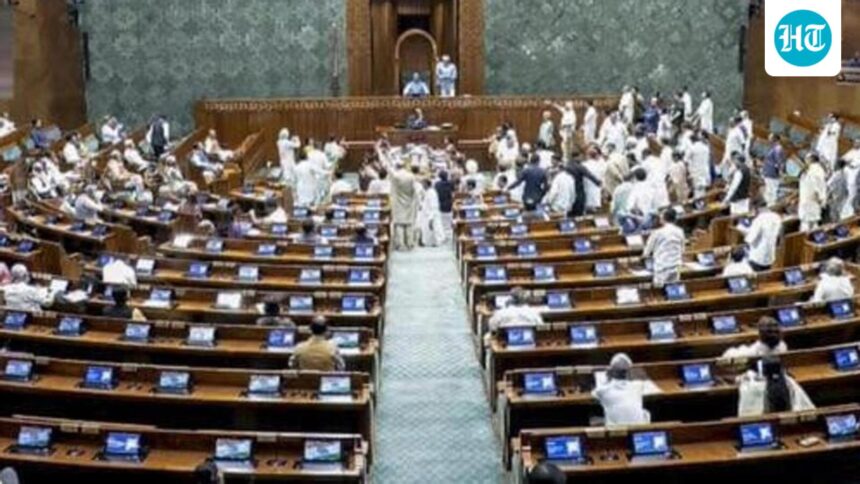
DoPT Minister Jitendra Singh, who is also the government interlocutor along with Union Health Minister JP Nadda, is scheduled to introduce the bill in the Lok Sabha on Monday.
The statement of objectives of the bill read: “In recent years, there have been some incidents of leakage of question papers and malpractices in examinations conducted by public examination authorities, which tend to affect the transparency and fairness of the public examination system. Hence, in order to further enhance justice, enhance the credibility of the public examination system, facilitate speedy prosecution and ensure time-bound investigations into the crimes stipulated in the said law, it is necessary to make amendments to the said law…”
The proposed bill includes two new sections – 12A and 12B – for investigation and speedy trial. The current bill provides for investigation by federal agencies. The new draft law allows the government to form a special task force for the same purpose. The new sections add that the central investigating agency, or special investigation team, must complete the investigation “within a period of two months from the date on which it is indicated by the central government.”
The Bill makes specific provisions for speedy courts, “For the purposes of providing speedy trial on a day-to-day basis, every State Government and the administration of a Union Territory shall, in consultation with the Chief Justice of the High Court concerned, by notification, appoint a Court of Session, to be a special speedy court for the trial of offenses under this Act.”
It also imposes strict trial timelines. “In every trial for an offense under this Act, the proceedings shall continue on a daily basis, until all witnesses present have been examined, unless the Special Fast Track Court, for reasons to be recorded in writing, finds that adjournment beyond the next day is necessary: Provided that such trial shall be completed within a period of three months from the date on which the indictment is filed,” the new provisions of the legislation state.
In an attempt to reduce judicial delay, the Bill provides that an appeal must be based on any judgment, judgment or order, and not an interlocutory order, from the Special Fast Track Court to the High Court and “every appeal under subsection (1) must be heard by a two-judge bench of the High Court and must, so far as practicable, be disposed of within a period of three months from the date on which the appeal is admitted”.
“Except as stated above, no appeal or review shall be made to any court from any judgment, sentence or order including an interlocutory order of the Special Fast Track Court” and “An appeal shall be made to the High Court against an order of the Special Fast Track Court granting or denying bail.”
The draft law also tightens appeal provisions. “Every appeal under this section shall be preferred within a period of thirty days from the date of the judgment, sentence or order appealed from: Provided, That the Supreme Court may entertain an appeal after the expiration of the said period of thirty days if it is satisfied that the appellant has sufficient cause for not preferring the appeal within the period of thirty days: Provided further, that no appeal shall be entertained after the expiration of the period of ninety days.”
However, it is not clear whether the government will succeed in passing the legislation, as the Opposition, which is bent on ousting Education Minister Dharmendra Pradhan, has weathered the first week of the monsoon period. Several opposition lawmakers told HT that unless Pradhan resigns, they do not want to give the government any scope to discuss or discuss issues related to students.