The Indian economy faces uncertain prospects in the near term, as the war in West Asia and the blockade of the Strait of Hormuz increase the risks of inflation in the medium term, the monthly economic review of the Indian Ministry of Finance said on Saturday.

The Indian Ministry of Finance’s monthly economic review said on Saturday that the Indian economy faces uncertain prospects in the near term, as the war in West Asia and the blockade of the Strait of Hormuz increase risks to inflation and the commodity trade balance.
The review noted a “decline” in net foreign direct investment, which has remained negative for five consecutive months. Total FDI inflows rose to $79.3 billion during the April-January period of FY26, up from $69.2 billion in the same period of FY25. “However, this momentum in total inflows did not translate into a rise in net FDI, which remained low at $1.7 billion during the period,” he added. The weak net position reflects a continued rise in repatriations of foreign investors ($49.5 billion) and increased outward investment by Indian companies ($28.1 billion).
Geopolitical uncertainty also dampened global risk appetite, pushing portfolio flows into negative territory in March 2026. About $12.5 billion remained in the portfolio side in March alone. However, foreign exchange reserves remain comfortable, providing import cover for more than 11 months.
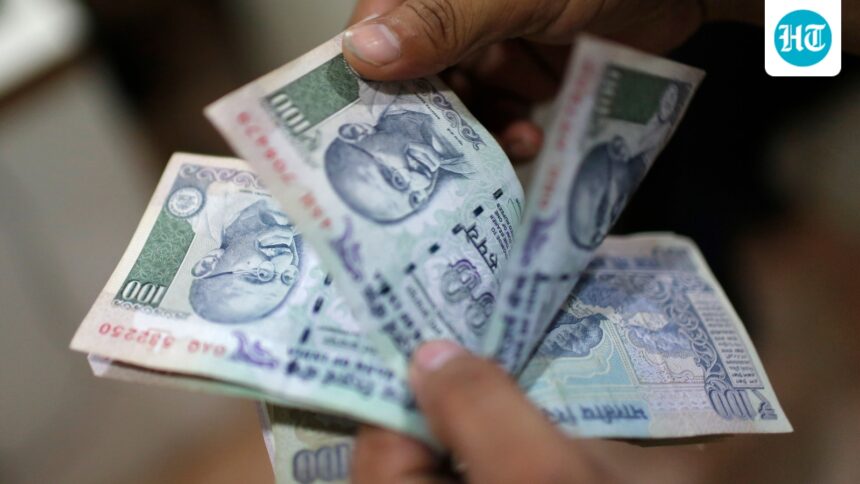
Aside from portfolio outflows, rising global prices and logistics costs affected the rupee, which depreciated to $93.88 per US dollar as of March 24, reflecting trade-related pressures and increased risk aversion in global markets.
Geopolitical developments have brought a complex and multi-layered set of risks for India, given its position as a major energy importer and enjoying strong trade, investment and remittance linkages with the West Asia region.
“While India’s relatively strong macroeconomic fundamentals and sustained policy efforts provide resilience, the evolving situation requires close monitoring and calibrated policy responses,” the review said. The near-term outlook remains uncertain, with external shocks posing downside risks to growth through higher input costs and supply constraints, even though domestic demand may help mitigate the impact.
Government interventions in energy diversification, agricultural preparedness, inflation management, external sector strength, and broader policy measures were cited as supporting the economy’s ability to absorb near-term disruptions, with continued monitoring needed as conditions evolve.
The report added, “The recent oil price shock represents an upward risk to the inflation path in the medium term, as higher energy costs are gradually transmitted to domestic prices, especially in fuel-intensive sectors.” Supply disruptions have exacerbated cost pressures, while selective price corrections for perishable goods – amid export-related disruptions – point to a domestic imbalance between supply and demand.
The continued rise in oil and gas prices could create broader second-round effects as input costs pass through sectors. The government remains vigilant, with measures underway to ensure adequate domestic energy availability and contain inflationary pressures.
The rise in crude oil prices also poses risks to the merchandise trade balance. The outlook for remittances is under similar pressure: GCC economies accounted for about 38% of India’s total remittances in FY24, and host nearly half of Indian migrants worldwide.
“In an increasingly uncertain global environment, the resilience of the Indian economy will depend on strengthening domestic fundamentals. This will require a sustained focus on structural reforms to enhance competitiveness, achieve efficiency gains, and drive investment,” the report added.