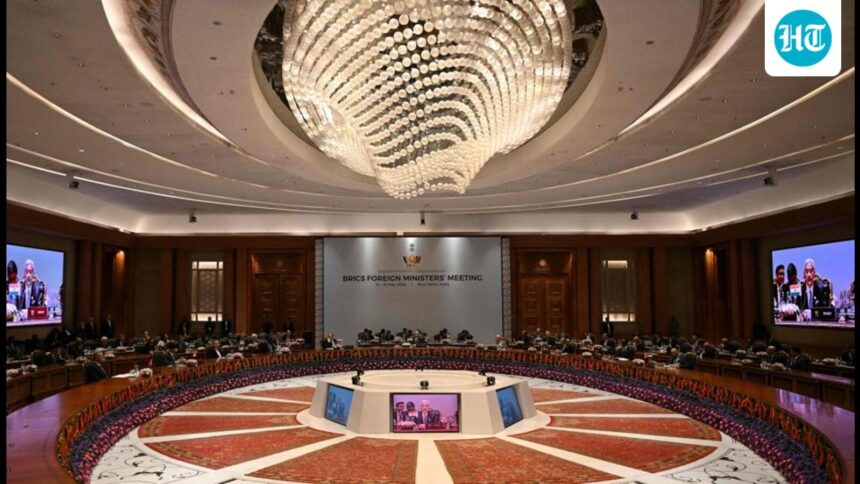
The first day of the BRICS foreign ministers’ meeting in New Delhi was marked by sharp exchanges between the ministers of Iran and the United Arab Emirates over the conflict in West Asia, raising questions about the bloc’s ability to achieve consensus on a joint statement.

Differences between Iran and the United Arab Emirates over the conflict came to the fore even before representatives of the 10 BRICS member states — including Iranian Foreign Minister Seyed Abbas Araqchi and UAE Deputy Foreign Minister Khalifa Shaheen Al Marar — gathered for the two-day meeting in New Delhi on Thursday.
The national statement issued by Araqchi during the first session of the meeting – which the Iranian Ministry of Foreign Affairs released to the media – urged BRICS member states and members of the international community to condemn the “illegal aggression against Iran” by the United States and Israel, but did not directly refer to the UAE in the context of the conflict in West Asia.
The problems began when the Emirati minister specifically referred to Iran in his national statement and sought to condemn Iranian actions, according to people familiar with the deliberations during the session, which was held behind closed doors. The sources said that after representatives of all BRICS member states made their statements, Araqchi asked for permission from the president to respond and raise the issue of the UAE allowing its territory to be used by the United States to carry out strikes against Iran.
The sources added that this was followed by a response from the Emirati side, before South African Foreign Minister Ronald Lamola intervened to say that the war in West Asia does not benefit anyone and must be stopped.
Araqchi responded a second time, claiming that the UAE violated international law by allowing the United States to use its military bases to strike Iran. He told attendees that the UAE was “directly involved in the aggression against my country” by providing military bases, airspace and intelligence facilities to the United States and Israel, according to Iranian state media.
“yesterday [Wednesday] It was revealed that UAE fighter jets participated in attacks against us, and even took direct action against us. The Iranian Islamic Republic News Agency quoted him as saying: “Therefore, the UAE is an active partner in this aggression.”
Araqchi said that he did not mention the UAE in his national statement “in order to preserve unity,” and added that the UAE did not condemn the “brutal attack” on a school in the Iranian city of Minab on the first day of the conflict, which led to the killing of about 170 students. Araqchi stressed that Iran did not attack the UAE and “only targeted American military bases” located on UAE territory.
The sources added that this was followed by another response from the Emirati minister, who repeated his country’s call to condemn Iran’s attacks on energy infrastructure and other facilities. The sources said that Russian Foreign Minister Sergei Lavrov also intervened to blame the United States and Israel for the situation in West Asia and stress that dialogue and diplomacy are the only way to find a solution.
Competing calls by Iran and the United Arab Emirates to condemn each other’s actions have been a key issue that has disrupted consensus on joint statements at previous BRICS meetings, and the people said it remains to be seen whether all member states will agree to a joint statement by the conclusion of the foreign ministers’ meeting on Friday.
“However, there was an understanding that the BRICS countries are not a platform for mediation in the West Asian conflict,” said one of the people familiar with the deliberations.
Since BRICS works by consensus, the Indian side was keen to guide the deliberations towards a common understanding on the conflict in West Asia to facilitate the issuance of a joint statement. This was evident in the welcoming remarks made by External Affairs Minister S Jaishankar at the meeting, when he spoke about the “integration of new members” into the caucus. Iran and the United Arab Emirates joined during the first BRICS expansion in 2024.
“It is essential for the smooth progress of BRICS that subsequent members fully appreciate and subscribe to the BRICS consensus on various important issues,” Jaishankar said.