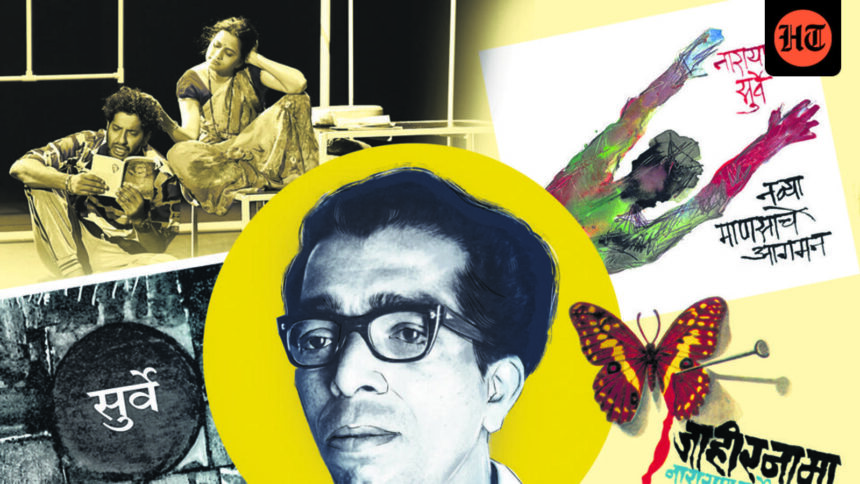
MUMBAI: The true measure of a poet’s legacy is not to be found under lock and key of government archives or endorsements of state awards, but in the improbable moments of human transformation she inspires long after she is gone. In a quiet, shuttered house in Neral (Navi Mumbai), the literary powerhouse of the late Padma Shri awardee, Narayan Surf, played for 100 minutes in Datta Patel’s latest play ‘Tambo’ recently.

The two-act play directed by Sachin Shinde is based on a story that is part of modern Maharashtrian folklore. Narration: A thief (in Patel’s play, a husband and wife working together) breaks into the home of a poet laureate while the family is away. After finding no cash or jewellery, the two thieves, over the course of three nights, stole an LED TV, brass and copper utensils, cooking oil and food grains. It is a low-risk crime resulting from poverty.
However, the course of the robbery changes when the thief stops, in the middle of the crime. On the wall, amidst many prestigious awards, are pictures of Kusumajraj, Mahatma Gandhi, Babasaheb Ambedkar and Karl Marx. When Govardhan (the thief) realizes that he is robbing the house of a man who has dedicated his entire life to writing about struggles, marginalized people and Kumgaris, it comes as a shock. The thief’s conscience was “shaken.” The consequences are immediate and absolute: The thief returns every item, including the LED TV, and leaves a note that reads: “I didn’t know this house belonged to Narayan Surve. If I had known, I would never have stolen from here. Please forgive me. I will return everything I took. I took the TV too, but I returned it. Sorry.”
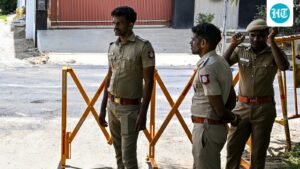
This act of repentance is a testimony to the moral authority of Narayan Surve, and provides evidence of the importance of the Surve Master today. As the two police officers investigate the case through a clever dramatic device of CCTV camera footage that allows them to rewind the stage’s events during the three nights of the heist, what emerges are questions about how the Surve Master’s work still has the power to awaken humanity, even within a thief forced by his reality to live outside the law.
“The world described in Surf’s poetry and our world in 2026 seem to be the same,” says playwright Datta Patel. In the poem “Eka Navya Sangharshaat” (A New Struggle), Surve Master says, “This is my country too / With the filthy people in it / If this filth gets into our house / What should we do / When they float like prisoners of war / Like a mob on the bridge / Shouldn’t we put luminous flowers in their hands / What else should we do?”
“‘Tambo’ was written because those luminous flowers that Surf Master talks about were found in the hands of a petty thief. And today through the play, those luminous flowers can be found in the hands of faceless members of the audience. That is the power of Narayan Surf’s words,” says Patel.
“Tambo” is an elegant and modern summary of Narayan Surve’s life’s work, proving that literature grounded in raw truth is ultimately “powerful,” capable of causing “the downfall of tyrants and the downfall of regimes,” or perhaps simply unsettling a petty thief.
Birth on the trail: The people’s poet is born
To understand the poetic force that astonished the thief (and his wife) and drove him to repentance, one must look not to the halls of literary conferences, though Surf was a Janasthan laureate and served as president of the Akhil Bharatiya Marathi Sahitya Sammelan, but to the streets, mill gates and footpaths where his life began.
Narayan Gangaram Surve’s origins were so humble that it was a miracle. Exactly one hundred years ago, a worker named Gangaram Surf was returning home from his factory shift early in the morning when he found an abandoned newborn baby crying on a footpath in Mumbai. Although he had two children and lived in a small hut, Gangaram adopted him. This abandoned child grew up to become Narayan Surf.
Surve never attended a regular school. He learned his alphabet by reading signs and posters plastered around the city. His education took place not in classrooms but in the city’s gullies and gutters. Poverty was his first teacher and the defining source of his consciousness. When he was three years old, his foster father Gangaram went out to the Konkan region, leaving Narayan with ten rupees. He survived by using wall posters as blankets. Since he was young, he was a worker, working in hotels, being a porter and doing odd jobs. His existence, like the workers he later championed, was centered on survival which was framed as a struggle for the “four breads.”
Surf’s real university, ‘Maajhe Vidyapeeth’, was Mumbai. In 1943, one year after the Quit India movement, he was jobless, homeless, and without a family. He joined Kohinoor Mills No. 3 as a Roller. Here he met Vaman Samant, a writer and union activist, and his relationship with the workers became “organic because I was a worker.” He joined the Communist Party, collecting union dues for the GKU. The party provided him with food and shelter, and he became politically informed by reading publications such as Lokyudh. He was known as Surve Master as a teacher at Naigaon Number One School.
Cerf’s identity was seamlessly integrated: he was a writer and activist whose philosophy was influenced by Marxist ideology, trade union movements, and literary texts such as Das Kapital. His poetry became an integral part of the communist and trade union movements in Mumbai and Maharashtra, turning him into a fixture at meetings and rallies. Lokshehr Sambhaji Bhagat says: “Surf rejected high and forceful theory, asserting that true proletarian literature cannot be created without the lived experience of struggle. In modern times, most poetry has retreated into the private sphere, turning its back on the political sphere. Surf Master’s poems are a mirror of his private life and the collective spirit of the working class.”
Lokshahr Bhagat adds: “Surf Master’s poems are dedicated to class struggle and the fundamental value of human labour. But what makes him relevant even today is that he is a ‘here and now’ poet. Surf’s cultural politics are poignant and he depicts harsh realities without romanticizing them and indulging in nostalgia.”
Behcet hints at seeing Surf. He says that the Surve Master was long ago demanding social justice for all and spoke on behalf of enslaved and unemployed workers, but the Surve Master was keenly aware of the class struggle of the 1990s and the emergence of a new world order. His political poems are powerful statements that use sharp imagery to criticize corporations that exploit India, solidifying his role as a voice for the oppressed.
“The survey master knew that yesterday’s working-class hero is today’s tramp,” says Bhagat.
Today’s slogan: “Thudasa Gunha Karnaar Ahe”
Why Narayan Surve is relevant in 2026 Beyond the statistic we celebrate the centenary of the Poet Laureate. Earlier this month, at the Sane Guruji Rashtriya Smarak Trust, there was a recitation of Surve Master’s poems and essays (as well as songs and lavanis) by the most important figures of the Marathi literary scene. Journalist and writer Yuvraj Mohite, actor and poet Kishore Kadam, writer Neerja, actor-author Akshay Shimpi, writer and poet Pragya Daya Pawar, director Deepak Rajadhyaksha, Chinmayi Sumit, and others.
As always, there is a literary precedence to things. Nothing is ever born from nothing. So, let’s rewind to a few months ago, when a film on Nnamdeo Dassal was at the center of controversy. A member of the oversight board asked the question “Who is Namdeo Dhasal?” This member suggested “cuts in the movie.” This created a stir. Literary protests were organized across the state. As part of this protest, a diverse group of actors, activists, authors and journalists recited Dassal’s poems. In an ironic twist, the title of the program was Who is Namdeo Dassal? The presentations were made all over Maharashtra.
“Similar to Who Namdeo Dhasal?, the same group of artistes organized a program to pay tribute to Narayan Surve,” says Akshay Shimpi. The show pays tribute to popular classics like ‘Money Order’, ‘Girnichi Lavani’, ‘Dongari Shet’ and ‘Tumchach Naav Liva’. What emerges through the renditions is Surve Master’s rise from the streets to literary fame in the mid-1950s. His distinctive voice, the voice of raw truth and zero embellishment, is what distinguishes him from the poets who came before him.
“Both Dasalle and Survi are important poets,” says Shimpi. “One poet depicted rebellion and the other depicted the world of workers. These two poets write about Mumbai, and above all… Yes, these two poets question power structures through rigorous thought.
The little things that make up poetry
There is a small library outside the hall. It contains Survi’s first poetry collection, ‘Aisa Ga Mi Brahma’, which won the State Award in 1963. There are also later collections like ‘Maje Vidyapeeth’ and ‘Sanad’ which changed Marathi literature, replacing traditional romantic themes with the ‘rough edges’ of the misbehaving city. But what was really exciting was seeing a gang of young women buying copies of Cerf’s poems. They pooled their meager resources, until they were finally able to afford a total of seven Master Surve books.
When I asked someone why they liked Cerf’s poems, a young girl in the group told me: Cerf chose poetry over other literary forms such as plays or short stories. “He is an original poet.” TRUE. Cerf felt that poetry was a powerful medium that could achieve a profound and lasting impact with the fewest words. The genius of Surve is its ability to say the most socially conscious propaganda thing in a sublime way.
Surve dealt with love and romance as was evident that evening at Sane Guruji Rashtriya Smarak Trust. He can be as sentimental as Alexander Pushkin, and as figurative as Kalidasa. But for Cerf, “love and human relationships are intertwined with the cultural and social environment, rather than existing in isolation.”
This commitment to earthly reality made his poetry, in the eyes of some traditionalists, a “threat.” Cerf described his revolutionary tone as a force that cuts through his words like a sword. My favorite Surf poem (a war cry for our generation, translated) is: I am a worker, I am a fiery sword/ The question of daily bread is a daily question/ Sometimes outside the gates, sometimes within the gates/ I am a worker, I am a fiery sword/ Oh Saraswats! I’m about to commit a petty crime.
Poet Neerja says this should be the actual motto of our times. The importance of committing a “petty crime” against established and stagnant norms to force a hypnotized society to look at the harsh realities of life. As actors and poets read Cerf’s poems, one thing is clear: his words are not a passive text; It is “a brewing storm aimed at awakening the masses.”
My first meeting with the poet
Twenty-five years ago, I attended a literary conference at Mumbai University. I introduced myself. “I’m Narayan,” said the unimpressive-looking old man to my left. I had a ticket for Malwani’s play ‘Vastraharan’. Notice that mr. He was proficient in malwani. He shared anecdotes about Lok-kala in Konkan and how today’s modern theater needs to borrow from Dashavtar and create a new kind of working class play.
And then we sat through three sessions in which we laughed at all the pomp and pageantry. Then a university teacher from Nanded spoke of how “we are fortunate to have one of Maharashtra’s greatest living poets among us, and of his energy in reading poetry directly to large audiences. How this poet’s words were not limited to the page; they were songs of the people, heard on the radio in Russia and sung by thousands of activists in India.”
The teacher from Nanded recalled how she was present at this historic moment during the women farmers’ conference where nearly 150,000 women sang Surf’s song “Dungari Shet Majha” in one unified voice.
And then the poet rose. The field was an unimpressive-looking gentleman to my left, Narayan.
He said, “I am not a singer like Qamar Sheikh, so do not expect me to sing the song.” I’m just a poet.
applause.
After a few moments, he was asked about his literary style. Narayan Surf agreed that his poetry dealt with bold, heavy and realistic topics such as child labor and the plight of the working class. But he stressed that his art carries a social responsibility and a connection with people. “It’s really quite simple. If you know people’s problems, your hair will know what to say.”
The final weed
When Surve Master died in August 2010, I was at his funeral.
At the Bhupesh Gupta Bhawan, the drama was complete, with chief ministers, former chief ministers and ministers from the Vidhan Parishad. Basically everyone who ignored him when he was alive. The bureaucrats who deprived him of a small house in Nashik. Young clerks in their small departments who believed that paperwork was more important than the words on paper. Everyone prostrates.
The funeral procession headed from Bhupesh Gupta Bhawan to the Electric Crematorium in Dadar. It was like Thomas Paine’s funeral. The loyal few in attendance. An ambulance in the foreground. Comrades chant slogans. Local passersby, showing their respect from balconies and the best buses. The man walking next to me was jotting down a shopping list dictated by his wife on the phone. A little boy was lying to his mother that he was in college.
Finally, the police paid ceremonial salutes to Padma Shri Narayan Surf and draped his body in the national flag. I was half expecting Surve Master to get up and walk into the Arabian Sea.
He was born an orphan. I think he’d rather be disposed of in death too.
Bhakricha chandra shodhnyaatach jindagi barbaad (I wasted a lifetime searching for Bhakri moon). You understand why Narayan Surve is important. This is what the thief repeats in the play “Tambo” by Datta Patel.
As actor and translator Omkar Govardhan, who essays the role of a thief in Tambo, says, “We have forgotten how to hope. We feel that it serves no purpose. We feel doomed to failure. We feel that any collective movement is useless because our voice is too small or because the powerful people in power will crush us. We feel that there can be no change in any social structures or any scope of salvation in any human being. In this sometimes bleakness, Narayan Surf makes us see things we don’t want to Seeing it, makes us believe and hope.
(Ramu Ramanathan is a playwright, poet and journalist).