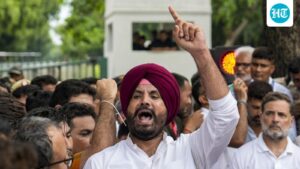
New Delhi: The government on Wednesday did not introduce the Foreign Contribution (Regulation) Amendment Bill, 2026 in the Lok Sabha following opposition protests and controversy in Kerala linked to the elections.

The bill sparked sharp reactions from opposition leaders, especially lawmakers in Kerala, where there were fears that Christian groups would be targeted under the new law. A controversial provision stipulates that the government can appoint a “designated authority” to seize, manage, or sell assets created with foreign funds by an NGO whose license under the FCRA has been revoked, suspended, or simply not renewed. (examines)
The bill was listed for approval on Wednesday. Amid the protests, Parliamentary Affairs Minister Kiren Rijiju told Lok Sabha that he had informed senior Congress leaders on Tuesday that “we will not take up the bill”.
During the Question Hour, when the Opposition lodged its representations, Rijiju said: “The Congress and the Communist Party are misleading the people of Kerala about the FCRA, which is not true. Please do not mislead the people of Kerala for the sake of elections.”
“This is not a political issue. Many bills have been introduced, and we are taking them up depending on the situation and timing. Andhra Pradesh Bill [to declare Amaravati as its capital] “The matter was urgent, which is why it was taken up today,” he added, noting that the FCRA bill had not been shelved.
The draft law, which was submitted to Parliament on March 25, sparked controversy.
Kerala Chief Minister Pinarayi Vijayan on Wednesday tweeted, “The Union government’s move to go ahead with the FCRA Amendment Bill, 2026 is a direct assault on the functioning of civil society. By giving sweeping powers to seize assets on technicalities, it creates an instrument of arbitrary control against those who serve the poor. This will severely impact education and healthcare for minority and oppressed communities. Democratic and secular forces must come together to ensure the withdrawal of these draconian provisions that will lead to and stifle Social justice.”
Congress general secretary KC Venugopal had claimed in Kerala that “the blatantly unconstitutional law will destroy NGOs and community organisations, especially those run by minority communities”.
Defending the amendments, Dinesh Sharma, a BJP MP, rejected opposition charges that the bill targets minorities. He said: “The government does not differentiate between minorities and majorities as the opposition does. National security is the government’s highest priority.”
“If foreign funds received by NGOs are being used in protests against the government, or in spreading misinformation in the media and social media, or in promoting Naxalism, then it is certainly necessary for the government to impose restrictions in the interest of national security,” Sharma said.
Bharatiya Janata Party MP Ghulam Ali Khatana accused Congress of marginalizing minorities. He added: “They pushed minorities to the margins, and now they are trying to intimidate and intimidate them. They want to turn them into a vote bank.”
Congress MP Manickam Tagore claimed that the opposition’s unity forced the government to block the bill. “Because of the unity of the Congress party – all MPs from Kerala, Tamil Nadu, Andhra Pradesh and Telangana – we showed the strength of the opposition. The government came under pressure.”
Member of Parliament Manish Tiwari termed the amendments “unconstitutional”, and Samajwadi Party chief Akhilesh Yadav alleged on X Program that the government seeks to exercise unwanted control over NGOs and turn them into its “puppets”.
“In fact, this is the undemocratic, hyper-controlling and monopolistic mentality of BJP politics, which seeks to exercise unwanted control over NGOs, turn them into its puppets and, under this pretext, slowly eat up their assets,” Yadav said.