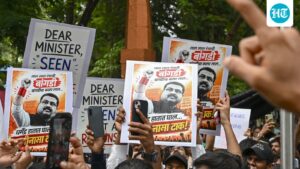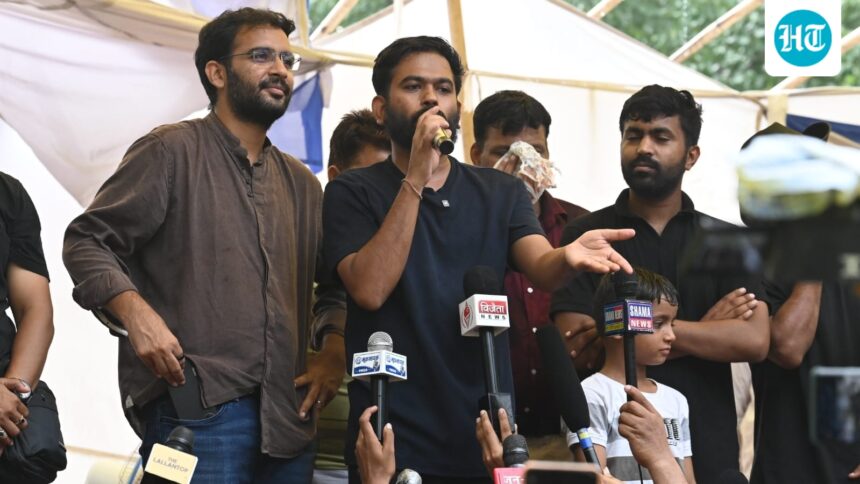
The government on Friday intensified efforts to break the impasse with protesting students, pushing the Cabinet with a tough bill to eliminate paper leaks, sack top officials of the National Testing Agency and move to hire specialists, but the talks failed to make headway as the agitators refused to back down from their demand for the resignation of Union Education Minister Dharmendra Pradhan.

Two representatives of the Cockroach Janata Party (CJP) – which is leading the protests in Jantar Mantar – met Union ministers JP Nadda and Jitendra Singh at Vithalbhai Patel’s residence for about two hours, the second meeting of the two sides this week. The CJP submitted a written note to the government, in which it said another meeting would be held on Saturday. The meeting is likely to be held at 3.30 pm at the Indian Constitution Club, APC members said.
“The meeting lasted for about two hours. They had three main demands and five reform proposals for exams. We told them that we will meet them again tomorrow afternoon and tell them about the discussion we had among the government,” Nadda said.
CJP spokesperson Ashutosh Ranka, who attended the talks along with another spokesperson Sourav Das, said they remained firm on the demand of Pradhan’s resignation.
Read also me ‘Government has sought time till tomorrow on Dharmendra Pradhan’s resignation demand’: CJP after second meeting
“The government has asked for time until tomorrow afternoon to respond to our request for Dharmendra Pradhan’s resignation. We hope that the government will dismiss him soon. The government has expressed its agreement in principle to the two compensation demands. [for families of NEET aspirants who died by suicide] “And withdraw the FIRs and legal cases related to the students,” he said.
“JP Nadda and Dr Jitendra Singh Ji have been informed of the growing anger and discontent among the public, which will not stop until Pradhan’s resignation,” he added.
The AKP memorandum also asked the security forces and the government to apologize for the violence that occurred on July 20, and to accept the demands as soon as possible. “If not, the movement will grow and spread across the country,” she added.
The developments came a day after a dramatic midnight video appeal by Prime Minister Narendra Modi, who promised a new law to tackle exam question paper leaks and fast-track courts to deal with those accused of the crime. Minutes later, activist Sonam Wangchuk broke his 26-day hunger strike in the presence of Nadda and Singh at Medanta Hospital in Gurugram. Wangchuk began fasting last month in support of the protesting students, before he was forcibly removed from Jantar Mantar last week. But the CJP made clear that although it welcomed Wangchuk’s end to his strike, the uproar would continue.
On Friday, Modi thanked the youth for responding to his video. “Thank you friends. I had the opportunity to meet with you late last night. I appreciate the way you responded to my video and your positive suggestions,” he said in a new video message.
Over the past 48 hours, the government has stepped up its efforts to end the impasse with the students, whose protest at Jantar Mantar continues to attract thousands of people streaming from every corner of the capital despite the closure of at least 15 metro stations over the past three days – one of the longest continuous closures of metro stations in the history of the Delhi Metro – and the suspension of internet services for four days, also the longest in the capital since the farmers’ protest in 2021. Delhi Police also briefly detained more than 150 people in south and southeast Delhi for carrying pepper spray or stickers, drawing the ire of agitators.
The Cabinet – headed by the Prime Minister in the Parliament Complex – on Friday approved a draft law requiring harsher penalties for those involved in leaking papers compared to the current law, people familiar with the developments said. In his video message, Modi promised that “stricter action” against paper leaks would be discussed in the Cabinet meeting. The bill will amend the Public Examinations (Prevention of Unfair Means) Act 2024, proposing a minimum five-year prison sentence for individuals involved in leaking papers and/or a fine. The new bill proposes a prison sentence of up to 10 years and a fine of up to £1,000 $Rs 10 crore in case of organized paper leak, said the above persons.
The current law includes prison sentences of between three and five years for individuals, imprisonment for a period of between five and ten years and a fine of not less than $1 crore to those involved in the organized crime of fraud and paper leakage.
The current law aims to reduce leaks and malpractices, as well as organized malpractices in employment examinations and admission tests.
NEET has certainly been embroiled in controversy in 2024 and 2026 – both of which come after the 2024 Act was passed.
Read also me Who is Naresh Pal Gangwar? Appointment of a new Minister of Education amid protest from the Justice and Development Party
The new bill is likely to be tabled in Parliament on Monday, Modi announced in his video message. But the opposition has indicated that it will not allow any discussion in Parliament until Pradhan resigns. As a result, the first week of the monsoon session was washed out.
In the evening, the government announced a massive cull at the National Testing Agency, which organizes NEET and other major exams like JEE Mains, CUET and UGC-NET. The NTA has sacked 47 officials – both permanent and contractual – and said legal and criminal action would be taken against some, with people aware of the development describing the action as part of an overhaul of the NTA, which has been mired in controversy over paper leaks. As part of its institutional reform, NTA has begun recruiting specialist leadership in cybersecurity, digital forensics, evaluation research and test center operations. It has announced four DG posts on three-year contracts and, for the first time, 16 posts for youth through UPSC’s PRATIBHA Setu portal in academic research, legal research and finance.
The agency said the recruitment is aimed at reducing dependence on contract and external staff, enhancing internal expertise and implementing the recommendations of the Radhakrishnan Committee. Further recruitment is planned across 10 job sectors and new training of experts and translators in this field. Since 2018, NTA has conducted more than 270 tests covering more than 66 million registered candidates.
The CJP first emerged out of a controversial statement made by Chief Justice of India, Surya Kant, earlier this year, had millions of followers on social media before launching a sit-in protest on June 6 demanding Pradhan’s resignation over repeated leaks of question papers. After days of listless crowds, the movement was galvanized by a hunger strike and the forced deportation of activist Sonam Wangchuk last week. Follow live updates here
Read also me CHP protest demands rare selfie message from Modi on paper leak: Here’s what the PM said
The crowds swelled over the weekend, and by Monday morning, queues of people — many of them students, first-time agitators and young professionals — braved persistent rain and police barricades to join what has become the largest street protests in Prime Minister Narendra Modi’s third term. More than 100 demonstrators and 129 security personnel were injured, and police filed 15 first information reports. One protester remains in the intensive care unit.
Tensions have flared intermittently at the protest site, most dramatically on Wednesday night when clashes between protesters and police left five instigators and five police officers injured. It showed scenes of the clashes that broke out In Sansad Marg – hundreds of people in the streets, stone-throwing and tear gas shelling, dozens of police and paramilitary personnel in riot gear beating with batons.