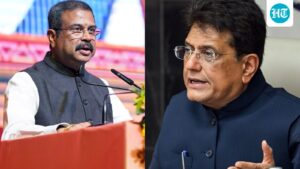
The Union Cabinet on Friday approved the Bharat Audiovik Vikas Yojana Rasayan (Bhavya Rasayan) scheme with a financial outlay of Rs. $3,030 crore to set up three dedicated chemical parks across the country.

The scheme, which was announced in the Union Budget for the financial year 2026-27, will have a total outlay of $3,030 Crore, incl $3000 crore for development of common infrastructure and basic facilities within the parks and $Rs 30 crore for administrative expenses.
The scheme will be implemented over a period of five years, from the fiscal year 2026-2027 to the fiscal year 2030-2031.
“The Center will provide a grant of up to $Rs 1,000 crore per park. This will be subject to a minimum contribution $500 crore by the state government concerned, according to an official statement.
“The Cabinet’s approval of the BHAVYA-Rasayan scheme represents an important step towards strengthening India’s chemical and petrochemical ecosystem,” Prime Minister Narendra Modi said at the X Conference.
In another decision, the Cabinet Committee on Economic Affairs, headed by Prime Minister Narendra Modi, on Friday approved the construction of the third and fourth railway lines on the Ballari-Guntakal section in Karnataka and Andhra Pradesh at a total cost of about $1,264 Crores.
The government said the project, which covers three districts across Karnataka and Andhra Pradesh, will increase the existing Indian railway network by about 46 km.
“The proposed multi-track project will enhance connectivity to around 99 villages, which have a population of around seven lakhs (700,000). The capacity enhancement will improve rail connectivity to several prominent tourist destinations across the country, including Ballari Fort and Sri Kumara Swamy Temple,” a government statement said.
It also stated that the proposed project is an essential route for transporting commodities such as iron ore, dolomite, limestone, iron, steel, coal, fertilizers and food grains.
“The capacity augmentation works will result in additional freight movement of 16.22 million tonnes per annum),” the government said, adding that the project was planned under the National Master Plan PM-Gati Shakti with a focus on enhancing multimodal connectivity and logistics efficiency through integrated planning and stakeholder consultations. This project will provide seamless connectivity for the movement of people, goods and services.
“Being an environment-friendly and energy-efficient mode of transport, railways will help achieve climate targets and reduce logistics cost of the country, reduce oil import (1.32 lakh crore litres) and reduce carbon dioxide emissions (6.67 lakh crore kg) which is equivalent to planting 0.27 lakh trees,” the government said.
It also said that the increase in line capacity will significantly enhance mobility, leading to improved operational efficiency and service reliability of Indian Railways.
“This multi-lane proposal is poised to streamline operations and decongest congestion. The project is in line with the Prime Minister’s vision of New India which will make the people of the region ‘Atmanirbhar’ through comprehensive development of the region which will enhance their job/self-employment opportunities,” he said in a statement.