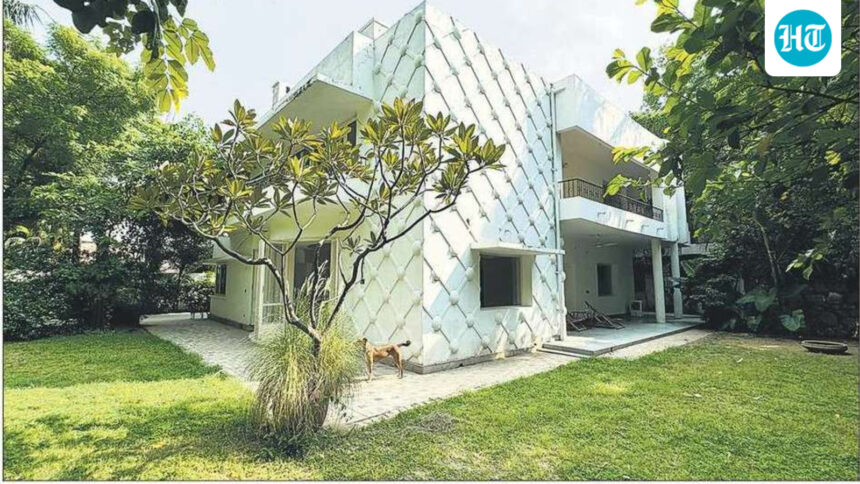
In the 1940s, the diplomatic enclave of Chanakyapuri was a jungle – an extension of the hills. A young family of Indian External Affairs Ministry workers bought a plot of land near Kautilya Marg, skeptical that anything would happen around it, yet decided to take the risk. In 1954, architect Karl Malte von Heinz was commissioned to build an Indian bungalow for them. And thus came Heinz’s treasure in Chanakyapuri.

There’s something cinematic about the Heinz house. The most popular feature is the glorious staircase, shaped mostly by temple workers. Every time I walk into the Hines house, I look for the stairs. Thick handrail.
Ornate railings, flowered or decorated with South Asian animals. It is almost impossible not to picture the lady of the house sliding down the wide staircase with its short, wide steps, allowing her proper entry. This staircase appears in many homes by the architect. If the stairs are the cherry on the cake, the cake will be the home’s exterior – patterned or modified to suit Indian Summer.
The house is organized with wide balconies covering parts of it, columned and well spaced to allow light to flow. The air moves through the structure. Light enters without heat. The plan follows the job. The rooms remain cool in the North Indian summer. Terrazzo flooring extends throughout the interior. The fireplace anchors the drawing room and study. In some of the houses below there was a wine cellar, which was a rarity in Delhi at that time.
From the outside, the shape is cubic. The walls bear a delicate surface – sometimes pressed, sometimes patterned, sometimes decorated. A dotted shape representing parts of the interface. Inside, the geometry is softened by curves in the edges of the stairs and ceiling. This contrast between external restraint and internal adjustment defines the house. This Indian bungalow becomes more interesting when one delves into the history of its architect. Karl Malte von Heinz, an Austrian by birth, was born in 1904. He was trained in the climate of German modernism.
He arrived in India after the turmoil in Europe, when Bauhaus and modernist culture were attacked by the Nazi regime. Modern architecture championed internationalism, experimentation and industrial life. The regime demanded national art, classical form, and tradition. Many architects dispersed. Hines was among those who moved east.
Accounts of his early years in India vary. One account places him in Hyderabad, where he travels with the Turkish prince Abdul Karim, and stays with a professor at Osmania University. Another places him in Indore, working with the Maharaja.
By the time he approached Delhi, he was designing for clients associated with the emerging Indian state. This house in Chanakyapuri belongs to this phase.
Local modernity, drawn from a global transformation – modernism not just as a fashion but as a resistance, as a future decision made by thinkers of the 1940s who saw a world destroyed by ideology. Solutions have been sought under cultural shifts on their own, without state approval, and have been adopted around the world, even if in small quantities. Sometimes you hear stories like this and think about how many people and communities India has given refuge to, and how well this safe space has worked for them.
His method followed the principles of German rationalism. Function before decoration. Planning as structure. Dealing with light, air and circulation as architectural elements. In India, he adapted quickly. The heat had to be deflected. Shade had to be built. Balconies have become climate instruments. Bearing walls are block. Glare controlled apertures. The modern home has been reworked for the Indian subcontinent.
Hines also designed diplomatic buildings for Pakistan, Thailand, Yugoslavia and the Vatican. Concrete and planning served as diplomacy. However, his residential work remained closer to what Delhi wanted as a home – homes for civil servants, diplomats, and families who sought modern living without abandoning climate logic. Chanakyapuri House is one such example.
When it was built, the area was still taking shape. The Foreign Service family expected the area to grow. During construction, a friend bought the adjacent lot, then bought it back, thinking development wouldn’t come. The house was larger than the family needed. It was later rented out to prominent residents, including the Nawabs of Rampur. The rent was Rs 1,500 in the 1950s.
Today, the house remains part of Delhi’s first layer of modernism. Record a moment when the city was rebuilding itself after independence and partition. Local materials combined with international thought. Together, architects, planners, government, and citizens shaped new neighborhoods and new identities. Through this house, one can trace the journey of the migrant modernist and the formation of a modern metropolis.
Anika Mann works in archeology and contemporary art in Delhi. Opinions expressed as personal