Jagdalpur: Monday evening. Union Home Minister Amit Shah speaks in the Lok Sabha, detailing his government’s success in ridding India of left-wing extremism or Naxalism. He speaks for about 85 minutes, explaining how the country won.

At an undisclosed location in the town of Jagdalpur in Bastar region, five senior Naxal leaders who surrendered in late 2025 listen to Shah. They fought the state for decades, but they admitted that the state ultimately won.
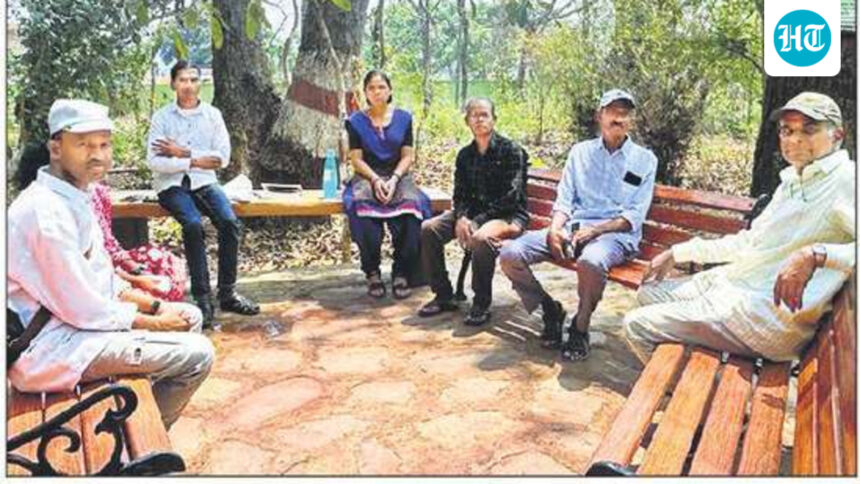
On Tuesday, the five met with the Hindustan Times in a park on the outskirts of Jagdalpur. They speak frankly about the decline of the Communist Party of India (Maoist), the continued strengthening of intelligence networks and security forces, the leadership vacuum at the head of the rebel group, their mistakes, curiosity about their former boss Ganpati, who remains at large, and their eventual loss of relevance.
The turning point in the state’s struggle came in 2009, says one of them. “Until 2009, the government and intelligence agencies knew very little about our party and its military structure. They had no real vision. The Maoists were in full force,” says Pawan Anand Reddy alias Chaitu (62), a member of the government committee of the banned party.
Then things changed.
He adds: “Sometime after 2009-2010, the government began systematically collecting information about us – our hierarchy, governance model, internal functioning. The first batches of surrendered cadres who joined the local reserve guards revealed everything: our training methods, weaknesses, military formations. Once this happened, the troops gained a clear understanding and prepared themselves for a long fight.”
Those years, according to Chaitu and his comrade Rupesh alias Satish Kova, also a member of the state district committee, were a phase when the CPI(M) was at its strongest.
“Between 2007 and 2009, we were at our strongest in terms of numbers and deployment. There were about 2,500 to 3,000 full-time armed cadres in the Dandakaranya district alone, with support from 50,000 to 100,000 cadres throughout Bastar and neighboring areas. The Salwa Judum movement of 2005 took its toll on us, but it also drove thousands of people from the country,” says Rupesh. Other states where our influence has spread,” he said, referring to a state-sponsored militia seeking to fight the Maoists.
Rupesh, Chaitu, Ranita, Bhaskar alias Yadagir and Ratan Elam alias Bajirao surrendered in October 2025 along with more than 150 cadres. Their immediate senior, Central Committee (CC) member Malugao Venugopal Rao aka Sonu Dada, surrendered in Maharashtra before Chief Minister Devendra Fadnavis.
Rupesh adds that the movement’s decline also had to do with the state’s performance. “Our rise in the 1980s and 1990s was linked to conditions in remote villages at the time. But by the mid-2000s, government schemes were starting to reach the people. Even a 20% improvement in communication meant we were steadily losing ground and personnel.”
The Chinese Communist Party (Maoist) has become an anachronism, says a third former Maoist. “As the government developed, we remained focused on building a liberated area,” says Bhaskar, who spent nearly 29 years in the forest. “Instead, we should have expanded into urban areas — among students and workers. We failed to do so. Over time, our influence shrank from multiple states to just a few, and eventually we became confined to the Dhandarkarnia forest among the tribal population.”
The warning signs that former Maoists acknowledged were there, but were ignored by the Maoist leadership. They failed to understand the importance of operations like Green Hunt and Operation Kagaar, large-scale offensive operations launched against the Naxals. They did not react even when security forces began using helicopters and drones and began entering the bush to confront them.
Chithu says the party should have been negotiating from a position of strength in the late 2000s.
“We had bargaining power at that time. Our leaders should have come out and done something.”
Instead, he adds, it was only over the past year that Maoist leaders sought a ceasefire, as it became clear that the end was near. “But why is the government listening to our demands? They insisted on disarmament first – and we have lost all our influence.”
Over the past six months, security forces have killed one prominent leader after another, literally emptying the military and political structure of the banned party. But the former Maoists are also curious about the whereabouts of former Maoist leader Ganpati alias Moppala Lakshmana Rao.
Some of the five claim to have last seen Ganpati at a CC meeting in Abujamad sometime in 2022. He attended the meeting even though, by then, he had handed over the reins of the party to Basavaraju (who was killed in a gun battle last year) in 2018.
“Ganpati was there. Sonu Dada (Venugopal Rao, who surrendered in Maharashtra on October 14, 2025) and Basavaraju were also there. Not everyone could attend the meeting but attendance was good. Basavaraju must have invited Ganpati to this meeting,” says Bhaskar.
Bhaskar believes that only Basavaraju knew about Ganpati’s actual location and possibly his new identity.
With Basavaraju’s death, I don’t think there is anyone who knows where Ganpati is. But one thing is for sure – it’s not in the Dandakaranya forest, because we were there.
In the banned Communist Party of Iran (Maoist), it is best to hold central committee meetings once a year in the forest to evaluate the party’s activities. Key decisions are made and the way forward is discussed.
Ratan Elam, popularly known as Bajirao, describes the killing of Basavaraju on May 21, 2025, as something that signified the beginning of the end. “I was with another team about 100 to 150 kilometers away inside the Abu Jahmad forest when Basavaraju was killed. It seems that the small cadres, not all of them, but some of them, have lost confidence in the movement.”
With the security forces intensifying their operations over the past two years, which has led to an unprecedented number of Maoists surrendering or being eliminated in armed battles, the Central Committee has become increasingly desperate to meet. There were three simple questions: Should they fight, should they surrender, or should they insist on a ceasefire? But there were no answers because the leaders could not meet, say the five former Maoists. Their stronghold in Abu Jahmad was breached. Security forces were deployed everywhere to meet the deadline of March 31, 2026.
“The Central Committee could not hold its meeting in Abu Jumad because the forest was no longer safe for us,” says Bajirao. “There was a communication gap and this led to friction among the remaining Central Committee members. That is why some surrendered with weapons, others without and others chose to fight.”
Apart from Ganpati, the only committee member at large is Misriya Basra, who is hiding somewhere in the Jharkhand jungle, pursued by security forces.
The five former military commanders were helping the security forces convince the remaining cadres to surrender. The five say they are telling the cadres that they will start a peaceful revolution and perhaps run in the elections. On Tuesday, 35 more cadres across Bastar surrendered to the security forces after a long and arduous effort by the police, local residents and surrendered cadres.
Rupesh admits that asking his former comrades to leave the jungle is a difficult and emotional task. “We are the ones who once told them to never give up and instead die for the cause.”