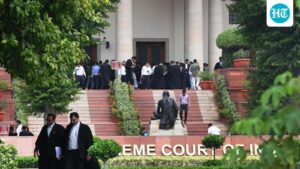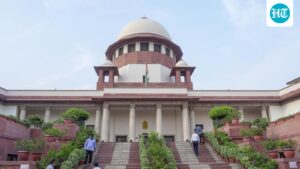
New Delhi, The Aravalli Committee constituted by the Supreme Court has invited submissions, suggestions and inputs from people on issues related to the Aravalli hill range.

The high-level committee was constituted on May 25 and was tasked with conducting an independent review of the Centre’s report on the definition and delineation of the Aravalli hill range.
According to the press note issued by the Ministry of Environment on Tuesday, the committee invited submissions, suggestions and inputs from NCT states and various stakeholders, including ecologists, mining lease holders and local communities, whose livelihoods and well-being may be intrinsically linked to the biodiversity of the region.
It added that submissions, supported “to the greatest extent possible” by documentary evidence or verifiable materials, must be submitted via email or an official Google Form within 21 days of notification.
This development comes amid concerns about the impartiality of the committee, as it mainly consists of former government officials.
The committee, which must submit its report by August 31, is headed by Kanchan Devi, director general of the Indian Council of Forest Research and Education.
Its members include Subhash Ashutosh, former Director General of the Forest Survey of India, Rajendra Kumar Sharma, former Director of the Geological Survey of India, Brij Mohan Singh Rathore, former Joint Secretary in the Ministry of Environment, and Professor Ashok K Bhatnagar, former Head of the Department of Botany at Delhi University.
The court also appointed Professor Jagdish Krishnaswamy of the Indian Institute of Human Settlements, Bengaluru, and Professor Laxmikant Sharma of Haryana Central University as special invitees with whom the President may participate in the work of the committee as required.
The Ministry of Environment was directed to nominate an employee with the rank of director to be the secretary of the committee member.
Critics say the committee chair reports directly to the Secretary and Minister of the Ministry of Environment and therefore does not meet the criteria of impartiality or independence as stipulated in the Supreme Court’s December 2025 suo motu order.
This article was generated from an automated news feed without any modifications to the text.