The global ripples from the West Asia crisis, triggered by the US-Israeli attack on Iran and the latter’s retaliation, hit stock markets in Mumbai and Parliament in New Delhi directly on Monday.

The Congress-led opposition, which accused Prime Minister Narendra Modi of “cowardice”, said the government had not done enough to anticipate or address the internal crisis, even when the Prime Minister visited Israel just two days before the US-Israeli strikes began on February 28.
It also renewed its claim that the trade deal agreement with the United States, which was announced last month, was against India’s interests, especially since it stipulated that India would no longer buy oil from Russia. This clause has been relaxed at the present time in light of the oil crisis. But the questions go broader, analysts say.
$Rs 25 crore were wiped out
On Monday morning, Indian stock markets witnessed what analysts described as their biggest decline in six years. Bombay Stock Exchange Index The Sensex fell over 3% (around 2,500 points), while the Nifty-50 index on the National Stock Exchange was also in a similar position.
Since the crisis began on February 29, the total market capitalization of all companies listed on the Bahrain Stock Exchange has fallen from $463.9 lakh crore to below $440 thousand crores. This means a loss of value$25 thousand crore rupees”>more than $25,000 crore of investors’ wealth, an amount equivalent to almost one-seventh of India’s annual GDP, HT reported.
The incident appears to have been prompted by ““Flight to Safety,” where investors withdraw money from risky emerging markets like India and move it into safer assets like gold or the US dollar.
At the same time, the scope of the US-Iranian conflict has expanded, with attacks reported on oil depots, desalination plants, and even counter-missile and drone strikes within the United Arab Emirates, Bahrain, Qatar, and Oman, countries where US military bases are located.
For India, This is not a long-range war in terms of human involvement either. West Asia has approximately 1 crore Indian nationals living and working there. Furthermore, the Gulf region is a vital trading partner, with annual trade volume reaching $200 billion.
External Affairs Minister S Jaishankar In his statement to Parliament, he noted that the region is “key to our energy security,” as it provides the bulk of India’s oil and gas needs.
Oil connectivity between India, the Gulf and beyond
The most obvious factor that will hit the Indian economy is the rise in crude oil prices due to the war. Brent crude rose 20% to… It exceeded $120 per barrel as of Monday.
India is generally at risk in this regard because it imports more than 85% to 90% of its crude oil needs; according to SBI Research Every $10 rise in the price of a barrel of oil has multiple impacts.
It fuels inflation and widens India’s trade deficit, meaning the gap between what the country spends on imports and what it earns from exports. If oil maintains a level of $120-130, India’s GDP growth could slow to 6%, down from the previous forecast of 7% for the next fiscal year, news agency ANI reported.
Meanwhile, the International Monetary Fund (IMF) He issued a global warning this week. “A 10% increase in crude oil prices, if sustained throughout the year, could lead to a 40 basis point increase in global inflation,” International Monetary Fund Director Kristalina Georgieva said on Monday. A basis point is a financial unit of measurement equal to one-hundredth of a percentage point (ie 0.01%). So, 40 basis points means 0.4%
“Think about the unthinkable and prepare for it,” Georgieva said in advice.
India’s oil supply calculations are affected by the virtual closure of the Strait of Hormuz, as Iran retaliates against US-Israeli bases and puts pressure on the global economy. With nearly half of India’s imports passing through the strait, Delhi is in diversification mode. Oil Minister Hardeep Singh Puri said that “energy imports into the country flow entirely through all routes other than the Strait of Hormuz” and that “India “In a comfortable situation, there is no room for worry or speculation.”
Impact on families
Over the weekend, LPG prices in India rose by $60 for a domestic LPG cylinder (14.2 kg) bringing the price in Delhi to $913.
Congressman and former minister Shashi Tharoor said: “Gas has completely stopped leaving Qatar. Our factories are not currently receiving gas from this side to India… We are definitely suffering.”
This has led to some strange, if tragic, local consequences. In Pune, the municipal corporation had to temporarily close gas-fired crematoriums because the conflict disrupted supplies of propane and butane, the two main components of liquefied petroleum gas.
Protests in Parliament: “Leadership, not silence”
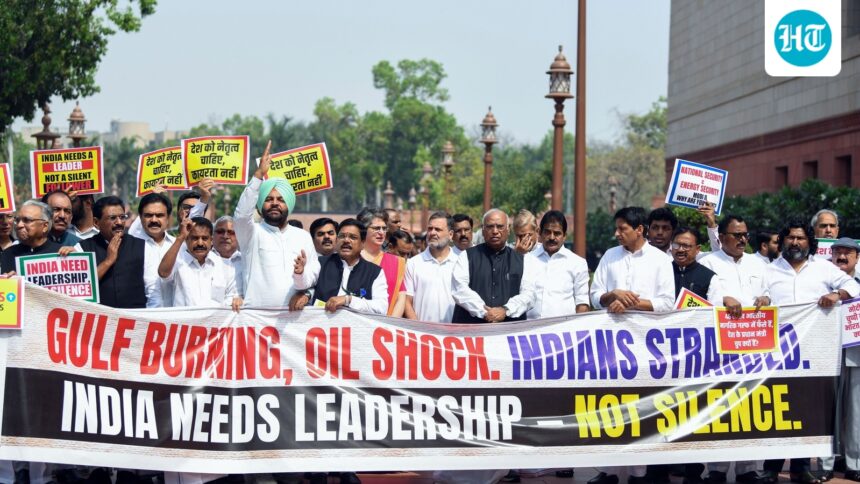
Amid this, politics has been sharply divisive with the government allegedly avoiding questions. The opposition India Bloc, led by Rahul Gandhi and Mallikarjun Kharge, staged a massive protest inside and outside the Houses on Monday.
The protesting representatives carried a large banner that read: “Gulf on fire, oil shock. Indians are stranded. Indians are stranded.” “India needs leadership – not silence.”
They accused the government of “cowardice” and called for a comprehensive parliamentary discussion and not just a statement, in reference to the statement made by the Foreign Minister. Jaishankar.
Leader of the Opposition in Rajya Sabha, Mallikarjun Kharge, said, “The conflict is not limited to West Asia; it has now affected India’s energy security and the image of the country. The outcome of this conflict will also affect our economic stability.”
Government response: “National interest is above all else.”
However, Jaishankar delivered a ‘moving statement’ – an official report submitted on his own initiative – detailing the government’s diplomatic efforts so far amid the crisis.
He said the Cabinet Committee on Security (CCS), chaired by Prime Minister Narendra Modi, met on March 1 to address the safety of Indians and risks to economic activity.
He said in both chambers, amid uproar from the opposition, that the government had been “assessing the situation” for months and had issued travel warnings as early as January. He said that about 67,000 Indian citizens have already been returned from the conflict zone through 150 flights over the past three days.
Regarding the economic shock, he said: “Our national interest, including energy security and trade flows, will always be of paramount importance… For us, the interests of the Indian consumer have been and will always remain the paramount priority.”
Who will hit the market?
Oil-dependent sectors, such as aviation, paints, chemicals and tires, are facing the greatest pressure. For example, airline IndiGo saw its share prices fall by more than 7% due to the huge rally It looks at aviation fuel costs, as HT noted in a previous report.
But companies like Reliance Industries and Coal India have held on as investors shift their money to energy producers that stand to benefit from higher prices.
However, analysts from SBI Research warned of a “stagflation dilemma”. Stagflation occurs when economic growth slows while prices continue to rise (recession + inflation).
The rupee is already under pressure, having crossed 92 against the US dollar on March 4, touching all-time lows since then.
For now, it’s somewhat helpful that the United States did this, For a month, it removed the condition of no Russian oil in order to reach a trade agreement with India. However, this has raised questions for the Modi government with Rahul Gandhi alleging that it is acting under “some kind of invisible pressure” and damaging India’s sovereign position in global affairs. The opposition also questioned his tilted stance towards Israel despite India’s longstanding links with Iran.