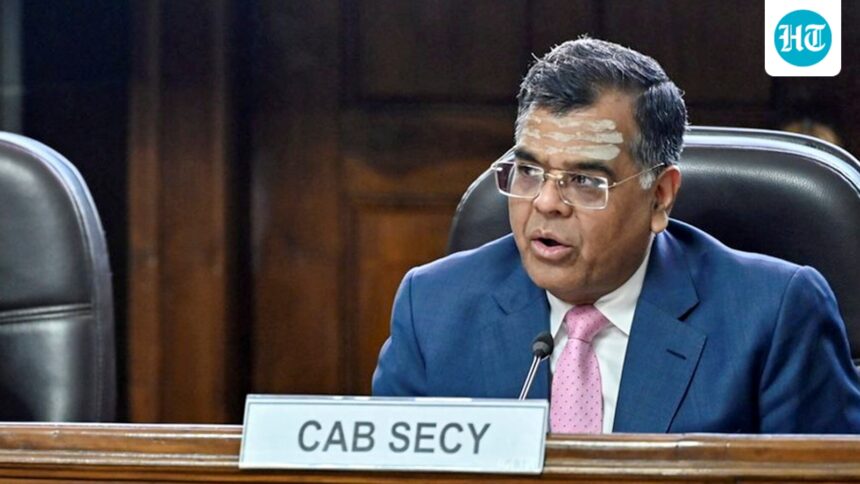
Cabinet Secretary T V Somanathan on Tuesday stressed the need for sovereign AI models and resilient supply chains to protect national interests, amid evolving geopolitical challenges arising from ongoing global conflicts.

Addressing the Army Commanders’ Conference, he said strong civil-military cooperation and a whole-of-nation approach are essential to achieving optimal outcomes in both conflict and peacetime, highlighting key strategic imperatives for national preparedness in an increasingly complex global environment.
His comments come at a time when India is developing about a dozen AI models using local infrastructure, data and manpower; The West Asian crisis disrupted global supply chains, led to higher oil and gas prices, and shook the global economy.
As part of the India Artificial Intelligence Mission, which was announced in 2024 with an outlay of $At Rs 10,372 crore for five years, the government is funding 12 organizations to build sovereign AI models. Among these, Sarvam, Gnani and BharatGen showcased their models at the India AI Summit in February 2026.
The government’s goal is to create local Hindi-focused models and reduce dependence on foreign platforms.
The latest technologies, including artificial intelligence, are being leveraged to achieve positive outcomes in ongoing conflicts. In March, Chief of Defense Staff General Anil Chouhan said that AI will shape future warfare and help armed forces take the right and timely decisions to emerge victorious in conflict. They already play a key role in ongoing conflicts in areas including decision support, targeting, intelligence, surveillance and reconnaissance.
The four-day Army Summit, chaired by Army Chief General Upendra Dwivedi, began on Monday. The Navy Commanders’ Conference is being held at the same time, chaired by Navy Chief Admiral Dinesh K Tripathi.
The two conferences come at a time when Defense Minister Rajnath Singh asked the army leadership to draw “operational and technological” lessons from the ongoing US-Israeli war with Iran to enhance India’s defense preparedness.
Lessons learned from the West Asia crisis include enhancing defense self-reliance, improving supply chain management for the production of defense equipment, and ensuring the maintenance and serviceability of existing equipment.
Somanathan described Atmanirbharta not just as a political goal, but as a national mindset in which every sector, institution and citizen contributes to building a resilient and self-reliant India.
Key discussions at the Army Commanders’ Conference will include the use of unmanned aerial systems (UAS) and counter-drone technologies in light of the ongoing conflicts, a review of the Army’s capabilities nearly a year after the Army launched Operation Sindoor, and modernization of the service, officials familiar with the matter said.
The Indian Army plans to induct tens of thousands of home-made drones and loitering munitions over the next five years to enhance its battlefield capabilities, given the growing impact of these systems on military operations and how they have reshaped modern warfare as evident in the ongoing global conflicts including the US-Israel war with Iran, as HT had previously reported.
The Army’s requirements include 80 different types of unmanned systems for specific roles including intelligence, surveillance, reconnaissance, precision strike, munitions drop, air defense, jamming, mine warfare, data relay and logistics.
The Navy is also conducting a comprehensive review of its operational posture to protect the country’s maritime interests and examining issues related to capability development and strategic alignment of the service with national security objectives. The conference comes in light of the rapid naval deployment to protect India’s energy security, amid the conflict in West Asia and the convergence of multinational forces in the Indian Ocean region.