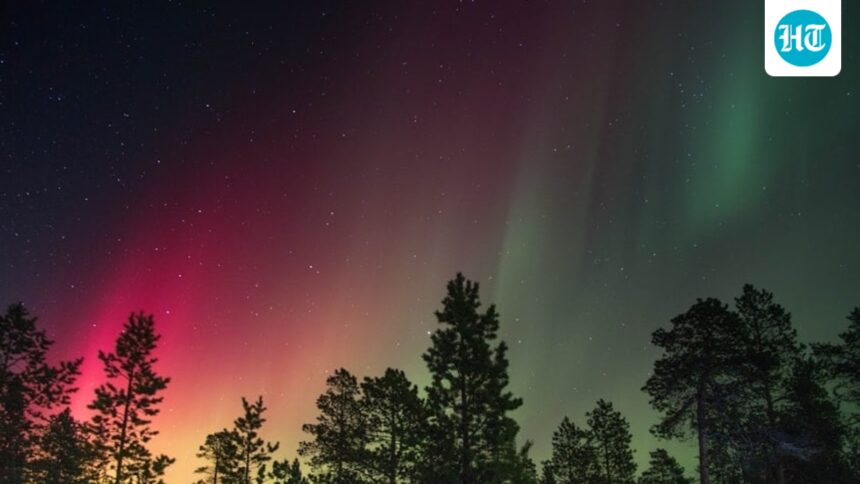
A powerful geomagnetic storm is expected to impact Earth on June 8, prompting astronomers and skywatchers to closely monitor the skies for possible auroral displays.

The event also revived memories of the rare appearance of the northern lights over Ladakh in May 2024, when an intense solar storm produced a sight rarely seen from Indian territory.
The U.S. National Oceanic and Atmospheric Administration (NOAA) issued a powerful geomagnetic storm watch (G3) after a coronal mass eruption (CME) erupted from the Sun and headed toward Earth.
Read also | Did a geomagnetic storm hit the Earth? A massive solar flare has been reported; Twilight is possible
The aurora borealis, often called the northern lights, are displays of natural light that occur when electrically charged particles released by the sun interact with gases in the Earth’s upper atmosphere, creating colorful patterns across the night sky.
NOAA expects the strongest activity on June 8
According to the National Oceanic and Atmospheric Administration’s (NOAA) Space Weather Prediction Center, the storm is expected to strengthen over three days before weakening.
“Geomagnetic storm category G3 predicted highest storm level forecast by day: June 07: None (below G1) June 08: G3 (strong) June 09: G2 (moderate) This replaces any/all previous watches in effect,” the warning read.
The upcoming storm is expected to interact with the Earth’s magnetic field, which could create a vivid aurora in high latitude regions.
May 2024 in Ladakh
In a rare and unexpected display, the aurora borealis lit up the night sky in Leh, Ladakh, after an intense geomagnetic storm struck Earth in May 2024. The aurora borealis were seen at India’s highest observatory in Hanle.
The aurora borealis are usually seen farther away at higher latitudes. However, the intensity and frequency of solar storms this year allowed the lights to capture the night sky much farther out at lower latitudes.
In Leh, the red auroral emission was captured by telescopes used by the Indian Ministry of Science and Technology.
Will India witness the phenomenon this time?
Currently, the possibility of seeing the aurora borealis from India remains low, according to a report by TOI. The upcoming G3 geomagnetic storm is much weaker than the historic G5 event that lit up the skies of Ladakh in May 2024.
However, astronomers and skywatchers will be watching closely.