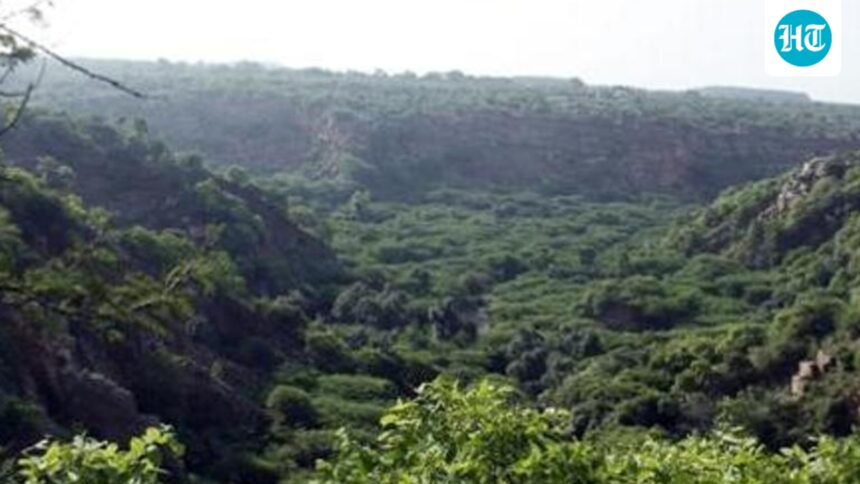
The Indian Supreme Court on Thursday moved a step closer to forming an expert committee to identify the Aravalli Hills, noting that even legally permitted mining operations in the area would have to wait for the panel’s opinion.

A bench headed by Chief Justice of India Surya Kant and comprising Justices Joymalia Bagchi and Vipul M Pancholi acknowledged the importance of the matter, noting that a blanket moratorium on mining could impact the availability of construction materials. At the same time, he made it clear that the status quo will continue for the time being. The court gave the Center and other stakeholders two weeks to suggest names of domain experts who can help in comprehensive identification of the Aravalli hills and ranges, taking into account the ecology, forest cover, gradients, hills and existing urban settlements.
“We are aware of the fact that all activities, especially mining activities, for which the lease was granted with all permissions, have been halted. However, this status quo should be maintained for the time being until some initial issues are answered in a phased manner after the formation of the expert committee,” the council said, deferring the matter to the second week of March.
The court is hearing a suo motu petition regarding the definition of the Aravalli Hills. In earlier proceedings, it had directed that the status quo on mining be maintained and kept pending its November 20, 2025 ruling, which accepted the definition proposed by a committee headed by the Secretary of the Union Ministry of Environment, Forest and Climate Change (MoEFCC). That committee proposed to classify the hills 100 meters above the local terrain as ‘Aravalli Hills’.
On Thursday, a mining company moved an application for permission to resume operations, claiming that it holds a valid lease and all necessary approvals. Senior advocate Mukul Rohatgi, representing the company, said the earlier court order had stopped even legal mining.
In response, the court members noted: “We realize that we cannot disrupt everything because construction materials are needed. But let the whole process be completed. Let the experts tell us whether mining is permissible and, if so, under what conditions.” The court directed Additional Solicitor General Aishwarya Bhatti, representing the Ministry of Economic and Financial Affairs, to propose by March 10 the formation of a committee of experts with their credentials: “We do not propose to extend the time beyond that as it will unnecessarily delay the proceedings.”
“The opinion of the Ministry of Environment and Climate Change shall be of great help for the purpose of determining the expression of Aravalli, the total area, gradations and hills, forest cover, and that part of Aravalli where cities, towns and villages have already developed over the centuries,” the bench, which directed the matter to be listed in the same week, said.
It also asked senior advocate K Parmeshwar, domain expert Jay Cheema, and lawyer representing states like Haryana and Rajasthan to recommend suitable names.
The Council indicated that it would formally form the committee in the next session. In its order dated December 29, 2025, the court laid out the mandate of the commission, which includes providing a final enumeration of the areas that fall within the definition of Aravalli and identifying the areas that will be excluded from protection under the proposed criteria.
The committee was also tasked with examining whether “sustainable” or “regulated” mining within the newly demarcated Aravalli areas would cause any negative environmental consequences affecting the overall safety of the group. In addition, it must evaluate the short- and long-term environmental impacts of implementing the revised definition and related guidance.
On Thursday, an amicus curiae filed a memorandum urging the court to direct the expert committee to conduct a comprehensive survey of the entire Aravalli district. He suggested that the survey should map the major ecological corridors and aquifers within the Aravalli ecosystem and existing mining plans, besides identifying hills and ranges.
In 2002, the Supreme Court imposed a ban on mining throughout the Aravalli region. However, a 2018 report by the Forest Survey of India (FSI) pointed to widespread illegal mining, citing the disappearance of 31 hills across more than 3,000 locations in Rajasthan and Haryana. While states have widely denied illegality, friends have argued that the absence of a uniform definition for the Aravalli Hills has created regulatory ambiguity.
However, this order was put on hold by the bench headed by CJI Kant in December when it said: “There has been a significant outcry among environmentalists, who have expressed deep concern about the potential for misinterpretation and improper implementation of the newly adopted definition and directions of this Court. This public dissent and criticism appears to stem from the perceived ambiguity and lack of clarity in some of the terminology and directions issued by this Court.”