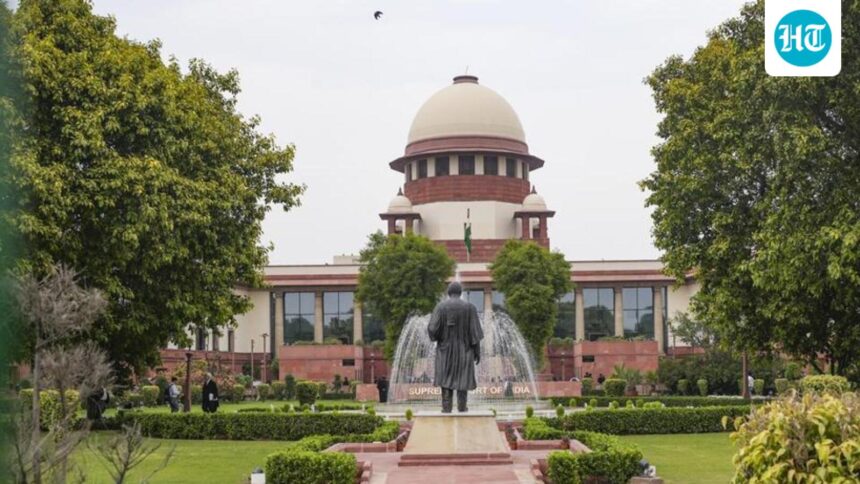
The Supreme Court on Tuesday refused to amend its November 2025 directions mandating removal of stray dogs from institutional areas such as schools, hospitals, sports complexes, railway stations and bus depots, adding that such dogs cannot be released back to these locations even after sterilization.

A bench of Justices Vikram Nath, Sandeep Mehta and N V Angaria dismissed all applications seeking amendment to the November directives, and also dismissed challenges to the Standard Operating Procedures 2025 drawn up by the Animal Welfare Board of India (AWBI), citing “deeply disturbing” incidents of dog bites across the country.
The court also authorized the authorities to take legally permissible measures, “including euthanasia in the case of rabid and dangerous dogs,” to reduce threats to human life.
While reading its implementing directives in open court, the bench noted that “the problem has taken on deeply worrying proportions,” adding that reports of dog bite incidents occur with “alarming frequency and severity.”
The court confirmed that the case extended beyond residential areas to airports and other public institutional places. Referring to the reports submitted before it, the bench noted that “the mere occurrence of repeated dog bite incidents at the busiest airport in the country (IGI) demonstrates its serious inadequacy.”
The Supreme Court also referred to incidents involving international travellers, including a German tourist who was allegedly bitten in Surat, and observed that such incidents adversely affect public confidence in “urban governance and civic administration”.
“The right to life with dignity includes the right to live freely without the threat of being attacked by a dog bite. The state cannot remain a passive spectator,” the bench said.
The court said the Animal Birth Control (ABC) framework, introduced in 2001, suffered from a “conspicuous lack of effort” by states to expand sterilization and vaccination infrastructure in proportion to the rising numbers of stray dogs.
He added: “Sterilization and vaccination campaigns took place without planning. This contradicts the goal of the framework. If countries had acted with due foresight, the current situation would not have reached such alarming proportions.”
Highlighting the seriousness of the situation, the court cited data indicating that 1,084 dog bite incidents were reported in one month in Rajasthan’s Sri Ganganagar, while Tamil Nadu recorded more than two lakh cases in the first four months of the year.
He pointed out that “the young children suffered serious injuries, including scratching their faces.”
Describing the damage as “not merely statistical but incomprehensible”, the court expressed regret that despite its orders in August and November 2025, the intended impact had not spread to ground level.
“Any non-compliance with the directives of this court must be viewed seriously. Contempt proceedings, disciplinary proceedings and tort proceedings will be initiated against states for non-compliance,” it warned.
The Council directed all states and union territories to take “decisive steps” to strengthen and implement the ABC framework and ensure establishment of at least one fully functional ABC center in every district, equipped with trained staff and logistical facilities for sterilization and vaccination.
Considering the population density, the states were also asked to expand ABC centers and ensure adequate availability of anti-rabies drugs in government pharmacies and hospitals.
In an important protection for enforcement officials, the bench directed that no FIRs or coercive actions should ordinarily be taken against municipal officials or authorities implementing the court’s directions, unless there is significant irregularities or illegality.
“Officials of municipal authorities, states and others charged with implementing the directives of this court are entitled to due protection in the actions they undertake,” the court said, adding that higher courts can quash criminal proceedings wrongly brought against officials and other persons.
The Union and state governments were also allowed to take “informed and reasonable decisions” to extend the November directives to other public places and high footfall transport hubs in a time-bound manner.
In addition, the court directed all high courts across the country to initiate automatic proceedings to monitor compliance with the Supreme Court’s directions in August and November 2025. Chief secretaries of states have been asked to file status reports before the respective high courts, while consolidated compliance reports will be submitted to the Supreme Court in November this year.
The directives are a continuation of the ongoing Supreme Court proceedings that began last year amid increasing dog bite incidents across the country. In its November 2025 order, the same court had directed all states and union territories to remove stray dogs from institutional premises and banned their re-release into such sites after sterilization, holding that allowing their return would “frustrate the very objective” of ensuring safe public spaces.
The November order had expanded a trend issued earlier in August 2025 requiring civic authorities in the Delhi-national capital to collect stray dogs and place them in shelters, effectively suspending the catch, castration, vaccination and release model in institutional areas.
The proceedings have since evolved into a national review of stray dog management, with the court repeatedly citing shortcomings in sterilization infrastructure, vaccination coverage, shelter capacity, and the accuracy of data provided by states.