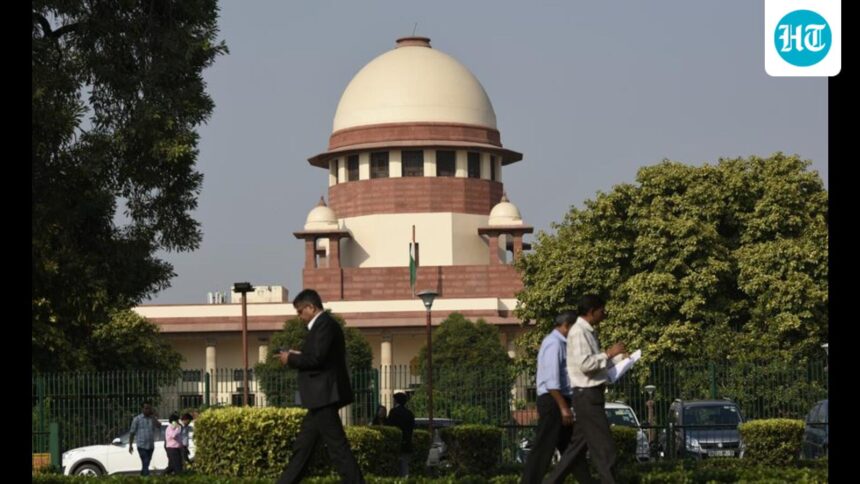
The Supreme Court on Wednesday refused to review its earlier ruling granting bonus and benefits to landowners retrospectively under the National Highways Act, even as it issued crucial clarifications and a deadline to balance the rights of landowners with the doctrine of finality in litigation.

A bench comprising Chief Justice of India (CJI) Surya Kant and Justice Ujjal Bhuiyan upheld its 2019 judgment as well as its February 4, 2025 order, and refused to reconsider the basic finding that landowners are entitled to solatium and interest notwithstanding acquisitions made under the special regime of the National Highways Act, 1956.
Reading out the executory part of the judgment in open court, the ICC made it clear that the financial implications cited by the National Highways Authority of India (NHAI) cannot be a reason for dilution of constitutional safeguards.
“The award of remuneration and interest cannot be made conditional on the extent of the financial burden. The mere expectation of financial liability does not constitute a valid basis for review,” the bench observed, even as it pointed to the revised estimate of liability issued by the bench of approx. $29,000 crore, down from the previous forecast of Rs $100 Crores.
The ruling is expected to have widespread ramifications across the country, especially in states with significant highway takeover activity. It resolves the long-standing tension between ensuring equality of compensation and maintaining the finality of concluded proceedings.
The court traced the controversy back to its landmark 2019 judgment in Union of India v. Tarsem Singh, wherein Section 3J of the National Highways Act was declared unconstitutional to the extent of depriving land owners of benefits and benefits. This provision, introduced in 1997, effectively excluded the statutory benefits of acquisitions under the Highway Act, resulting in unequal compensation when compared to acquisitions under the Land Acquisition Act.
In reaffirming this position, the bench reiterated that landowners whose lands were seized between 1997 and 2015 – before the 2013 extension of the land acquisition regime – would be entitled to solatium and interest as part of “just compensation.” The court did not allow all previous cases to be reopened unconditionally, stressing that “settled claims cannot be allowed to be reopened indefinitely.”
In an important clarification, the court distinguished between pending and closed procedures. It held that only landowners whose compensation proceedings were pending as on March 28, 2008, the date on which the Punjab and Haryana High Court, in the Golden Iron & Steel Forgings case, struck down Section 3J, were entitled to claim compensation and interest under the prescribed law.
For cases where compensation has been enhanced but the question of specific compensation and interest has not been raised or decided, the court has allowed landowners to seek these benefits, but with a caveat: interest on these components will only be paid as of the date the claim is actually filed, and not for prior delay periods.
At the same time, the bench categorically prohibited the reopening of cases that had reached finality before 28 March 2008. “Once a judgment or order reaches a final stage and is not subject to appeal or review within the stipulated time, it cannot be reopened merely by subsequent proclamation of the law,” the bench said, stressing the need to maintain certainty in litigation.
The ruling effectively rejects the NHAI’s plea, argued by Solicitor General Tushar Mehta, for a purely prospective application of the 2019 ruling, while establishing a calibrated framework that limits retrospective claims to a specific class of cases. The authority said that reopening settled compensation would lead to widespread lawsuits and disruption of infrastructure financing. The court held that the constitutional principles of equality and fair compensation cannot be subordinated to financial considerations.