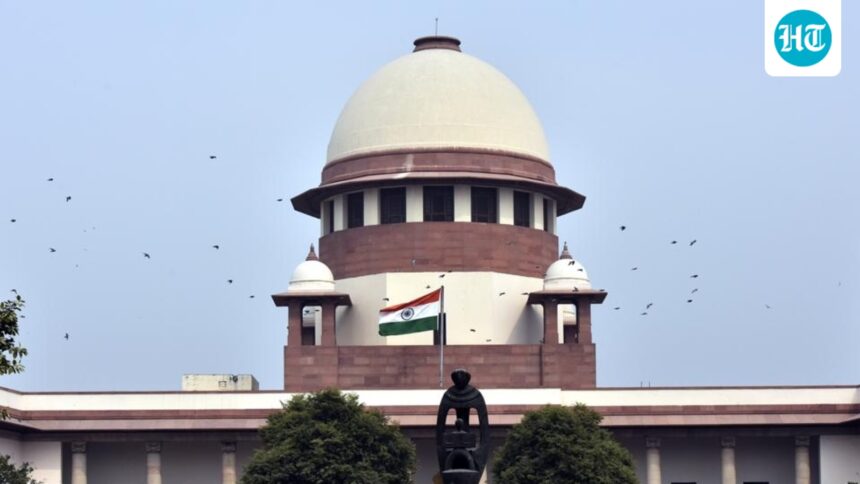
The Supreme Court on Thursday came down hard on civic authorities over unauthorized construction across Delhi and the National Capital Region, ordering an independent audit of vulnerable areas, summoning top municipal officials, and warning that it would “put personal liability” on officers who failed to act against illegal constructions despite repeated judicial directions.

A bench of Justices Ehsanuddin Amanullah and R Mahadevan said it was “particularly disturbed” by the conduct of the Municipal Corporation of Delhi (MCD), observing that despite its May 20 directions highlighting dangerous unauthorized constructions in areas such as Lajpat Nagar and Sarojini Nagar, the authorities have done little other than issuing notices to violators.
“We were hoping the officers would take action…but now I’m going to give orders and it’s going to hurt a lot of people. We’re going to hold the officers personally accountable and talk in black and white,” the jury commented during the hearing.
The court ordered the personal appearance of the MCD Commissioner and Vice Chairman of the Gurugram Metropolitan Development Authority (GMDA) after taking note of the Hindustan Times report of July 7 which found that nearly 93% of the establishments inspected in the ongoing fire safety drive in Gurugram were deficient in mandatory fire safety measures. The officials were asked to explain the concrete steps taken to comply with the May 20 court order.
The bench also constituted an expert inspection team comprising two senior professors from IIT Delhi, two draftsmen from the institute, officials from MCD and court-appointed senior advocate amicus curiae Ajit Kumar Sinha to conduct field inspections in Malviya Nagar, Saket and Lajpat Nagar in Delhi. A similar exercise has been requested for Aliganj area in Lucknow. On June 22, a devastating fire broke out in a three-story building in the area, killing 15 people, most of them students, and injuring several others.
The directions came after Sinha told the court that recent tragedies, including the June 3 Hauz Rani fire that claimed 23 lives and the May 30 collapse of an illegally constructed building in Saidulagab in which six people died, vindicated concerns that had been repeatedly reported before the court.
“After the order of this court, the Delhi building collapse happened only near Saket Metro station. Floors after floors were built and then everything fell down. Malviya Nagar (Hauz Rani) fire also happened on June 3,” Sinha submitted, with the help of advocate Govind ji.
He also warned the court that “the next victim will be in Lajpat Nagar,” adding that he has already received 10 complaints from the area.
Sinha also submitted before the court two new fire situation reports in connection with the Hauz Rani fire and the June 22 fire tragedy in Lucknow, seeking directions to the authorities to disclose the progress of investigations and action taken against officials who allegedly allowed illegal construction to continue.
While appearing before the MCD, Additional Solicitor General SD Sanjay sought time to submit a detailed case report and stated that action has already been initiated against the erring officers.
But the authority expressed its dissatisfaction. “Imagine how helpless people will be when we see all this,” the bench noted, noting that despite their previous directives identifying vulnerable areas, not much has changed on the ground.
The court noted in its order that while notices had already been issued to violators, “no follow-up was done,” adding that rampant construction continued despite the Delhi High Court’s directions to restrict further construction activities. “We are of the view that caution must be taken,” the bench recorded, while noting that it was “not convinced” of MCD’s good faith, although it accepted the municipal body’s request for a short opportunity to prove compliance.
The court also criticized what it described as “face-saving exercises” by the authorities, noting that law enforcement agencies were only going after construction companies while avoiding officials responsible for allowing widespread violations in the first place.
“If this happens, the responsibility will be placed on the CEO,” the council said, referring to reports that demolition orders in Gurugram had reached a final stage but remained unimplemented.
Apart from Delhi and Haryana, the court also directed Tamil Nadu to submit details of action taken in cases related to unauthorized constructions. In Patna, where the current municipal commissioner took office only recently, the court also approached his predecessor and sought details of enforcement actions taken during his tenure.
The proceedings form part of the Supreme Court’s ongoing nationwide monitoring of illegal constructions and land misuse across the states.
On May 20, the court had warned that buildings constructed far beyond approved plans were inherently unsafe and could not bear the additional structural burden, noting that such large-scale violations often indicate tacit collusion between construction companies and civil authorities.
The issue gained greater importance after the collapse of the five-storey building near Saket Metro Station. In a detailed status report filed last month, amicus curiae Sinha asserted that the building had been repeatedly booked for unauthorized construction since 2012 but had not been effectively demolished or sealed despite multiple proceedings before the Delhi High Court. He had sought a city-wide structural audit, demolition of illegal structures, holding municipal officials accountable, and compensation to the families of the victims.
Officials at MCD and GMDA did not comment on the court orders.