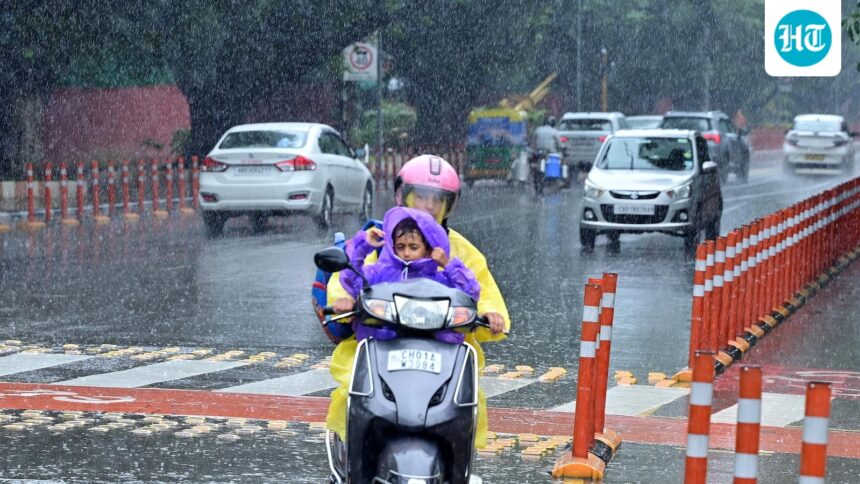
The southwest monsoon blanketed the entire country on Thursday, marking the last full, delayed coverage since 2021 as torrential rains destroyed critical infrastructure, submerged roads and caused deadly landslides across multiple states.

According to the India Meteorological Department (IMD), the monsoon has reached the last remaining parts of North Arabian Sea, Rajasthan, Haryana and Punjab a day later than its normal structural date on July 8.
Despite arriving three days late over Kerala on 4 June and enduring a slow two-week break, the monsoon accelerated significantly in late June, bringing heavy rains in early July.
Read also | Boats take out, a car and a motorcycle sink into a roadside ditch: Ghaziabad is hit by heavy rains exceeding 160 mm | Videos
Kerala to Maharashtra
In Kerala, the death toll from the July 7 landslide in Wayanad rose to six on Thursday after emergency workers recovered three more bodies. Three individuals are still missing. The landslide occurred after heavy rains at the construction site of the Annakumpole-Meppadi tunnel project, which connects Wayanad and Kozhikode districts.
In Maharashtra state, rescue operations continued in Pimpri Chinchwad near Pune after a building collapsed on Wednesday at a waste-to-energy plant. The collapse occurred when a huge pile of rain-soaked garbage collapsed. Rescuers recovered one body on Thursday. Nearly eight people are still trapped under the rubble.
Read also | A three-year-old boy died after slipping in rainwater outside a Ghaziabad house
Uttarakhand remains among the worst affected
Uttarakhand remains among the worst affected states. The incessant heavy rains closed more than 185 roads, caused widespread landslides, and disrupted the Char Dham Yatra pilgrimage in several sectors. In Tehri district, a landslide on the Chamba-Mussoorie highway near Kadu Khal caused a vacant and old building to collapse.
In Himachal Pradesh’s Kinnaur district, floods triggered by heavy rain on Thursday submerged a 100-foot iron bridge, completely cutting off some villages. The IMD has extended its yellow alert, anticipating thunderstorms, lightning and gusty winds in the state until July 15.
In West Bengal, the IMD issued landslide warnings in the hilly districts of Darjeeling and Kalimpong, advising fishermen in coastal areas to stay on the beach until Friday. “The wind pattern is favorable and moisture-laden winds are flowing in from the Bay of Bengal. Heavy rains are expected in some areas of West Bengal,” a Meteorological Department official in Kolkata said.
In the northeastern states, more than 300 passengers heading towards the southern Mizoram towns of Siaha and Laungtlai were stranded in Pulti village after two major landslides blocked National Highway 54. In Tripura, incessant rains displaced more than 2,500 people from 434 families. Displaced residents were transported to relief camps across Al Dhalea and Khwai. Floods affected six districts of Arunachal Pradesh.
Rainfall has declined significantly across Chhattisgarh, turning into light to moderate rainfall in southern districts. Over a 24-hour period, Dantewada recorded 22.6 mm of rainfall, followed by Geedam 19.4 mm, Dhanora 11.5 mm, Katikalyan 7.6 mm, Badirajpur 7 mm, Barsur 5.2 mm, and Badi Pacheli 4.5 mm.