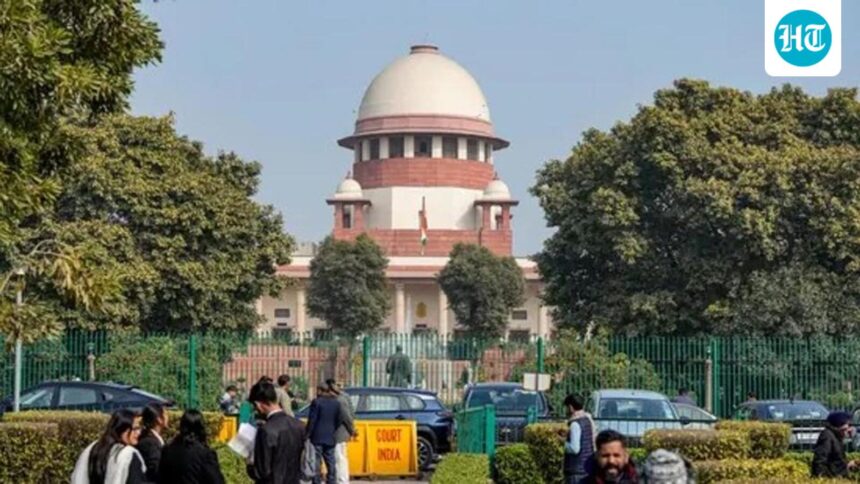
The Supreme Court on Monday upheld a National Green Tribunal (NGT) order that said a commercial property owner in Gujarat cannot be forced to compensate for environmental wrongs committed by its tenant.

A bench of Justices Satish Chandra Sharma and Sanjeev Sachdeva dismissed the appeal filed by the Gujarat Pollution Control Board (GPCB) challenging the NGT’s November 2025 order directing the closure of the building and imposing a penalty of $25 lakh.
The GPCB appealed the court’s decision on the ground that the property owner could not be completely absolved from the damage caused to the environment as the unit was operating as an unlicensed manufacturing facility for dyes which was generating harmful effluents into the water stream in excess of permissible limits.
Furthermore, the council said that in most cases the unit operator flees and there is no way to recover the damage to the environment.
The court favored the owner, Jagmohan Lashiram Jalan, who reported that his plot of land in Gujarat’s Mangrol in Surat district had been leased out to Suryaprakash Selaram Somani in September 2020.
Read also: What do the Supreme Court’s proposed regulations mean for the use of artificial intelligence in courts?
The lease agreement stipulates that no illegal activity will be permitted from the aforementioned building. Somani was a director of Satyam Chemicals and renewed the agreement every year.
The owner told the court that he was not aware of the fact that the unit operating in the building in the name of M/s Genial Chemi, had not obtained the required approval for incorporation and other licenses from the Board of Directors.
He was not aware of the fact that on October 16, 2021, the Board held Somani accountable and imposed interim Environmental Damage Compensation (EDC) of $25 thousand according to a previous court decision.
Somani failed to deposit the amount and it remained untraceable. In March 2022, the building lost power. The landlord then learned that the tenant had incurred the wrath of the Council and was pressed with the EDC under Section 33A of the Water (Prevention and Control of Pollution) Act 1974 to the extent of $25 lakh.
Jalan filed a police complaint against Somani and three others for cheating and criminal conspiracy among other offenses under the Indian Penal Code (IPC) and lodged a complaint with the council against the order to seal his properties. The Board of Directors rejected his representation on December 6, 2024 and ordered the unit closed.
Faced with the question whether a landlord can be held accountable for illegal acts committed by a tenant, the NGT said: “We are of the view that for illegal acts committed by a tenant, the landlord cannot be held accountable.”
It set aside the December 2024 order and said, “We are of the view that the impugned order, which imposes the provisional EDC amount amounting to $The amount of Rs 25 lakh cannot be charged from the appellant, who is the owner of the building in question and not the actual occupant thereof.”