The vast floodplains along the Chambal River in Madhya Pradesh burn under the scorching summer sun. In Morena, the temperature rose to more than 45 degrees Celsius. In Khajuraho, the temperature reached 47.4 degrees Celsius.

But just off NH-44 outside Morena, relief lies in the form of an unexpected oasis. Here at Eco Park in Deori, about 240 gharials enjoy cool shade in specially designed covered enclosures – each filled with fine river sand from the Chambal River and small water tanks to mimic their natural habitat – protecting them from the harsh sun and predators. These reptiles range in age from one to three years, with the largest population set to be released into the Chambal Wildlife Sanctuary at the end of the year.
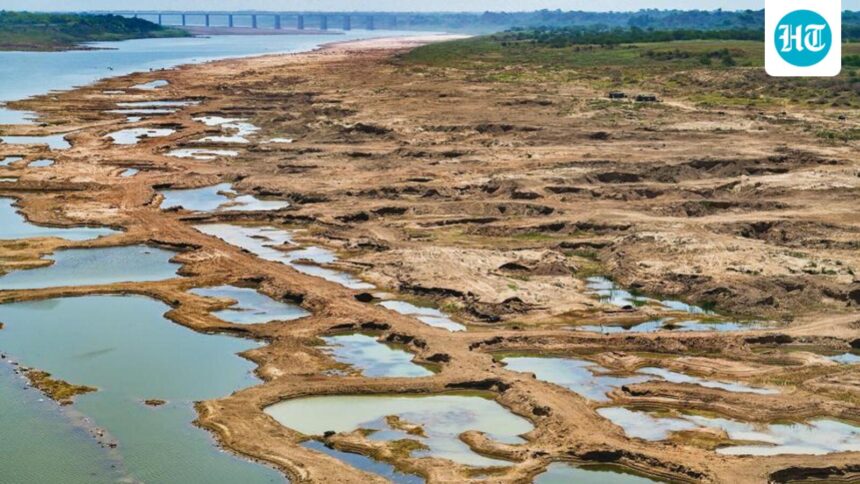
Gharials are lucky. Outside the 3.5-acre manicured park, just 15 kilometers away, the animals’ natural habitat – what should be undulating, wide, undisturbed floodplains made up of Chambal River sand – looks devastated. Large craters distort the banks of the Chambal River with clear evidence of sand mining leaving deep indentations where natural sand used to accumulate through the river’s flow. The riverbank – which once served as a nesting site for gharial birds, which account for approximately 80 to 90% of the world’s total wild gharial population – is degraded, with deep sinkholes filling the floodplain landscape. The pits are now located where the sand was supposed to be.
“We have seen sand mining happening here for nearly three decades now,” said a senior Madhya Pradesh Forest Department official who has worked in the area for 36 years. “Though it was in the open in the early 2000s, it is largely confined to nights these days. Ultimately, mining has not stopped, despite interventions.”
Sand mining first reared its head in the region in the late 1990s. Even as the courts did their best to reiterate the ban and emphasize the restrictions, little had changed on the ground.
A standing committee of the National Board for Wildlife (NBWL) had previously recommended changing the reserve’s boundaries to allow partial sand mining in some parts of Morena – a proposal that would cover nearly 300 hectares. But the Supreme Court rejected this plan.
Earlier this month, the Supreme Court observed that steps to prevent illegal sand mining exist only on paper, noted major loopholes in existing enforcement measures, and received suggestions from the expert body of the Central Empowered Commission (CEC).
Hizb ut-Tahrir’s surprise inspections confirmed the Supreme Court’s observations.
The areas around a major bridge in Morena were heavily protected by forest rangers and about 100 special armed forces. But the sand mining site only seems to have changed, as several tractors carrying river sand were seen, even in broad daylight, coming from nearby areas like Rithuna, Ambah and Nayakpura. Hizb ut-Tahrir found that this movement intensified at night, with little resistance from security personnel.
One thing was clear: the fragile habitat of the reserve, which is also home to the endangered Ganges river dolphin, red-roofed turtle and Indian skimmer, clearly needed more protection. It also requires better enforcement.
In the Hindu epic Mahabharata, an infamous dice game occurred in which the Pandavas gambled and lost Draupadi to the Kauravas on the banks of the Chambal River. Angered by her public humiliation, Draupadi cursed the river for bearing witness to her shame. Ironically, the legend of the curse saved the Chambal region from plunder and degradation for centuries, keeping its waters and banks clean. Instead, its valleys became notorious for thieves who took advantage of the undulating landscape, filled with clay hills, forests and thorny bushes, to plunder police stations, treasuries and granaries.
Today, the dacoit has faded. They have been replaced by the faceless sand mafia, responsible for dozens of deaths in the region since 2010, through avalanches or direct attacks on forest officials and residents. Locals and experts said this spot – where the states of Uttar Pradesh, Rajasthan and Madhya Pradesh intersect – is a hotbed of sand mining.
The 5,400-square-kilometre reserve, which stretches across the three states, is also home to the Indian skimmer (rynchops albicollis) – an endangered waterbird world-famous for its unique beak, with larger lower jaws that it uses to skim water and push fish and other prey in; The angry crocodile (crocodylus palustris), also known as swamp crocodiles and the red-roofed turtle (batagur kachuga), use the refuge as a nesting site.
On paper, conservation projects work. Last February, an annual assessment by the Madhya Pradesh Forest Department showed the number of gharial dolphins at 2,938, up from 476 in 2025. The number of Ganges dolphins reached 155, up from 111 last year.
But both species face external threats. In Morena, the HT team found a stretch of about 4 km on either side of Rajghat Bridge, which was devoid of dolphins and had only a few dolphins. Locals said the area was more densely populated earlier.
“We see only three dolphins in this part of the reserve, where earlier we were seeing them in double numbers,” said Kalyan Singh, a 40-year-old local boatman. “Since the bridge was built and the sand was extracted, the number of dolphins has decreased dramatically. Gharials need clear, calm sand, which is missing here during all the sand mining operations.”
“While boating, I also try to educate people and show them the different species we see here.” People now have to take boats further to spot the gharial, Singh said.
Jelabdeen A, who works on the Madras Crocodile Bank’s Gharial Eco-Project, said mining work around Rajghat Bridge has intensified over the years with the development of the highway and other roads in the area.
“Before the Covid-19 pandemic, sand mining was taking place extensively around the bridge. But after the pandemic, it spread throughout the sanctuary,” he said.
Jyoti Dandotia, the person in charge of the hatchery at the Gharial Eco Park, said that while the long-term data for the species, including the gharial, is trending positively, it is important to protect the natural habitats and sand.
“In 1978-79, there were only about 75 gharials, so the number rose rapidly through this conservation and breeding program. The flow of the Chambal River is very strong during the monsoon season, and when they hatch, these gharials are only about 30cm long and are vulnerable to being washed away by floods. While each gharial can lay between 18 and 52 eggs, the survival rate is low during the monsoon,” “Compared to the hatchery here, there is a factor Another key is that gharis are very selective about the shape and quality of sand and space along the river, before eventually burrowing about 60cm deep and laying their eggs. “If that habitat is mined, they either don’t lay their eggs there or their eggs end up being destroyed by sand mining.”
The location is equally important for the Indian skier, which lays its eggs directly on these sandbanks. Unlike gharials and crocodiles, which lay their eggs under the sand, skimmers lay their eggs directly on the shallow sand, said biologist RJ Rao, 70, a member of NBWL, who has also extensively studied aquatic animals and wildlife in the Chambal River. “It is essential that they have minimum disturbance from humans. If there is any activity, the bird will abandon the egg and fly away. If it stays away even for a few hours, the egg will dry out,” Rao said.
Challenge oppression
The Supreme Court noted glaring failures in implementation, citing unregistered tractors transporting illegally mined sand, inadequate protection for forest workers, and a severe shortage of rangers in areas under… Environmentally sensitive.
The CEC cited Rajasthan’s failure to notify the eco-sensitive zone around the reserve, saying the legal vacuum had allowed rampant mining in the critical ghari habitat.
“How can tractors be operated without registration? What should home guards do against the armed organized mafia? A special task force would be the best answer,” the court said.
On May 18, HT found that the ecosystem around Rajghat Bridge is well protected but the impact of mining is clearly visible. Avdesh Sharma, 18, a resident of the nearby village of Dholpur, said: “They (sand mafia) come at night and dig areas along the bridge for years without much resistance. This sand goes directly to homes and construction sites that need sand. We still see their movement.”
A Sudanese Armed Forces official said that the area had not witnessed any mining activity during the past month. “On the highway, we were seizing at least one or two tractors almost every day at this time,” the officer said, noting that earlier the tractor would sell this extracted sand for between $2500 and $3000, increased protection means that this activity has decreased. “Those who sell these things are now demanding up to $6000 per cart.
In addition to mined pits in the floodplains, signs of dumping of plastic and other waste were also visible. The plastic was floating in the Chambal River, or accumulating as waste in the floodplain.
The Central Election Commission’s report on May 7 pointed out this problem.
“During the site visit, it was observed that a large amount of waste was being dumped into the Chambal River from the National Highway Bridge spanning the river. Photographic evidence shows accumulation of waste at the base of the bridge piers, visible gaps in the protective structures, and alarming instances of aquatic wildlife – a crocodile and a mugger amidst this waste. This reflects a serious threat to the fragile ecosystem of the river and the Chambal National Park,” the report said. Systematic mining near the bridge may have a potential impact on the structural integrity of the bridge.
The CEC said based on an assessment conducted with the National Highways Authority of India (NHAI), the bridge was found to be safe at present.
With impunity
H.T. For some time along the main highway and in the villages along it on May 18 and 19, he found frequent movement of tractors carrying sand, some of which also moved during the day.
On the nearly 32-km stretch of NH-44 between Dholpur and Morena, HT witnessed at least 40 tractor trolleys laden with sand moving throughout the day, between 8 am and 9 pm. Only a few had number plates. This included approximately 20 trucks between 3pm and 5pm between the villages of Sikroda and Kansana. As the sun set in the afternoon, there were only a few security personnel outside.
As dusk fell, the activity intensified. Convoys of three to four tractors at a time were seen at least three times speeding along the highway between Dholpur and Morena.
On one occasion, Hizb ut-Tahrir saw at least three such tractors emerging from Nayakpura village along the highway at around 7:45 p.m. The tractors, moving in groups, a few kilometers away, easily passed through a checkpoint before Morena – set up by agencies to track the movement of trucks carrying sand. While a security personnel was seen at the checkpoint, little was done to stop the movement of these tractors.
In almost all cases, the tractors did not have license plates, making it impossible to identify the person who owned them or the state in which they were registered.
The stretch of NH-44 between Dholpur and Morena has at least two major checkpoints, one RTO check and another set up by the Forest Department and SAF, just before Morena city limits. HT only saw one security personnel during the day and could not see any of them at night. The roads were also well lit.
A local resident, who requested to remain anonymous, said trucks and tractors move through the city, but are rarely stopped. “The activity is known. They will contact people who are building houses or buildings and deliver sand to them at night.”
On April 8, one of the tractor trailers, which again did not have a license plate, killed a forest ranger while trying to intercept it. The tractor was allegedly extracting sand from the Aisha Ghat area, but was stopped by a patrolling team near Ambah. When he was asked to stop, the tractor collided directly with the guard, killing him instantly. The three suspects have been arrested.
At the Madhya Pradesh state forest department headquarters in Morena, officials said efforts include increasing the deployment of forest officials and SAF but acknowledged staff shortages.
“Vacancies in the department remain a challenge, but we are looking forward to covering all the vulnerable areas. All the tractors will gradually be equipped with GPS and CCTV cameras will also be installed for monitoring,” said Shyam Singh Chauhan, Sub Divisional Officer (SDO) of Morena.
On May 19, officials said they destroyed illegal piles of mined sand — the equivalent of 5,300 tractor trolleys — in the Rithura Ghat area, adjacent to Rithuna village in Ambah tehsil in Morena.
“This is carried out by the forest department, where the sand is mixed with coarse and dirty gravel, to make it unfit for use for construction purposes or any other use,” a second official said, adding that the modus operandi of miners in particular is to move sand at night to create piles at accessible locations near villages. “Once these mounds are created, it is very easy for people, especially locals, to move them away at night,” the official said.
HT saw at least 100 similar mounds at the site, stretching across acres near Rajghat Bridge as well.
Fueling the construction boom
Illegal sand mining in the reserve has developed into a huge parallel economy fueled by a building boom in northern and central India, where demand for river sand has driven organized extraction networks operating across Madhya Pradesh, Rajasthan and Uttar Pradesh.
The Supreme Court noted that “ever-increasing demand for construction materials” has led to “large-scale illegal sand mining operations, which are often carried out in an organized manner with little regard for the rule of law,” while repeatedly noting that despite judicial and administrative interventions, mining continues almost unabated.
Court records and scientific studies have linked illegal sand mining in the Chambal region to riverbank erosion, unstable sediment flows, declining groundwater levels, increased vulnerability to flooding, and the destruction of aquatic habitats. A remote sensing study from March 2023, published in the journal Water, found that erosion rates in mined stretches of the Chambal River are much higher than in unmined areas, directly linking illegal extraction to shoreline instability.
Conservation biologist Tarun Nair, who has worked extensively on gharials and crocodiles, said that although gharial numbers are gradually rising, the rise is nowhere near what it should have been, despite the hatchery’s conservation programme.
“This is because a lot of the breeding sites where gharis could lay eggs have been destroyed. The best nesting sites are also always those targeted by the mining mafia, given the preference of the construction industry,” Nair said, noting that there have been multiple instances where gharis eggs were found in sand dumps after mining was completed.
Rao said the growing population along the river has spurred sand mining as a viable and easy money-making technology.
“The government has declared Chambal as a wildlife sanctuary and, therefore, has taken it upon itself to protect the area and the wildlife there…Birds like the Indian skimmer nest in the open along the river banks, so they need a quiet habitat. Likewise, Mongol crocodiles will not come out as There was human movement along the floodplain. While there are still undisturbed pockets where these tractor trailers cannot easily reach, the increase in numbers of these endangered species would be significantly higher if we protected these areas vulnerable to sand mining as well.
As Singh points out, while he will continue to offer boat trips in the area, the chances of visitors seeing a gharial or a dolphin will decrease further if sand mining continues.
“We see too much plastic nowadays and not enough wildlife.”