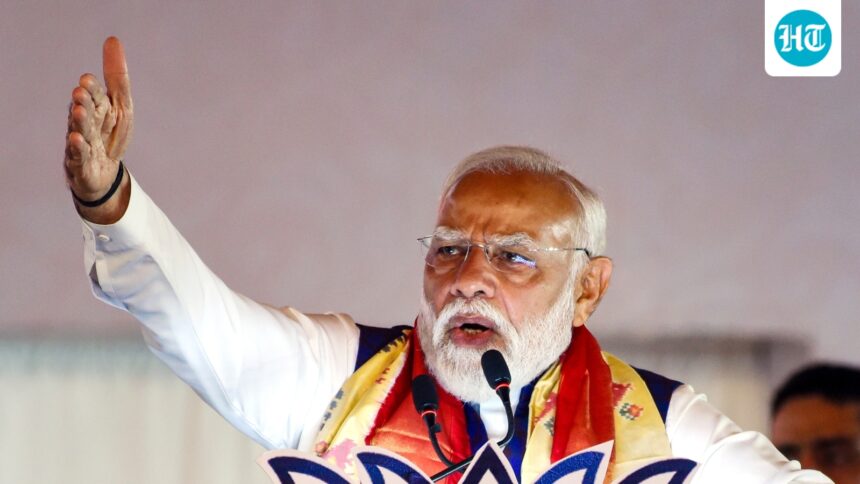
Prime Minister Narendra Modi on Sunday urged Indians to adopt austerity measures ranging from cutting fuel consumption and postponing foreign travel to reducing the use of edible oil and avoiding buying gold, as the government grapples with the economic fallout of the ongoing global energy crisis and rising crude oil prices.

Speaking in Hyderabad, where he inaugurated multiple projects, Modi framed the appeal as a national duty at a time when India imports more than 88% of the crude oil it processes and supply chains remain under pressure amid conflict in West Asia.
“At this time of global crisis, we have to take a decision that keeps duty first and implement it with full dedication,” Modi said. “The big solution is to use petrol and diesel in moderation. We must limit our use of petrol and diesel. In cities with metro lines, we should decide to travel by metro only. If we have to use a car, we should try to use shared cars,” he said.
Read also: War damage reparations and Hormuz’s sovereignty: Inside Iran’s response to the US proposal that Trump called “unacceptable”
“Switching to working from home and saving foreign currency”
The Prime Minister also urged people to maximize the use of electric vehicles, shift freight traffic towards railways and revive work-from-home arrangements that have become common during the Covid-19 pandemic.
He said: “During the Corona period, we developed many systems for working from home, online meetings, and video conferences, and we even got used to them. Today, the requirements of the times are that if we restart these systems, it will be in the national interest.”
Modi has repeatedly stressed the need to conserve foreign exchange as India faces rising import costs.
“We must also focus strongly on saving foreign exchange, as petrol and diesel have become expensive globally,” he said. “It is our responsibility to save the foreign currency spent on purchasing gasoline and diesel.”
Crude oil prices have risen sharply since the outbreak of war in West Asia on February 28, with average import prices rising from about $70 per barrel to nearly $120. The pressure also affected the rupee, which weakened from all sides $91 to the dollar before the conflict to approximately $95.
Read also: Hantavirus outbreak: Two Indians on board MV Hondius ‘asymptomatic and well’, says Indian Embassy in Spain
To be sure, the rupee’s depreciation was a reflection of the pressures on many major Asian currencies during the broader global crisis.
The rise in oil prices also led to a sharp increase in India’s import bill. India imported crude oil worth $121.8 billion in the period 2025-2026, and officials expect the burden to rise further if the conflict continues and shipping through the Strait of Hormuz remains disrupted.
A government official, speaking on condition of anonymity, said that while the Center has so far protected consumers from the full impact of the global energy crisis by keeping petrol, diesel and cooking gas prices largely steady, the situation remains fragile.
“There is no certainty about when the Strait of Hormuz will return to normal commercial operation, and no firm view on where post-conflict prices will stabilize even after the conflict itself ends,” he said. “Most reliable forecasts see prices continuing to rise for at least four months after a permanent ceasefire is reached, at the expense of time needed for shipping, insurance and inventory systems to return to normal.”
The official added that fuel retailers may not be able to maintain prices at current levels for longer.
“Postponing travel abroad for a year”
Modi also urged people to avoid non-essential foreign travel, weddings and holidays abroad for at least a year to reduce pressure on foreign exchange reserves.
“The growing culture of weddings abroad, traveling abroad, and spending holidays abroad is becoming mainstream among the middle class. We must decide that during this time of crisis, we must postpone traveling abroad for at least a year,” he said.
Modi also appealed to citizens to avoid buying gold for a year, saying gold imports were putting additional pressure on foreign exchange reserves. “Gold purchases are another area where foreign exchange is widely used… In the national interest, we must resolve not to buy gold for a year, no matter how many tasks we have scheduled at home,” he said.
The Prime Minister also called for reducing consumption of edible oil and reducing dependence on imported chemical fertilisers. “The same applies to edible oil. We have to spend foreign currency on its imports. If every household reduces the use of edible oil, it is a huge contribution to patriotism,” Modi said.
“We should halve our consumption of chemical fertilizers and move towards natural agriculture. This way, we can save foreign currency, our farms and Mother Earth.”
At an inter-ministerial press conference on Friday, Oil Ministry Joint Secretary Sujata Sharma said the total monthly shortfall in recovery of petrol, diesel and cooking gas was about $30,000 Crores.
State-run fuel retailers have kept petrol and diesel prices in Delhi at a level $94.77 f $87.67 per liter respectively over the past two years, despite increasing global pressure on fuel prices.
On March 27, the government reduced customs duties on gasoline and diesel by one amount $The government has imposed duties on diesel and aviation turbine fuel exports to prevent the diversion of domestic supplies abroad.
An energy sector expert, who requested anonymity, said Modi’s comments should be seen as preparation for potential fuel price increases and broader austerity measures.
“The Prime Minister’s speech on Sunday should be taken seriously and individuals, companies and state governments should implement fuel conservation measures immediately,” the expert said. “People must be prepared to share the partial burden of this crisis in terms of rising prices, which are imminent.”
Union Home Minister Amit Shah backed Modi’s call in a post on X, calling it an “ideal” road map towards making India “self-reliant and energy secure”.
“His call for moderation in the use of petrol and diesel, encouraging work from home, and ditching chemical fertilizers to embrace natural agriculture is a clear roadmap to make India a self-reliant and energy-secure nation,” Shah wrote.
Indian Petroleum Minister Hardeep Singh Puri also urged citizens to conserve fuel and said that India’s energy sector is absorbing the impact of the global crisis to protect consumers. “India is among the very few countries that have not raised energy prices and have maintained steady supplies to citizens even as we see crises unfolding in many parts of the world,” Puri posted on X.
He said that oil marketing companies are buying crude oil, gas and LPG at high prices while continuing to sell the fuel locally at lower prices, leading to “huge increasing losses.”
According to Puri, oil marketing companies are facing losses amounting to… $1,000 crore per day, while underrecovery estimates during the current quarter may rise to $2 lakh crore.
He said: “Let us turn Prime Minister Modi’s sympathetic appeal to… Jan Andolan to save and conserve energy.
But the opposition accused the government of failing to adequately prepare for the crisis.
Congress general secretary KC Venugopal said Modi “remains clueless about ensuring India’s energy security” even three months after the Iran-US war.
“It is shameful, reckless and completely unethical for the Prime Minister to push the common citizen into inconvenience, instead of building the emergency to ensure our economy is not affected by this global crisis,” Venugopal said in a post on X.
He added: “The Prime Minister and his government must make all necessary arrangements to ensure the availability of sufficient fuel reserves and that no citizen is exposed to any difficulties as a result of a lack of planning.”