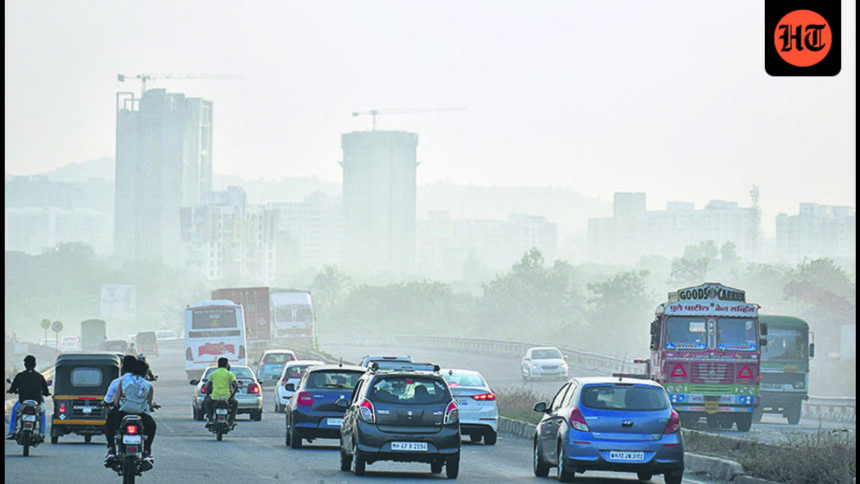
In a first for an Indian city, Pune will institutionalize a Low Emission Zone (LEZ) in its most polluted area, Shivajinagar area in the central business district, potentially creating a model for other Indian cities.

Pune Municipal Commissioner Naval Kishore Ram said the city plans to ban or restrict entry of old, highly polluting vehicles in an area covering 7-10% of the city around Shivajinagar. “We will launch it in a couple of months. We are already working with departments like the police and the RTO, as their role will be crucial,” he added, adding that the exact details were still being worked out.
The LEZ initiative comes after three years of work by the Pune Municipal Corporation, with support from ITDP India (Institute for Transport Policy and Development), under the Maharashtra Electric Vehicle Policy 2021. The policy mandates designated economic zones in six cities to reduce emissions in line with the National Clean Air Program (NCAP). Preparatory work included studying the legal framework for designated economic zones and improving public transport and pedestrian infrastructure.
A Low Emission Zone (LEZ) is a designated urban area where the most polluting vehicles are restricted, charged or prohibited from entering to reduce harmful emissions such as particulate matter (PM2.5) and nitrogen oxides (NOx).
The first LEZs appeared in Scandinavia in the 1990s. Stockholm imposed one of the earliest city-wide restrictions on heavy diesel vehicles in 1996. The idea then spread throughout Europe, especially in Germany, the Netherlands and Italy.
However, the most influential and widely cited LEZ program was launched in London in 2008 under the leadership of then Mayor Ken Livingstone. London later expanded the model with the Ultra Low Emission Zone (ULEZ) in 2019 under the leadership of the city’s mayor, Sadiq Khan, making it one of the world’s most popular traffic restriction programs to promote clean air.
While Ram did not specify the final scope of the LEZ in Pune, another person involved in the project said preliminary studies showed that stringent restrictions on BS-III and older vehicles across a 14.5 sq km area covering Shivajinagar and Peth districts could reduce PM2.5 levels by 80%. The area designated under the program extends from Shivajinagar in the north to Swargate in the south, and from SB Road in the west to East Street in the east. The municipal corporation has already granted initial approvals to work in this area.
A special vehicle information platform has been used to further evaluate the vehicle profile in the proposed area, said Pranjal Kulkarni, project director, ITDP India. He pointed out that during the initial assessment, vehicle categories were determined through surveys conducted at gas stations.
A study and survey by ITDP released in October 2025 said that about 71% of internal combustion engine (ICE) vehicles operating in PMC are BS-4 or below. The same found that 96% of ICE vehicle owners surveyed in 2000 indicated they did not want to pay pollution fees. This shows that pricing can be a deterrent for people using polluting vehicles. The resulting fees can be used to develop public transportation, and improve walking and cycling infrastructure.
Another person aware of the developments said the restrictions are likely to apply to BS-III, older two-wheelers, passenger cars and heavy and light commercial vehicles. It is expected that rickshaws, public buses and emergency vehicles will be exempt. Instead of a complete ban, owners of polluting vehicles may be allowed to pay daily pollution fees. Vehicles found operating without paying tolls may face harsher penalties.
While Pune is set to become the first Indian city to implement a LEZ, its Pimpri-Chinchwad Industrial City is planning a city-wide initiative under the Graded Response Action Plan (GRAP), said Parin Visaria, program director, ITDP India. He added that revenues collected through pollution fees and fines will be used to either expand the program or strengthen public and non-motorized transportation systems.
Even as Pune and Pimpri Chinchwad move towards implementation, similar initiatives are emerging across the country, from bustling temple towns to industrial coastal cities.
Jag Parvesh, municipal commissioner of Mathura Vrindavan, said they aim to restrict the 11-km-long Parikrama Marg stretch to electric vehicles and pedestrians only by Diwali. He said that this step is part of a phased plan to arrange an appropriate number of electric buses and e-rickshaws in the temple city, which receives nearly 90 million visitors annually. He added: “We want to make the city as environmentally friendly as possible.”
He added that the authorities are currently working to operate 50 electric buses, all of which are operating at full capacity. “We have registered more than 7,500 e-rickshaws operating on 17 routes and designated stops to ease congestion and pollution. Soon, we will add more e-rickshaws and expand charging infrastructure,” he said.
Likewise, Varanasi Municipal Commissioner Himanshu Nagpal said that only e-golf carts and pedestrians will be allowed to ply on the 4-km-long temple corridor that runs between Maidagain and the main temple in Varanasi. “This stretch attracts one million tourists daily. We have procured golf carts and operations can begin within a month. Parking spaces will also be created for visitors arriving in private vehicles,” he said.
The long-term goal is to phase out all polluting commercial vehicles by 2030 in a phased manner, said Sarika Panda, who is working with municipal corporations in Varanasi and Mathura on the plans.
In Andhra Pradesh, cities are developing clean air zones (CAZs) around hospitals, educational institutions and markets to address transportation emissions.
Vivek Vaidyanathan, director, Artha Global, who works with urban local bodies in Visakhapatnam and Vijayawada, said the plans focus on expanding public transport through electric auto buses, including dedicated services for educational institutions to reduce dependence on private vehicles and polluting three-wheelers. Measures such as paid off-street parking, improved walkability and cycling infrastructure are also being worked on to reduce congestion and vehicle emissions.
Added customization $50 lakh crore for five cities in Andhra Pradesh under the state’s new electric vehicle policy has set ambitious targets to tackle urban air pollution by creating zero-emission zones, installing electric vehicle charging infrastructure at parking lots, converting entire city bus fleets to electric vehicles, and rolling out electric vehicle bus services along major corridors.
Although there is not a lot of real-world data in India, their research has shown that LEZs have the potential to reduce emission loads by 85% for nitrogen oxides and 50% for carbon monoxide, said Vaibhav Kosh, principal researcher on LEZs at ICCT India, studying preliminary plans in Maharashtra cities. “However, it will depend on multiple factors such as the LEZ notified, duration of implementation, regulated vehicle sectors among others.”