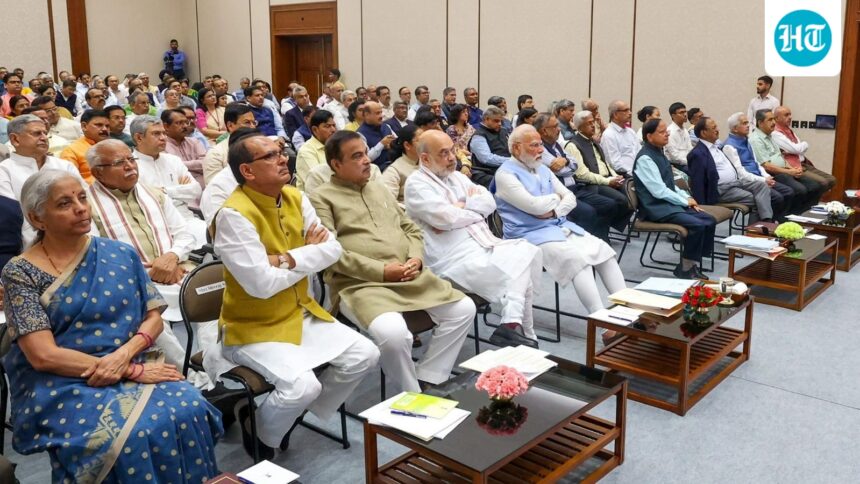
Prime Minister Narendra Modi on Thursday delivered three key messages to his Cabinet – accelerating governance, preparing for potential power outages caused by the US-Iran war, and staying focused on the long-term goal of ‘Fixit Bharat 2047’.

The meeting, which lasted more than four hours, came at a time when India is facing the economic fallout from the escalating conflict in West Asia, especially the unrest linked to the Strait of Hormuz – one of the world’s most important oil transit points.
The first message: speed, transparency and implementation
Prime Minister Modi reiterated his call for faster governance and warned ministers against bureaucratic delays.
According to people familiar with the discussions, the Prime Minister said files should not be “moved endlessly from one office to another” and asked ministers to simplify procedures, ensure transparency and deliver faster results.
He stressed that there should be no complacency in government work, and said that governance should focus on improving the “ease of living” for citizens.
“The Prime Minister said files should not be kept from table to table, and processes should be streamlined,” said one of the people familiar with the meeting.
Modi also asked the ministers to focus on future goals rather than past achievements and ensure speedy implementation of backward central schemes in some states.
Second message: Energy security amid the Strait of Hormuz crisis
The main focus of the meeting was the growing energy crisis caused by the US-Iran conflict.
The war has intensified tensions around the Strait of Hormuz – the narrow waterway connecting the Persian Gulf to the Arabian Sea and through which nearly a fifth of the world’s oil supplies pass.
Iran has repeatedly threatened to impose restrictions on shipping movement through the strait in the wake of US-led strikes and escalating military action in the region. The uncertainty has rocked global oil markets and raised fears of prolonged supply disruptions.
During the meeting, Modi reportedly stressed the need to look for alternative sources of fuel such as biogas and renewable energy in view of the disruptions in the supplies of crude oil, gas and fertilisers.
India is particularly vulnerable because a large share of its crude oil and LPG imports pass through the Strait of Hormuz.
The impact is already beginning to be felt at the local level. State-run oil companies recently raised a sum of ₹4 pounds per liter”>Gasoline and diesel prices are approx $$4 per liter amid the rise in global crude oil prices due to the conflict. LPG prices also rose, while delays in cooking gas shipments added pressure on supplies.
Meanwhile, the Center called for austerity measures and called for fiscal discipline, including cutting fuel consumption and cutting non-essential spending, as global energy uncertainty worsens.
Message 3: “Fixit Bharat 2047” is not just a slogan
The Prime Minister also used the meeting to affirm the government’s long-term development vision.
Modi said the call for ‘Fixit Bharat 2047’, to transform India into a developed nation by the centenary of independence, should not be treated as just a slogan, but as a “binding commitment”.
He urged ministers to focus on “next generation reforms” that directly improve people’s lives and ensure maximum benefits from social welfare programmes.
“He said it was time to look at specific targets to achieve the newer ones, and the government could not rest on its past glories and victories,” a person familiar with the discussions said.
The meeting also included presentations by External Affairs Minister S Jaishankar, Cabinet Secretary T V Somanathan and NITI Aayog member Rajeev Gauba on foreign policy, governance reforms and implementation of key schemes.
The cabinet meeting came amid speculation of a cabinet reshuffle and at a time when the opposition intensified its attacks on the government due to inflation, fuel prices and the broader economic impact of the conflict in West Asia.
Where does the US-Iranian war stand now?
Even as the fragile ceasefire continues, the US-Iran conflict is still far from resolved.
Pakistan-brokered peace negotiations have largely continued over the past few weeks, but major sticking points remain – particularly regarding Iran’s nuclear program and control of shipping traffic through the Strait of Hormuz.
According to Reuters, talks between Washington and Tehran have led to a “narrowing of gaps” slightly, but the two sides are still divided on key demands. Iran is reviewing the latest US proposal, while US officials have indicated impatience with the pace of negotiations.
The Strait of Hormuz remains severely disrupted, with shipping traffic still well below normal levels. Reuters reported that ship traffic through the waterway has declined sharply since the conflict began, with only a limited number of cargo ships and tankers crossing daily.
Global oil markets remain tense, with investors skeptical of an immediate diplomatic breakthrough. Oil prices remained volatile amid concerns that prolonged unrest in Hormuz will continue to impact crude oil supplies and inflation around the world.