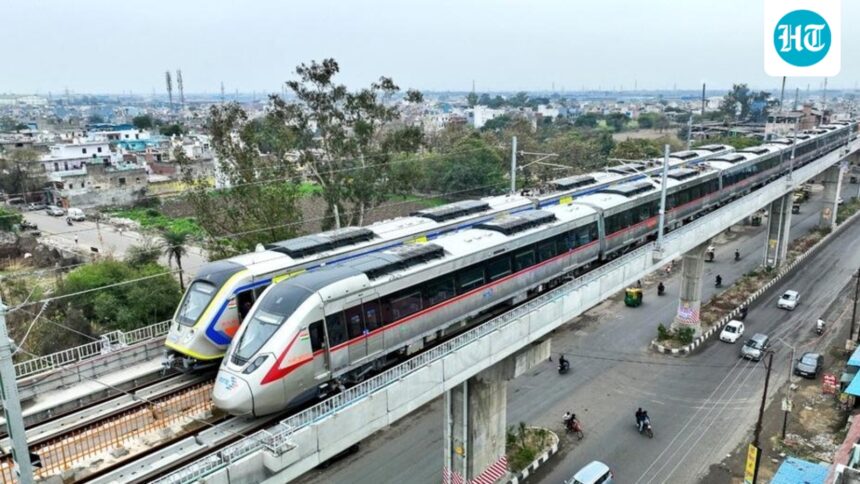
The 82-km Namo Bharat high-speed rail corridor across the National Capital Region is now fully operational and Prime Minister Narendra Modi is scheduled to inaugurate the high-speed line on Sunday.

The state-of-the-art transit line will connect Delhi to Meerut in just 55 minutes using trains designed for speeds of up to 160 km/h.
The corridor extends from Sarai Kale Khan in Delhi to Modipuram in Meerut and is expected to accelerate economic, social and urban development across the National Capital Region (NCR) and western Uttar Pradesh.
The project, developed by the National Capital Territory Transport Corporation, marks India’s first Namo Bharat corridor extending across its entire length from one end to the other.
Officials say the line will significantly reduce travel time while enhancing regional connectivity between western Uttar Pradesh and Delhi.
NCRTC spokesperson Puneet Vats said the foundation stone for the Delhi-Ghaziabad-Meerut corridor was laid on March 8, 2019. Despite pandemic-related challenges, construction has progressed steadily, and the first 17-km priority section between Sahibabad and Dohay depot was inaugurated on October 20, 2023, marking the launch of India’s first regional fast rail service.
Subsequent stages expanded the network step by step. A 17 km stretch up to North Modinagar was inaugurated on 6 March 2024, followed by an extension to Meerut South on 18 August 2024. On 5 January 2025, a 13 km stretch from Sahibabad to New Ashok Nagar came into operation, enabling trains to enter Delhi and connect major intermodal hubs such as Anand Vihar. With the launch of the final sections – 5 km from New Ashok Nagar to Sarai Kale Khan and 21 km from Meerut South to Modipuram – on February 22, the entire 82.15 km corridor will operate as one continuous line.
Of the total length, about 70 kilometers are elevated and about 12 kilometers are underground. It is located approximately 14 km in Delhi and approximately 68 km in Uttar Pradesh. Two maintenance depots were built at Dohai and Modipuram. The estimated cost of the project is $30,274 crore, funded through contributions from the central and state governments along with multilateral institutions including the Asian Development Bank, the New Development Bank and the Asian Infrastructure Investment Bank.
Sixteen stations have been developed along the corridor, featuring platform barrier doors synchronized with the train doors for passenger safety. The trains offer 2 x 2 seating, premium coaches, mobile charging points, CCTV monitoring, fire safety systems and selective door opening technology.
The stations are integrated with metro systems, railway stations, bus stations and other public transport networks. Integrated QR tickets and common national mobility cards support the government’s “One Nation, One Card” initiative. The corridor is expected to raise the share of public transportation in the region from 37% to 63%, with the help of solar panels, regenerative braking, and rainwater harvesting systems.
The Delhi-Meerut line is the first and most important part of the proposed NCR Regional Rapid Transit System network, with additional corridors such as Delhi-Alwar and Delhi-Panipat planned for the future. Officials say the February 22 launch not only marks the beginning of a new rail service, but also the launch of a transformative regional transport model for north India.