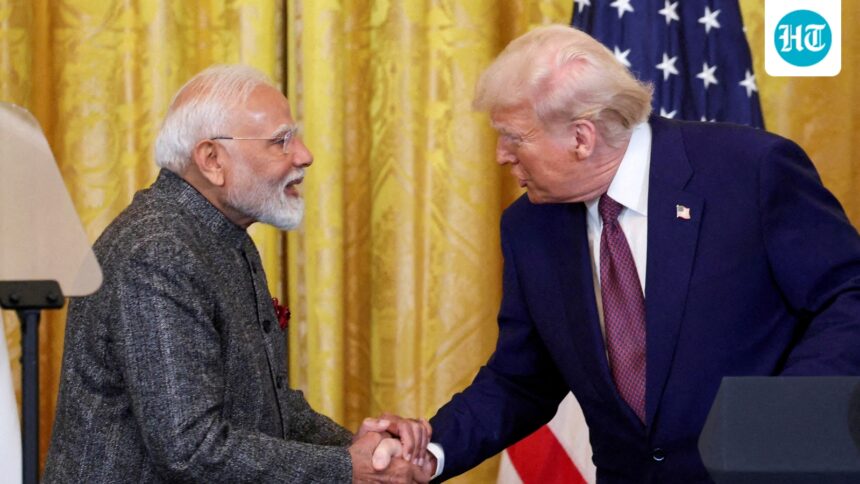
New Delhi: The proposed 18% reciprocal tariff on Indian goods in the US market – announced earlier this month – may no longer be relevant after the US Supreme Court ruling, but both partners are committed to formalizing a “mutually beneficial” interim trade agreement in the spirit of the India-US Joint Statement keeping in mind the changed physical situation, people familiar with the developments said.

For India, the current reciprocal tariff of 25% will fall to 15%, instead of 18% (as agreed in a joint statement issued on February 7), after the US Supreme Court struck down the legal basis for the higher tax. Trump on Saturday announced 15% tariffs on all trading partners, up from the 10% he imposed less than 24 hours earlier after a court setback. The tariff rate will be 15% in addition to product-specific most favored nation (MFN) rates – non-discriminatory tariffs imposed by the country on imports from all WTO members, except countries with which it has concluded preferential trade agreements.
After the ruling, 15% plus MFN became the new normal, the people said. The “mutually beneficial” agreement would “ideally” require Washington to either cut the 15% tax or most-favored-nation rates so that Indian goods remain competitive with China, Bangladesh, Vietnam, Cambodia and Indonesia, the people said, stressing the “spirit” of the joint statement.
“Tariff obligations may have to be realigned with the changing situation as the joint statement specifically provides for such adjustments,” one of them said. “In the event of any changes in agreed tariffs for either country, the United States and India agree that the other country may modify its commitments,” the joint statement issued by the US on February 6 said.
The Ministries of Commerce and Foreign Affairs did not respond to specific email inquiries sent by Hizb ut Tahrir. However, the Commerce Department issued a statement on Saturday evening: “We noted the US Supreme Court’s ruling on tariffs yesterday. President Trump also spoke at a press conference in this regard. The US administration has announced some steps. We are studying all of these developments for their implications.”
To be sure, India and the US have not finalized the legal text of the interim bilateral trade agreement on the basis of the agreed framework laid down by the joint statement. An Indian team led by chief negotiator Darpan Jain was scheduled to arrive in Washington on February 23 for three days of talks to finalize the text before the expected visit of US Trade Representative Jamieson Greer in March to sign the agreement. It was not immediately possible to confirm whether any change had occurred in these meetings.
While the industry is concerned about continued uncertainty in India’s largest goods export market, experts expect more clarity by early next week. However, US Treasury Secretary Scott Besent indicated that the administration is exploring multiple ways to continue the tariff actions.
In a post to
Section 232 enables the government to impose tariffs or quotas on imports that threaten national security. Section 301 enables the US Trade Representative to investigate and retaliate against unfair trade practices of foreign countries. Section 122, which has now been invoked to enforce the uniform, 15% statutory maximum tariff, allows the administration to impose temporary import duties for a maximum of 150 days to address balance of payments issues.
What does it mean to govern globally?
People familiar with the matter said the development must be viewed in a global context.
First, the ruling limits the Trump administration’s power to arbitrarily impose tariffs — a move that could end the weaponization of trade and restore rules-based, predictable trade.
Second, the administration now has limited options for arm-twisting countries. Sections 232, 301, and 122 are based on realistic “cause and effect” principles with caps on tariff levels and restrictions on their continuation, such as requiring congressional approval.
Third, while many countries, including India, have negotiated legal trade agreements with the United States but have not yet signed them, many countries with established agreements may seek compensation.
The fourth expected development concerns refunds. Many importers are expected to file claims with the US government to recover excess tariffs that were illegally imposed. Some have told exporters in various countries, including India, that they will share the refunds with them, some said. American exporters, importers, and consumers bear the brunt of high tariffs, especially on labor-intensive products that the United States is obligated to import. They added that prices of various items are expected to decline.
“As the US and India are important partners of each other, some mutually beneficial solutions are expected soon,” said Ajay Sahai, Director General and CEO, Federation of Indian Export Organizations (FIEO). It is expected that the proposed definitions will be reorganized before the ruling is issued. He added: “In light of the fact that mutual tariffs have been abolished, and the customs tariff on all countries has been reduced to 15%, the 18% tariff becomes irrelevant.”
The ruling, which struck down reciprocal tariffs that put them outside the President’s legal authority, means the tariffs will no longer apply to goods cleared in the US on or after February 20, 2026, Deloitte India partner Gulzar Didwania said.
“This will provide major relief to India’s exports of products like gems, jewellery, textiles, selected automobiles, engineering goods etc which were subject to reciprocal tariffs,” he said. He added that the ruling does not apply to products subject to Article 232 duties such as steel, aluminum, copper and their specified derivatives, which still attract 50% tariffs.
Regarding the proposed FTA, Diedwanya said: “The FTA covered several aspects such as reciprocal tariff rate, removal of the Russian penalty, quota-based concessional tariffs on products subject to Section 232 of tariffs and non-tariff restrictions. While reciprocal tariffs will no longer be applicable due to the Supreme Court ruling, all other areas will remain covered and subject to the concessions agreed upon under the FTA.”
He added: “Given the mutual definitions [18% proposed for India] would no longer be valid, the question of imposing a rate of 18% would no longer arise. If all other countries pay [15%]Indian exports will also be subject to the same rate or tariffs. Moreover, this [15%] The fees are temporary in nature and subject to Congressional approval after a period of 150 days.
The textile sector remains labour-intensive, and is among the… For the hardest-hit industries, be careful. Confederation of Indian Textile Industry (CITI) president Ashwin Chandran said the body is analyzing the implications of the recent developments. “There is no doubt that the developments on February 20, 2026 have cast a new wave of uncertainty. The authorities providing greater clarity, including what happens now to the terms agreed in the India-US interim trade agreement, would be very helpful. This is particularly important because the US is the largest single market for Indian textile and apparel exports,” he added.
However, some labour-intensive sectors breathed a sigh of relief. Colin Shah, Managing Director of Kama Jewellers, called for the abolition of the tariffs by A [15%] It called the additional duties a “huge relief for Indian gem and jewelery exporters”, saying it would address the gap between supply and demand created by the previous steep duties.
“The court’s ruling is a reminder that any trade action must comply with constitutional processes and that predictability is a top priority in global trade. While the new development represents a paradigm shift, it is also true that exporters still have to walk a tightrope,” Shah said, adding that he hoped the India-US trade relationship would continue to move in a constructive manner, bringing stability and growth to the sector.