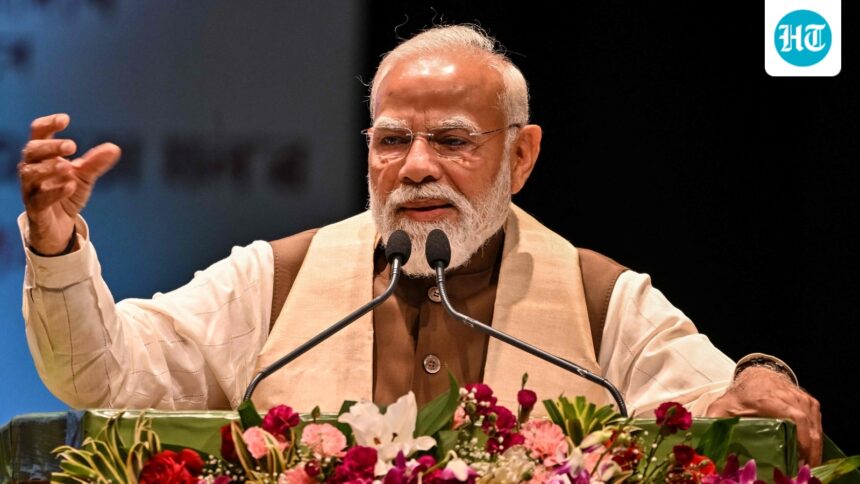
The push to introduce 33% reservation for women in the Lok Sabha and state assemblies – Parliament is scheduled to meet later this week to consider the matter – is in line with the Opposition’s demand for early implementation of the law passed in 2023, Prime Minister Narendra Modi said at the Nari Shakti Vandhan Sammelan at Vigyan Bhawan, New Delhi, on Monday.

He added that Parliament is on the verge of making history as it brings up amendments to the Women’s Reservation Bill for discussion and passage, in comments widely seen as a counter to opposition parties’ arguments that the amendments are being brought in the middle of state elections to favor the ruling Bharatiya Janata Party.
“In 2023, when the bill was introduced, all political parties passed the bill unanimously. Then it was decided with one voice that it should be implemented by 2029… No one wanted the bill to pass and not be implemented, especially our opposition leaders. They were very vocal in emphasizing that it should be implemented in 2029. With this timetable in mind, the government decided to take what the opposition said seriously…”
Read also | ‘India one of the biggest decisions of the 21st century’: PM Modi hails Women’s Reservation Bill
Prime Minister Modi shares credit for the bill with all political parties
The government is scheduled to introduce two bills in the next three-day session of Parliament, which begins on April 16, that would pave the way for implementing 33% reservation for women in the Lok Sabha and state assemblies, and setting up a delimitation commission.
The Prime Minister specifically referred to the upcoming session and expressed hope that the amendments would be approved “unanimously” with lawmakers “getting beyond partisan politics.”
However, the opposition opposes the government’s proposal to separate the delimitation process from the ongoing population census, and to form new constituencies on the basis of the 2011 census. The amendments seek to increase the total number of seats in the Lok Sabha from 543 to 816 seats, of which 273 seats are reserved for women.
The Prime Minister shared the credit for passing the bill in 2023 with all political parties. He said that when the amended bills are passed, it will not be a question of who wins or loses.
He said: “…It will not be about parties…It will not be about who won and who lost. It is all thanks to the power of women, to Parliament, to all political parties and to those who have worked tirelessly over the past three or four decades… It is for everyone, with the support of everyone and for the good of everyone.”
He urged all political parties to approve the draft law unanimously, saying that the government is making an effort to approve the draft law this time as well through dialogue, cooperation and participation.
“I am confident that just as this law was passed and the pride of Parliament was raised (in 2023), the dignity of Parliament this time too, through the collective efforts of all, will reach new heights.”
The Prime Minister described this step as one of the most important decisions of the twenty-first century.
Read also | Move to accelerate quota for women by 33% in line with opposition demand: Modi
‘Dedicated to Nari Shakti’: PM Modi
“This resolution is dedicated to Nari Shakti (the power of women). Our Parliament is moving closer to creating a new history that fulfills the aspirations of the past and fulfills the dreams of the future. It envisions a country where social justice is not just a slogan but part of our work culture… April 16, 17 and 18 will bring to fruition the long-awaited promise.” D.
The Prime Minister noted that the first legislative act taken up in the new Parliament House was the Women’s Reservation Bill in 2023. “…Today I seek the blessings of billions of women across the country. I have not come here to give you any lesson, I have come here to seek your blessings,” he said.
He said that the need to allocate quotas for women had been felt for decades and several parties and generations had worked for it. He said that after the draft law was passed and the opposition demanded its implementation by 2029, there were extensive discussions and consultations with constitutional experts to find ways to implement quotas by 2029.
He said that implementing the quotes will give new wings to women’s dreams.
He said: “I can feel that there is a positive atmosphere in the country… From the freedom struggle to the decisions of the Constituent Assembly, women have made limitless contributions. History bears witness that even after independence, women, who were given the opportunity to lead, did wonderful work for the country. We have had female prime ministers and presidents, and they have left their own legacy.”
The Prime Minister cites the example of women in panchayats
The Prime Minister cited the example of women in panchayats and said that there are over 1.4 million women in local government bodies. “In 21 states, 50% of panchayat members are women… When I talk to foreign delegates about this, they are amazed. They are amazed.”
He said that the government has put in place a set of policies to empower women socially and economically, and emphasized on women-led development which will be key to India’s dream of Vixit Bharat (developed India). “Several studies have proven that increased participation of women in decision-making processes leads to greater sensitivity and responsiveness within systems. The success of the Jal Jeevan Mission is a prime example of this, where women have played an important role at the panchayat level,” he said.
The Prime Minister said that the measures taken by his government to empower women financially gave them a greater role in family affairs. “Main grihastha nahi hoon, par pata bahut hai (I am not a family man, but I am aware of many things),” he said, referring to how women’s status within the family has changed.