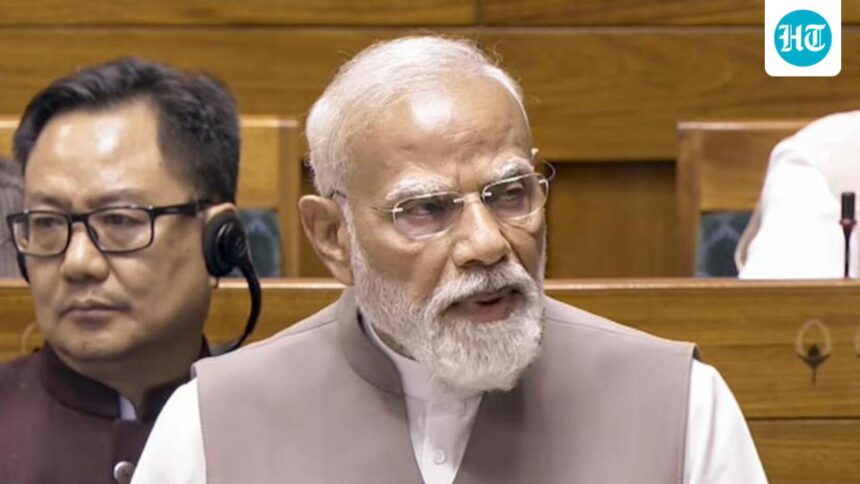
Prime Minister Narendra Modi on Tuesday told the Rajya Sabha that the ongoing conflict in West Asia has sparked a serious global energy crisis and disrupted major trade routes, with direct implications for the Indian economy and supply chains.

Speaking in the Senate, Prime Minister Modi said the crisis has affected the movement of goods and led to uncertainty in supplies of essential commodities like petrol, diesel, gas and fertilisers.
“This situation also worries India,” he said, noting that the war has already begun to affect commercial shipping lanes.
Prime Minister Modi described any attempt by Iran to block maritime traffic through the Strait of Hormuz, a vital corridor for global oil shipments, as “unacceptable.” He said that India cooperated with all stakeholders through diplomatic channels and successfully facilitated the movement of Indian ships out of the affected area.
Read also: Prime Minister Modi condemns the attacks on Kuwait and emphasizes freedom of navigation in Hormuz
“In this time of crisis, we have adopted the path of dialogue,” Modi said, adding that India has spoken to leaders of most West Asian countries several times since the conflict escalated. He reiterated that New Delhi supports a peaceful solution and stopping the escalation.
Highlighting the humanitarian dimension, Modi said that the safety and livelihood of Indians living in the Gulf countries remains a top priority for the government. He noted that nearly ten million Indians live and work in the region, making the situation particularly sensitive.
He also cited concerns about Indian crew members stranded on ships in the Strait of Hormuz, calling it a “serious issue” that is being closely monitored. He added: “We are doing our best to ensure their safety and early return.”
Prime Minister Modi warned that a prolonged conflict could have far-reaching consequences. “If the war continues, its repercussions will be dire,” he said, adding that the crisis had already “shocked the world” and that recovery may take time.
The Prime Minister stressed India’s efforts to reduce excessive dependence on external sources in vital sectors. He pointed to efforts ranging from shipbuilding to rare earth minerals as part of a broader drive for self-reliance.
“We are trying to make sure that in any sector we do not remain overly dependent on other countries,” he said.