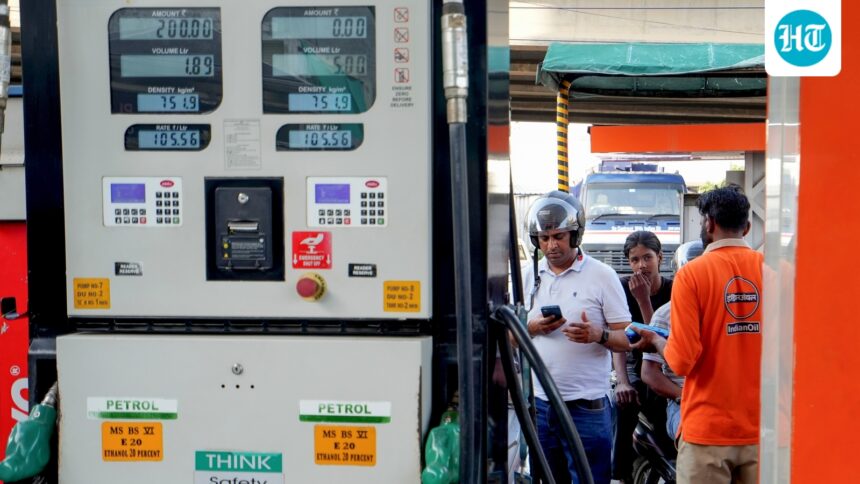
On Monday, government oil companies raised gasoline prices by 10%. $2.61 per liter and diesel prices $2.71 litres, the fourth rate hike in two weeks which saw the cost of petrol and diesel cumulatively increase by 2.71 litres. $7.35 f $7.53 per liter, respectively, since May 15, the date of the first revision in retail fuel prices since the conflict in West Asia, sending the global price of crude oil to its highest levels in several years.

Prices revised on Monday – pushing petrol prices in the capital even further $100 liters for the first time since 2022 – it came days after global oil prices fell below $100 per barrel. Benchmark Brent crude fell 5.84% to $97.49 per barrel in intraday trading on Monday (9.30pm) from $103.54 per barrel on Friday.
Industry executives and sector analysts said the further bull cycle was unlikely to end soon as the three state-run oil marketing companies (OMCs) were not only recovering existing revenue losses from petrol and diesel, but also making up for their earlier shortfall in recovery of motor fuel and cooking gas.
Read also | Why India may not finish raising petrol and diesel prices yet | He explained
Joint Secretary of the Ministry of Petroleum, Sujata Sharma, said that the initial daily losses of oil and gas companies were in the region of Rs $1,000 crore (before the first price hike on May 15), which was reduced to “slightly less than $600 crore” after the price hike. Sharma did not disclose the shortfall in recovery per liter of individual fuel products like petrol and diesel.
According to experts, this loss figure includes huge revenue losses on LPG (liquefied petroleum gas or cooking gas), and not just on automobile fuel. Under a transparent pricing mechanism for individual petroleum products, the current recovery for petrol and diesel will be no more than $They said 10-13 each.
After the fourth price hike on Monday, petrol prices at petrol stations in Delhi have exceeded $100 mark for the first time in four years. Last time I crossed gasoline $100 in Delhi was on 21 May 2022 (in $105.41 per litre). On that day, the price of diesel was at $96.67. According to available data, the highest price of gasoline ever recorded $110.04 per liter on November 2, 2021, and for diesel it was $98.42 on November 1, 2021.
Read also | Amid rising fuel costs, PMPML is opting for route optimization rather than increasing fare
The recent price increase has raised gasoline prices at gas stations $102.12 per liter and diesel $95.20 per liter in Delhi. Across the metro, the price of gasoline rose to $113.51 in Kolkata (highest $2.87), $111.21 in Mumbai (highest $2.72), and $107.77 in Chennai (highest $2.46).
Diesel is $95.20 per liter in Delhi $99.82 in Kolkata, $97.83 in Mumbai and $99.55 in Chennai in increments of $2.71 per litre $2.80, $2.81 f $2.57 respectively. Differences in local fees represent differences from one city to another.
According to company executives and sector experts, a fifth fuel price hike is expected unless Brent crude stabilizes below $100 per barrel — and in the best-case scenario analysts suggest, closer to $70. The increases follow the same increasing pattern that occurred in April 2022, when pump prices rose roughly $9 pounds per liter per day (80 paise) following the Russian invasion of Ukraine. This review took just over a week. The current session has moved at a similar pace, although the short-recovery gap is larger and the crude oil price environment remains more volatile.
However, global oil prices have been declining since the first price rise on May 15. Brent crude closed at $103.54 on Friday from $109.26 on the first day of the rise, recording a decline of more than 5%. Since the conflict erupted on February 28, Brent crude has risen nearly 42% from $72.87 on Friday. The downward trend continued on Monday.
India imports more than 88% of the crude oil it processes and pays in dollars, so the devaluation of the rupee has also been a drag. However, the rupee rose for the second straight session on Friday, closing at $95.60 to the dollar, supported by easing crude oil prices and expectations of monetary policy intervention.
This rise comes against an amazing financial backdrop. Although the full impact of the conflict in West Asia was absorbed in the January-March 2026 quarter (the crisis began on March 1), the three asset management companies recorded combined net profits of $19,470 crore – an increase of 40.74% compared to the same period last year. For the full year 2025-2026, their combined net profits rose 130% to $77,280.65 Crores, from $33,601.57 lakh crore in 2024-25, on the back of stable crude oil prices and healthy refining margins during most of the year before the outbreak of conflict. IOC and HPCL reported strong quarterly earnings; BPCL stock remained flat.
Union Finance Minister Nirmala Sitharaman said the increases were inevitable.
“The increases are now coming from the oil marketing companies because they are the ones who buy (crude oil from raw materials) and sell (the final product – fuel),” Sitharaman said on the sidelines of the Cotton Textile Export Promotion Council’s export awards ceremony.
She said that if customs duties had not been reduced earlier, there would have been an increase of $10 would have happened.
“If we had not given this discount at that time, A $There would have been an increase of 10, which is what we assumed, which is approximately $1 lakh crore has been hit on the job budget. The minister added that the increases now come from direct marketing companies, because they are the ones who buy and sell.
The opposition attacked the government.
“BJP’s appetite is not satisfied even after imposition of central tax on $1000 crores per day on petrol and diesel. When global prices were low, they did not pass on the benefits to the people, instead, they plundered them relentlessly,” Congress leader Mallikarjun Kharge wrote on X.