The US administration’s decision to rename its oldest and largest military command from the Indo-Pacific Command to the former Pacific Command amid rebalancing relations with China has raised questions in New Delhi about Washington’s commitment to the Indo-Pacific concept and the Quad group that includes India.

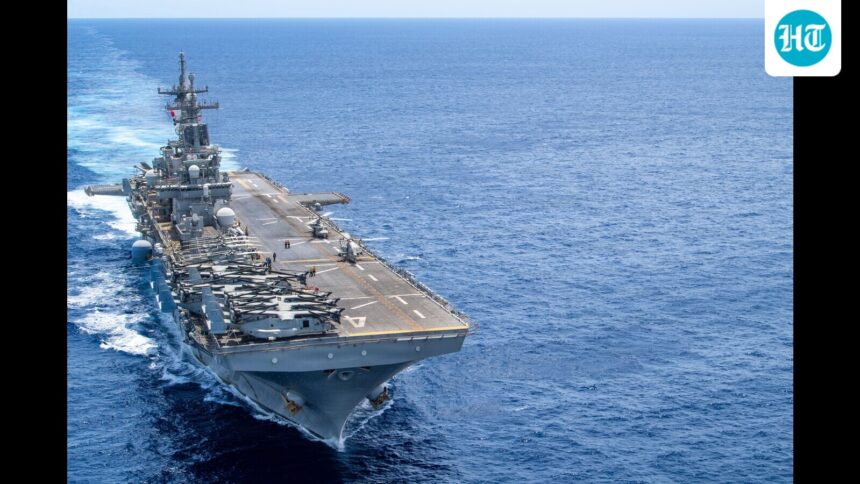
The US Department of Defense announced on Wednesday that the Indo-Pacific Command will “officially rename it to US Pacific Command” to honor the formation’s historical roots, although its area of responsibility — from the waters off the US west coast to India’s western border — will remain the same.
The move came hours before a planned meeting between Prime Minister Narendra Modi and US President Donald Trump on the sidelines of the G7 summit in France, and about a week after three Indian sailors were killed in a US Navy attack on a merchant ship off the coast of Oman, casting a pall over Indo-US relations.
The change in designations also came just over two weeks after US Defense Secretary Pete Hegseth spoke at the Shangri-La Dialogue in Singapore, where he said the US was on its way to a “return to realism” in the Pacific and “chart a new course for our alliances and partnerships” in the region “grounded in the realities of power and interests.”
Former Indian Navy chief Admiral Arun Prakash said the US move only reflects how “unreliable and poorly thought out” Washington’s policies are, and the “borderline between deceit and deceit”. He said: At the time [the command’s name was changed in 2018]is set up as a major step. But now their interests have changed and they have changed their policy.”
Prakash, who criticized the US attacks on three commercial ships carrying dozens of Indian crew members last week, noted that the naming of the Indo-Pacific Command was a US creation aimed at “drawing India into the net of what they were planning”. He noted that Indian diplomats were reluctant to accept the name because it was “too broad,” though the Navy approved it because it reflected the confluence of the Indo-Pacific and “overlapping interests.”
The change in name of the US military formation, created by President Harry Truman in 1947, came exactly eight years after the designation was changed to Indo-Pacific Command — a move that then-US Defense Secretary James Mattis said reflected “the growing engagement between the Indo-Pacific.”
Read also:G7 Summit 2026: Modi and Trump have warm exchanges before the meeting
Experts at the time noted that the move was part of US efforts to counter China’s growing influence across the Asia-Pacific region, and Pentagon officials said the name Indo-Pacific was an acknowledgment of India’s increasing role in providing regional security and would prompt military thinkers to consider the broader region.
Former Ambassador Rajeev Bhatia, a distinguished fellow for foreign policy studies at Gateway House, said there were three main takeaways from the US move. “First, the concept of the Indo-Pacific has lost some relevance since the Covid-19 pandemic. It has become less relevant between the war in Ukraine and the conflict in West Asia.
“Secondly, everything is linked to US policy towards China, and there seems to be clarity after Trump’s recent visit to Beijing, and Hegseth’s speech at the Shangri-La Dialogue, where he spoke of a path to constructive relations with China on the basis of strategic stability,” Bhatia said. “Third, Trump has remained isolated from the Quad, which is another indicator of the US position in the Indo-Pacific and China.”
Bhatia said that the change in the name of the US military command “was not very surprising and India should draw appropriate conclusions from it.”
Read also:First meeting in 16 months: Modi and Trump exchange pleasantries at the G7 summit
Former Foreign Secretary Nirupama Menon Rao said the “China factor” brought India and the US closer to each other, but it was not enough to sustain the relationship. “The Indo-Pacific concept was an oversold stock, although I consider it an incomplete prospectus,” she said.
Although he acknowledged the limits of using the Indo-Pacific concept as an organizing framework for Indo-US relations, Rao described the change in the name of the US military command as “a healthy correction because it forces us to make a more realistic assessment of where our interests converge with the United States and where these interests do not.”
Pointing to Trump’s comments about India being a “dead economy”, US Deputy Secretary of State Christopher Landau’s comments in March about the US not allowing India to become an economic competitor like China, the killings of Indian sailors and the possible downgrading of “the symbolism of the Indo-Pacific”, she said that while none of these “individually prove a strategic rupture”, they collectively indicate that “the euphoric phase of Indo-US relations may be coming to an end”.