A parliamentary committee has summoned officials of the Union Education Ministry and the Central Board of Secondary Education (CBSE) for a meeting on June 2 to discuss the problems faced by students due to the on-screen marking (OSM) system in Class 12 board examinations and implementation of the three-language formula in classes 9 and 10.

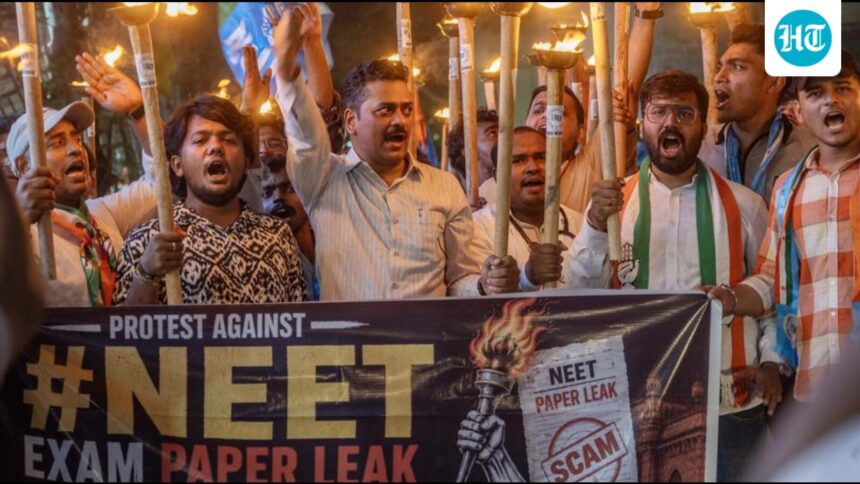
The 31-member Parliamentary Standing Committee on Education, Women, Children, Youth and Sports has also called on officials of the National Testing Agency (NTA), Ministry of Education and Federal Ministry of Health to hold a meeting on June 1 to discuss pen-and-paper tests versus computer-based tests (CBT), and issues related to NEET and NTA.
According to the agenda circulated in the Rajya Sabha Secretariat notification dated May 25, the committee headed by Congress MP Digvijaya Singh will hold meetings on June 1 and 2.
On June 1, the committee will meet for the first time at 10 a.m. to consider and adopt “Report No. 381 on Action Taken by the Government on the Recommendations and Observations of Report No. 364 on Grant Applications (2025-26) of the Department of Higher Education of the Ministry of Education.”
At 11 am, the committee will meet with secretaries of the Higher Education Department and the Health Ministry, the Director General of the National Training Agency, representatives of the United Doctors Front and Dr (Major) Gulshan Garg, former Indian Air Force orthopedic surgeon, “to discuss: the use of pen and paper testing versus cognitive behavioral therapy, and perspectives on NEET and NTA”.
The committee had earlier met on May 21 to review the ongoing investigation into the alleged NEET-UG 2026 paper leak and implement the recommendations of the Radhakrishnan Committee.
During that meeting, the NTA informed the committee that it was considering limiting the number of attempts and introducing an upper age limit for NEET-UG aspirants — a major shift in exam policy which currently has no such restrictions — besides a gradual move to computer-based testing from next year.
Regarding the investigation, the NTA told the committee that it received inputs on the “alleged malpractice” late on May 7, escalated the matter to central agencies on May 8, and canceled the exam on May 12. The retest is scheduled for June 21.
On June 2, the committee will meet School Education Secretary Sanjay Kumar and CBSE Chairman Rahul Singh “to review: the use of OSM in the CBSE Class 12 examinations and the problems faced by students as a result of it, and; the implementation of the three-language formula in Class 9 and 10.”
The move comes amid complaints from students and parents over technical glitches in the CBSE post-result services portal and concerns over lower-than-expected marks under the new digital assessment system.
A four-member expert team from the Indian Institute of Technology Madras and the Indian Institute of Technology Kanpur has been appointed to help the CBSE in resolving the issues associated with the re-evaluation process and the OSM system.
Concerns emerged after CBSE announced the Class 12 results on May 13, with the overall pass percentage falling to 85.20%, down from 88.39% last year – the lowest since 2019.
In a circular issued on May 15, CBSE made it mandatory to study three languages, including at least two indigenous Indian languages, for Class 9 and 10 students from July 1, expanding the scope of the scheme which was already made compulsory for Class 6 students.
However, the board clarified that “no student will be prevented from appearing in the Class 10 board examinations” due to the third language requirement. However, the move has caught many school heads by surprise.
“The way the education department works is highly impractical. Take the NEET issue, for example. It is strange that the whole country says there was a paper leak, but the NTA says there was no leakage. It is a strange situation. We have heard that they maintain that there was no leakage. Then what happened? Why are they holding the re-examination? Now, OSM was used once in 2014 and it turned out to be impractical. In 2017, Mumbai University also implemented it and found it impractical. So when you have already failed twice, why are you trying CBSE students across the country?