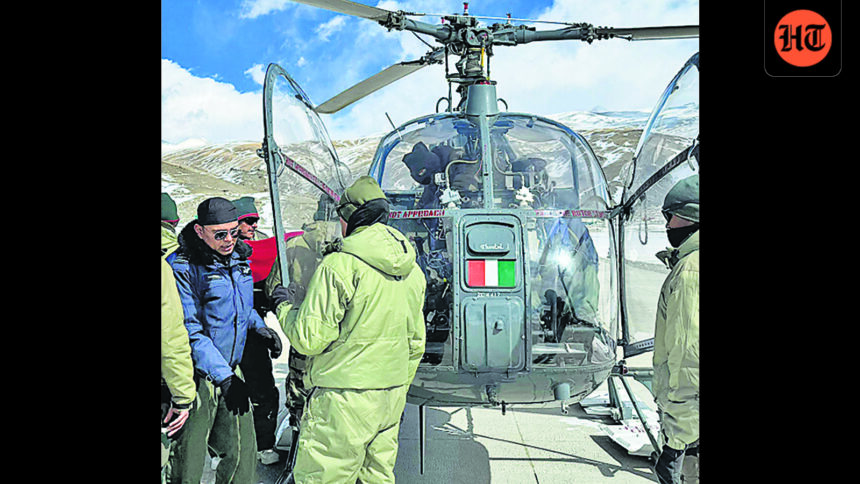
NEW DELHI: The Indian Army’s Chital helicopters continue to make regular mountain sorties in the Ladakh sector, including the Siachen Glacier, even as investigators examine a suspected technical fault that caused the recent crash, officials familiar with the development said on Thursday.

The investigation focused on a physical failure in the transmission system of the single-engine helicopter that crashed near Tangtse district in Leh on May 20, said the officials, who requested anonymity. “The investigation will determine which component of the transportation system failed after which corrective steps will be taken,” an official said.
Headquarters Leh’s 14 Corps, which is responsible for operations in this sector, operates about 25 Chital aircraft – a re-engined version of the Cheetah workhorse helicopter.
“The heavier and advanced light helicopter Dhruv cannot be used for frontline missions in the mountains of Ladakh. The Chital aircraft, which have an exceptional power-to-weight ratio, have been flying daily since the crash on May 20,” another official said. The two pilots – a lieutenant colonel and a major – and the third passenger Major General Sachin Mehta, General Officer Commanding-in-Chief of the Karu-based 3rd Infantry Division, miraculously survived the crash with minor injuries, as first reported by HT.
Equipped with a modern, fuel-efficient TM333–2M2 engine, the Sheetal features an automatic standby engine control system. Project Cheetal began approximately 25 years ago to enhance high-altitude operational capabilities, improve maintainability, and provide a mid-life upgrade for safe and reliable operations.
The May 20 accident once again highlighted the need for rapid replacement of the aging Cheetah and Chetak fleets, as these helicopters were designed six decades ago. A series of accidents has led to scrutiny of the helicopters’ safety record.
The Army will begin phasing out the fleets within a year or two, replacing them with new light helicopters over the next eight to 10 years, as part of the Army Aviation Corps’ drive to modernize its capabilities. The planned two-pronged replacement approach includes the introduction of locally produced LUH helicopters and the leasing of similar helicopters as an interim solution to meet critical requirements. The army needs about 250 new helicopters.
Hindustan Aeronautics Limited (HAL) has produced 625 Cheetah and Chetak helicopters for use in various defense services. He no longer builds it, but is responsible for its maintenance and repair. In 1970, HAL signed an agreement with French airline Aerospatiale to produce Cheetahs, eight years after it partnered with another French company, Sud-Aviation (now Airbus), to manufacture Cheetahs.